
The struggle for life is less about defending ourselves from attack and more about increasing our capacity for intimacy.
View the study sheet here. Recording here.
One of the fundamental tasks of scientists is to engage in the systematic classification of organisms or phenomena. They identify unique characteristics of what they observe and create groups based on shared traits, structures or behavioral patterns. Ongoing study can result in the refinement of observed phenomena into new or sub-group classifications.
As a chemistry scientist, Primo Levi was an observer and classifier of substances. As a Jew growing up in Fascist Italy, he was also the observed and the classified.
Born into a middle-class Jewish family in Turin in 1919, Levi entered the University of Turin in 1937. One year later the Fascist regime of Benito Mussolini passed the Racial Laws, which restricted Jews from attending public schools, serving in the military, marrying non-Jews, owning businesses, or holding government positions. Because he had enrolled the year prior, Levi was allowed to complete his studies, which he did in 1941 with a degree in chemistry.
Upon graduation Levi secured forged papers, which enabled him to work first for a mining company and then for a Swiss pharmaceutical company in Milan. When he returned home to Turin in 1942 following his father’s death, he learned that his mother and sister were hiding in the hills. He found them and together they fled to Northern Italy, where he joined a partisan resistance group.
The next year Italian militia forces arrested the group. Initially placed in an Italian prison camp, Levi, upon being identified as a Jew, was sent to Auschwitz, where he worked as part of the camp’s slave labor detail until the camp’s liberation by the Soviet Army in January 1945.
Shortly after the conclusion of World War II, Levi wrote a memoir about his time at Auschwitz and the daily struggle for survival, If This Is a Man. And in 1963 he wrote a sequel describing his long, winding journey back to Italy after his liberation, The Reawakening.
And then, in 1975, Levi wrote a book about Fascism and the holocaust that was unlike any other. The Periodic Table is a memoir and collection of 21 stories in which he uses chemical elements as metaphors to explore his life as a Jewish-Italian chemist, his survival of Auschwitz, and the human condition. Each chapter, named after an element, weaves scientific properties with personal narrative, philosophical reflection, and resistance against Fascism.
In the chapter titled “Zinc,” Levi describes the process of preparing zinc sulfate. He marvels at the difference in properties between zinc in its pure form and zinc mixed with an acid. In the latter instance, “…the zinc wakes up, it is covered with a white fur of hydrogen bubbles, and there we are, the enchantment has taken place.”
Musing on the “enchantment that has taken place,” Levi compares the element in its pure form, “which protects from evil like a coat of mail,” and the element in its impure form, “which gives rise to changes, in other words, to life.” He concludes: “for life to be lived, impurities are needed.”
Notions of purity and impurity are fundamental to the book of Leviticus. Parshat Tazria-Metzora (“she bears seeds”-“a skin affliction”) covers the degree of ritual impurity experienced by a woman who has just given birth, various form of skin affliction, the ritual process for treating someone who has such a condition, and how such an impurifying condition can affect clothing and even dwellings.
On the surface, it is easy to read this ancient text as describing a binary value system between pure and impure, with impurity to be avoided as an obstacle to the desired state of purity. Jewish commentaries, however, treat impurity as an essential ingredient in producing the compound of a higher state of being.
This view of the life-elevating reaction produced by the interaction of pure and impure, appears in Torah as early as the story of creation. There God proclaims as “good” the creation of light, land, sea, plants, and animals. After creating the human being on the sixth day, God proclaims it “very good.”
In an early midrash, Rabbi Shmuel identifies the term “good” with the yetzer tov, the good inclination in all things. The term “very good” refers to the yetzer hara, the evil inclination in all things. That “evil” urge is the tendency to expand, build, acquire, compete. Absent passion and aggressiveness and acquisitiveness, the midrash proclaims, a human being would never start a business, plant a vineyard, expand one’s flocks, get married, have children, or seek new knowledge.
The spiritual dimension of Jewish tradition, particularly as expressed through kabbalah and Hasidism, emphasizes the dynamic possibilities unleashed by a mindful mixing of assertive drives with domesticating ones.
Rabbi Schneur Zalman of Liadi, founder of the Hasidic movement Chabad, examined how to treat the human condition described at the end of the great flood, that “the intention of a person’s heart is evil from their youth” (Genesis 8:21). He described two approaches. One is complete repression of passion and the propensity for aggression. He found this technique to be unrealistic and ineffective for most human beings.
The second method he identified was the transformation of the heart, using the power of evil for good. This means not to avoid one’s darker nature, but to sublimate it, use it, harness it. The yetzer hara is the repository of enormous, undirected powers, which can be shaped into creative, sustaining, nurturing outcomes.
As a young man, Vincent van Gogh’s greatest desire was to follow in the footsteps of his grandfather, father and uncle: to serve as a Protestant minister and to bring God’s words of love and compassion to the suffering.
He secured a position through the Belgian Evangelical Committee to serve as a lay preacher in a small community of miners. But within months the Committee decided he was not suited to the life of the clergy and revoked his commission.
Van Gogh was devastated and adrift. Within himself he experienced both profound sadness and a renewed purpose and joy: “Even in that deep misery I felt my energy revive, and I said to myself, in spite of everything I shall rise again: I will take up my pencil, which I have forsaken in my great discouragement, and I will go on with my drawing.”
That marked the beginning of a frenzied period of creativity and extraordinary artistic innovation that would last ten years, until his death in 1890. Van Gogh’s work joined together compassionate observation of others, a sense of wonder in the presence of nature, and an intense exploration of his own inner self.
During those years van Gogh was tormented by an inner pain, the exact nature of which remains unclear. Scholars variously suggest that he suffered from bipolar disorder, borderline personality, psychosis, anxiety, and depression. Through it all, or maybe because of it all, he painted…in ways never seen before.
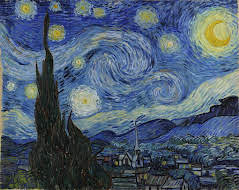
Pictured here is his work The Starry Night. Van Gogh painted it while he was at the Saint-Paul-de-Mausole asylum in Saint-Rémy-de-Provence, where he had self-admitted for treatment of his mental health.
Van Gogh had an enhanced awareness of himself on a number of levels: his mental anguish; his longing for community and human attachment; and his sense of God’s presence. All of that is on display on this canvas.
Stabilizing the center of the painting is a village. It is not one that van Gogh could have seen with his eyes from the asylum. It does not even seem to be a setting located in southern France. Rather, it is evocative of childhood home for van Gogh, the Netherlands. Home is at the center of van Gogh’s awakening to himself, nature, community, and God.
The role of home, dis-ease and spiritual healing appears in parshat Tazria-Metzora. “When you enter the land of Canaan…I shall place an eruptive affliction on a house of your possession,” proclaims God. Settlement in the promised land is not the end of dis-ease. Quite the opposite. To have achieved the realizations of one’s spiritual journey only heightens susceptibility to spiritual disorder…so that one can achieve a new cleansing. An elevated renewal.
And it may be that the turbulence sweeping across the canvas is van Gogh’s pain turned into beauty. “I didn’t know,” van Gogh wrote to his brother Theo, “that one could break one’s brain and that afterwards that got better too.”
Remaing pure brings nothing new into the world. “Immaculate virtue,” Primo Levi wrote, “does not exist; or if it exists, it is detestable.” Repression of dark urges is not only impossible; it deprives us of the opportunity to reshape who we are for the better, advises Rabbi Zalman. Paint your pain and see the beauty that it reveals, van Gogh hints. All of these interpenetrations between pure and impure are at the heart of the struggle for life renewed.
Join us here on Thursday April 16 at 7:00 p.m. as we explore the struggle for life.
The Starry Night by Vincent van Gogh