
A state of liminal flow, that between wakefulness and dreaming, can release us from a constraining past and enable us to experience an empowering new future.
View the study sheet here. Recording here.
Here is a tale about two different awakenings at 3:00 a.m. in the life of Otto Loewi. Born in Frankfurt, Germany, Loewi studied medicine at the University of Strasbourg and eventually accepted a position at the University of Graz in Austria. In 1909 he was appointed Chair of Pharmacology. There he set out to explore one of the great unsolved mysteries of medical science: How do autonomic nerves work?
By the beginning of the 19th century, scientists had established that electrical messages passed down along nerves causing physiological responses. However, by the end of the century, neuroscientists identified that nerve cells were separated by tiny gaps, eventually named “synapses.” How did the electrical messages pass from one nerve cell to another? The dominant theory at the time was that an electrical spark somehow jumped across the gap.
Pharmacological experiments in the first decade of the 20th century suggested that perhaps chemical messengers, such as adrenaline, transmitted by one nerve cell stimulated the next nerve cell and so on, ultimately producing the physiological response. The controversy of whether cells used chemical or electrical transmissions was fierce.
On April 2, 1921, Loewi woke up in the middle of the night and jotted down notes about a dream in which he had carried out a breakthrough experiment. However, in the morning, he could not remember the dream nor could he read the notes he had scrawled. The next night he woke up at 3:00 a.m., having dreamed of designing an experiment to test a theory he had formulated about chemical transmission between nerves. He jumped out of bed and rushed to his lab.
In the reality-based environment of his lab, Loewi replicated his dream-state designed experiment and demonstrated that nerves liberate specific chemical substances which, in turn, cause physiological modifications to an organ. Loewi had discovered the “neurotransmitter,” a chemical that an electrically stimulated nerve cell releases into the synapse that then fits into a receptor on an adjacent cell.
The discovery of neurotransmitters changed the practice of medicine by presenting the possibility of drugs that can enhance, bloc or mimic the action of neurotransmitters. Today such drugs are used to treat a wide variety of neurodegenerative, neurological and mental health conditions, including: Parkinson’s, Alzheimer’s, Huntington’s, epilepsy, schizophrenia, and ADHD.
For this work, he was awarded, jointly with Sir Henry Dale, the 1936 Nobel Prize in Physiology or Medicine.
Two years later, on March 12, 1938, at 3:00 a.m. there was a loud banging on Loewi’s front door. It was the Gestapo. They had come, on the very day of the Nazi invasion of Austria, to arrest Loewi. He was held in prison for several months and was released only after surrendering his Nobel Prize money, all his possessions and research materials. He left for England in September 1938 and arrived in the United States in 1940, where he became a research professor at New York University.
Loewi’s discovery of how nerve cells communicate occurred during a hypnagogic state, a half-dreaming condition in which our minds work differently. Our thinking becomes more visual and symbolic, creating unexpected connections.
This form of cognition is also referred to as a liminal flow state: a transitional phase that is in between the familiar and the yet-to-be. We have been released from the grip of old habits even as new ones have not yet been established. A feeling of anxiety caused by the disengagement from the rigid and the routine is offset by experiencing new ways forward.
Researchers Johan Liedgren, Pieter Desmet and Andrea Gaggioli in a paper reprinted by the National Institute of Health titled “Liminal Design” explore liminal flow as a supplement to the current User Experience model for product design developed by Don Norman at Apple in 1993.
Whereas User Experience emphasizes usability, transactional speed and efficiency, Liminal Design focuses on the language of narrative, suspension of disbelief, and personal transformation. There is an element of awe, of self-transcendence at play. The paper’s authors write: “In liminality, we know that what we see is not our existing world, yet we experience an immediate feeling of something very real.”
To experience liminal flow is to be at the threshold of not only a new world but also a new self.
Osnat Tzadok is an Israeli-born Canadian artist. She began painting in her thirties, inspired in part by a book she read on the power of the subconscious mind. She paints in an abstract style. She writes that such an approach “allows me to detach myself from the physical world and delve into my inner world where the real celebration is taking place.”
To paint this way is to surrender reliance on the formulated, the static, the clearly identifiable. It is to thrive in the space that is intermediate between fantasy and reality. To paint this way is not to represent what is. It is to discover what lies waiting to be uncovered.
She writes, “As a spiritual person but especially as an artist – flow is my motto. Flow is the art of letting things happen; it is where the subconscious is leading the conscious, and where the apparent is giving way to the hidden.”
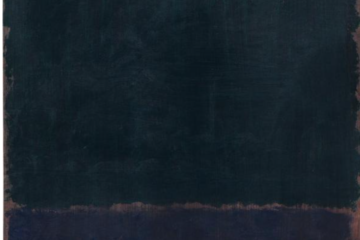
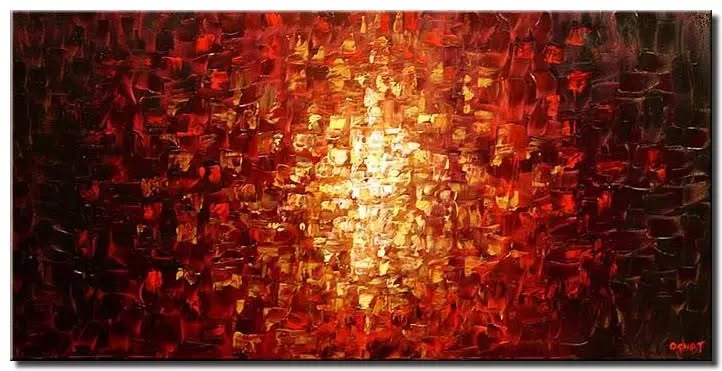
Pictured here is her painting “Fire Within.” The medium is acrylic paint, which she has worked upon with a palette knife, digging deep into the layers of black. It is not conscious thought that has planned this approach. It is a yearning that leads the way. That flow takes her to “where the apparent is giving way to the hidden.” And there she discovers fire within.
Parshat Tzav (“command”) describes a moment and a place of transition. The Tent of Meeting has been built. Now the priests must remain within its entrance for seven days as they undergo a process of transformation from ordinary human beings to sacred vessels of service. During that time they are to shamar, keep watch.
The description of place and purpose here evokes a scene from a time earlier, when the Israelites were on the verge of breaking free from Egypt’s bonds. The divine voice instructs them “not to go forth from the entrance to your homes until morning.” They are to shamar “this event for yourself and your children forever.”
The medieval commentator Rashi attunes us to the nuance of shamar. It is to watch over, to wait in expectation for something that is not yet but is coming.
The priests in this week’s portion and the Israelites in the earlier portion are both placed at a threshold, where they must wait. They are called upon to participate in a liminal flow. To be free, to cause the divine to dwell within them, they need to be able to wait unanxiously for a new reality and a new self that they can sense but have not yet seen existing in the world.
In her extraordinary poem, inspired perhaps by a love lost, Emily Dickonson wrote about the resilience that is hope, a song that is watched over…eternally.
“Hope” is the thing with feathers/That perches in the soul/And sings the tune without the words/And never stops – at all –
The ceremony to transform the priests into practitioners of the Mishkan’s ritual, which is designed to overcome the perceived distance between God and human, is called a “filling.” At the end of Exodus, God’s glory “filled” the Mishkan. Now they will be filled, and they will help others get closer to the fullness that is life attuned with the divine. A transfer of power and responsibility from divine to human is an elemental part of the journey from Egypt to the divine promise of fulfillment and peace.
In just a week’s time we will participate in our own share of that journey. Around tables we will tell a story that is of no time and of all time. It is a dream which we have the power to bring from fantasy into reality. A world and a self free of narrowness and rich in hospitality. By telling that story and singing its tune, we can spread wings of hope.
Join us here at 7:00 p.m. (PT) on Thursday, March 26 as we explore wings of hope.
Fire Within by Osnat Tzadok