
To imagine ourselves – and those around us – as capable of so much more than the limitations we are told are realistic enlarges our world in compassion.
View the study sheet here. Recording here.
One of our favorite evening home rituals is to settle in and watch a couple of episodes of Home of the Year. It’s an Irish television series in which three expert judges explore twenty-one unique and diverse homes over eight weeks to select a winner.
Each show begins with a voice-over intro asking, “What makes a house a home?” The intro continues that the judges will be looking for “functionality, individuality and clever design.”
In the episodes that we have watched, two of the judges have been architects and the third has been an interior designer.
It has been fascinating to watch as one of the architects has consistently been primarily interested in the objective structural aspects of the home while the other has focused more on the infusion of the owner’s individual personality into the overall project. And the interior designer has opened herself to the lived presence of those who dwell there by touching fabrics, experiencing colors and noticing small personal objects on shelves.
Despite frequent statements from the judges that personal “authenticity” is a top value, what makes a house a winner and possibly “home of the year” seems to vary from vote to vote. Sometimes a house wins due to objective elements of proportionality and placement of windows and doors. Other times, the subjective, expressed presence of the owner overcomes a more technically well-designed project.
For all its entertainment value – and helpful design hints! – Home of the Year’s definition of “what makes a house a home” remains elusive.
Gaston Bachelard was a French philosopher who originally studied and taught the hard sciences of mathematics, physics and chemistry. He later shifted to the philosophy of science; how scientific knowledge is generated and justified.
In 1958 Bachelard published The Poetics of Space. It explores the distinction between the physical structure in which we live and the space in which we experience relationships, encounter memories and exercise our imagination. Such a space he calls “home.” A home is a dimension not of a static arrangement of surfaces with specific physical dimensions. It is a site of dynamic relations with others and with ourself over time.
The Poetics of Space is less a study of physical structures than it is of the human psyche. “If I were asked to name the chief benefit of the house,” Bachelard wrote in The Poetics of Space, “I should say: the house shelters daydreaming, the house protects the dreamer, the house allows one to dream in peace.”
The language of geometry may provide us with shelter from what is around us, but it is the language of poetry that provides entry to our imagination, where we can make contact with that which is beyond the rational. With the wonder that transforms everyday human life into an endlessly meaningful, creative adventure.
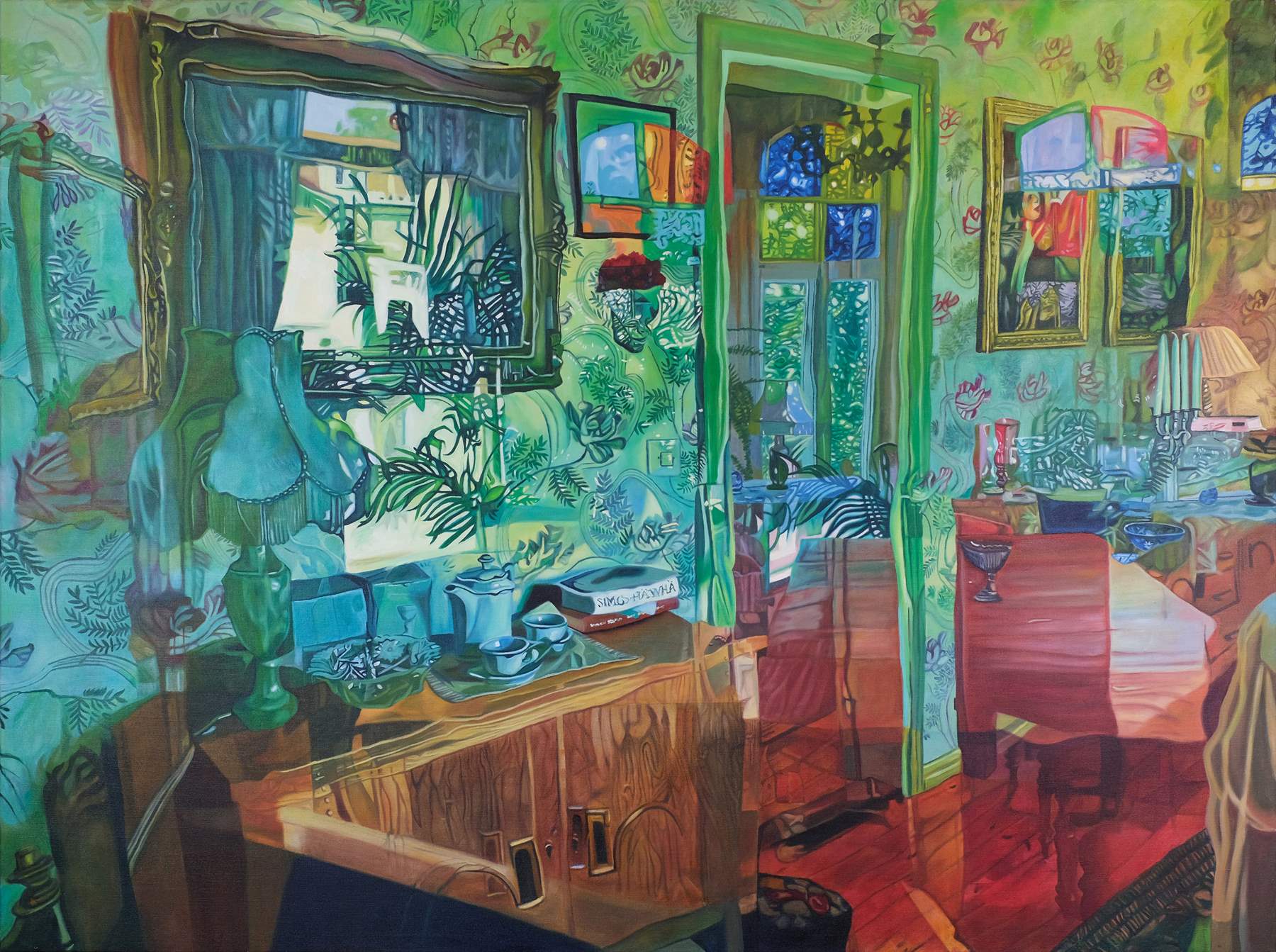
Emilia Nurmivaara is a Finnish artist whose paintings are visual expressions of Bachelard’s philosophical explorations on notions of space. Through her paintings she examines physical objects in a home and “the significance they have for our soul space and dreamscape.” She says, “To me the home is an intimate place where the interior is loaded with memories, thoughts and atmospheres.”
In 2022 she had a solo exhibition at the Gallery Poulsen in Copenhagen. It was titled “The Poetics of Space,” an express acknowledgment of Bachelard’s influence on her work.
Pictured here from that exhibition is her painting Room to Dream. The objects in it are readily identifiable: a table, chairs, lamps, doorways, goblets, drapes, plants. Less identifiable are their relationships to each other: Why is a goblet protruding from the side of a table, a bowl floating in the air, a ghostly image of a table-top object intervening between us and a red vase? Also unclear is what time dimension we are witnessing: Past? Present? Future?
Nurmivaara has breathed new life into an interior space that could otherwise appear as static and resolved. “I want to create the illusion of a room,” she wrote, “and try solving the problem between figurative and abstract imagery in a physical space. The image is built as a collaboration between reality and fantasy.”
Using reflective glass panels, she has distorted the visually familiar and created a new room…one that only imagination can sustain, where multiple time dimensions can exist and where more than one object can occupy the same space.
As a scientist, Gaston Bachelard studied and embraced the new physics of quantum mechanics, which disrupted the centuries-long dominance of Newtonian physics. Newtonian physics, a triumph of the Scientific Revolution and the Age of Enlightenment, posits a determinative universe consisting of discrete slices of time: past, present and future.
Quantum physics has added to that Newtonian unbroachable separation of time the observation that our experience of time is subjective and relative to our frame of reference, which is necessarily limited. Time and space are understood not as separate entities but as part of a four-dimensional continuum called “spacetime.” Reality consists of multiple dimensions. And those multiple dimensions can interpenetrate and contact each other.
In Parshat Vayakhel-Pekudei (“he assembled”- “accountings of”), the Israelites are engaged in the construction of a building for the worship of God. Those enlisted to build such a structure are described as chacham-lev: literally, “wise-hearted.” Chochmah is the Hebrew word for wisdom.
The Zohar, the central Jewish mystical text, identifies chochmah as built from two words: koach, meaning “ability,” and mah, meaning “what is.” Chochmah is the potential of what is, or the potential to be.
In the kabbalistic system of the sefirot, the divine emanations that enter the human realm, chochmah is the first of those. It is a lightning flash, appearing then disappearing. It is in a state of constant flux between being and non-being. Before there is analysis, clarification and understanding, there is the spark of something from beyond what is already known: “Chochmah emerges from nothingness” (Job 28:12).
Chochmah is the initial and primary spark from beyond that permeates all of creation. It flows into all living things…including you and me. Its dwelling place is our imagination.
Gaston Bachelard wrote, “We always think of the imagination as the faculty that forms images. On the contrary, it deforms what we perceive; it is, above all, the faculty that frees us from immediate images and changes them… If the image that is present does not make us think if one that is absent…then there is no imagination.”
This is the construction project that concludes the book of Exodus, the beginning of our liberation and of our journey home: the building of Wisdom’s House. Its exterior may look recognizable (metals and wood and fabrics), but the interior is dynamic, suffused with intoxicating aromas and bewildering mists…and “filled with the presence of the Source of all life” (Exodus 40:35).
Wisdom’s house has both a firm structure and a luxuriant interior: “Chochmah has built her house. She has hewn her seven pillars. She has prepared her feast, mixed the wine and also set the table.” (Proverbs 9:1-2)
As we build around us so can we build within us. We can construct ourselves into houses of wisdom. Calling upon the divine gift of chochmah, we can imagine a self that is otherwise than currently exists: one inspired by a summons to greater responsibility, compassion and peace. We become “filled with the presence of the Source of all life.” As more and more join in that journey and its enterprise, what a home this world would become.
Join us here at 7:00 p.m. on Thursday March 12 as we explore wisdom’s house.
Room to Dream by Emilia Nurmivaara