
View the study sheet here.
In 1970 Scottish psychiatrist R.D. Laing published a book of poems set in a dialogue format that explores the tangled nature of human relationships. It gives voice to the many ways that human beings all too often bind themselves up in webs of miscommunication and create impasses to healthy relationships through jealousies and contorted acts of self-defense.
In one of Laing’s poem-dialogues, Jack announces to Jill: You are a pain in the neck/To stop you giving me a pain in the neck/ I protect my neck by tightening my neck muscles/ which gives me the pain in the neck you are.
Laing titled his book Knots, a term that for him connotes disfunction and obstruction. In his introduction, he offers as worthy synonyms: “tangles, fankles, impasses, disjunctions, whirligogs, binds.”
To say that one has a knot in one’s chest or stomach is to describe a haunting, disabling stress. Muscle knots are tight, tender lumps of muscle fibers that have contracted and failed to relax. A knotty problem is a highly complicated, baffling issue that is difficult to solve.
Yet knots can also refer to positive conditions or experiences. To tie the knot is symbolic of friendship, affection, love. A knot of friends is a close-knit, mutually supportive group. And where would we be without the knots that help us to wear shoes, rig sails, moor vessels and secure equipment. Knots are critical to “the ties that bind.”
Knots, it seems, can either obstruct or connect.
Knots are also critical elements in crochet, sewing and weaving. Those creative works have generally been identified as “crafts” rather than as “art.” Anni Albers changed all that.
Albers was born as Annelise Fleischman in 1899 to parents who were both from prominent German Jewish families. However, most of her family converted to Protestantism as an effort to assimilate into German society and secure social acceptance. Albers herself was raised in the Protestant church.
She began studying painting as a child and was eventually accepted into the Bauhaus School. Like many other women, Albers was barred from many of the art disciplines at Bauhaus. She begrudgingly accepted placement in the weaving workshop. Once there, she revolutionized weaving by shaping it as a form of radical artistic expression, integrating abstract modernism into textile weavings that bridged the gap between craft and art, between the everyday and the rarified.
While at Bauhaus she met fellow student Josef Albers. They married in 1925. By 1933 it was clear to the Albers that their lives were in danger under the Nazi regime. American architect Philip Johnson helped to secure positions for them at Black Mountain College in North Carolina. There Anni Albers founded the college’s weaving program and became renowned as both an innovative artist and an inspiring teacher. In 1949 she became the first weaver to have a solo exhibition at the Museum of Modern Art.
Through her experimentation with new materials and technologies, she created an entirely new vocabulary for weaving as an art form. “I learned to listen to threads and to speak their language,” she said.
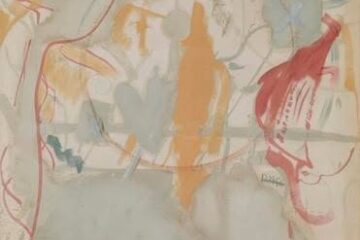
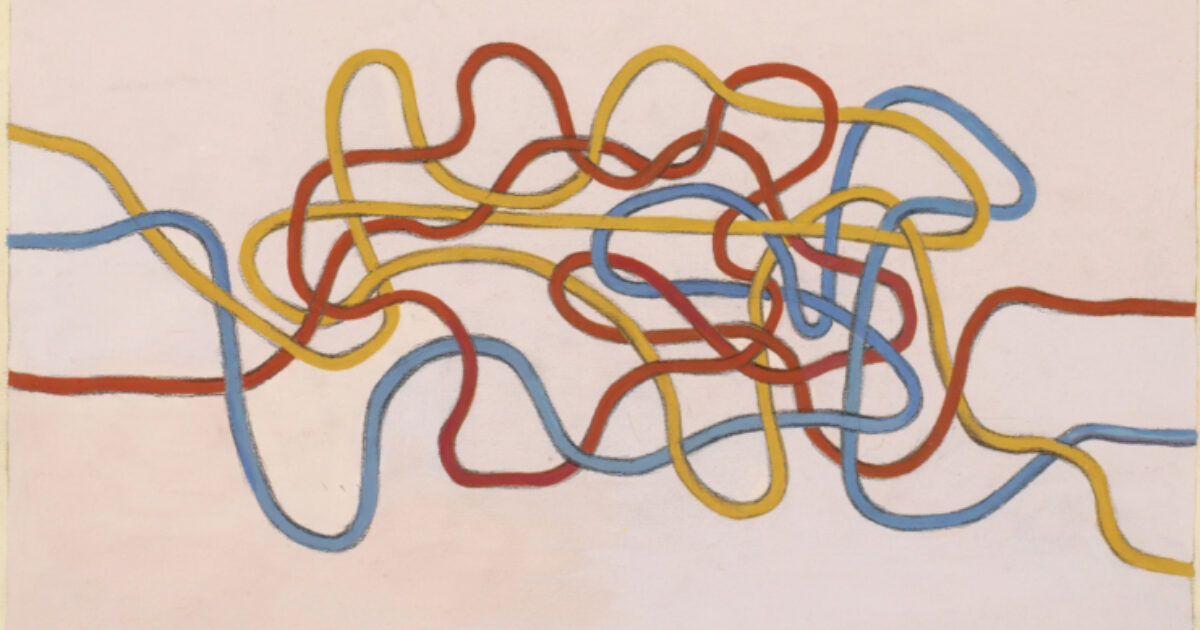
In addition to her work at a loom, Albers also produced hundreds of prints, watercolors and drawings. Pictured here is her gouache on paper Knot, 1947. Is this knot as tangled mess or knot as stabilizing attachment? Obstruction or connection?
One of Albers’ teachers at Bauhaus had been Paul Klee, who had proclaimed: “A line is just a dot that went for a walk. It is an active line on a walk, moving freely, without a goal.” The dot yearns and seeks. And in the course of its meandering it explores the mysterious and in so doing produces beauty.
Albers’ threads are on a journey. They are moving across the paper in search, yearning to become a beautiful weaving. To achieve structural stability, threads in a weaving need knots.
In many forms of fabric work – knitting, crochet, sewing, weaving – one kind of knot used to join separate strings together is the mystery or magic knot. It is a double overhand knot that creates an immensely strong, small and virtually invisible attachment between two threads. The knot itself blends seamlessly into each. The integrity of each strand remains, and in between, where they meet, is the mystery.
Parshat Ki Tisa (“when you elevate”) describes the terrible rift in the Israelite communal fabric when their anxieties drive them to create a golden calf. Seeing the concrete manifestation of their spiritual and moral collapse, Moses smashes the tablets of the Ten Commandments. He then withdraws into a cave, where he has a secluded encounter with God.
“Oh, let me behold Your Presence!” Moses cries out. The divine responds, “As My Presence passes by you, My hand will cover your eyes. Once I am past you, I will take away My hand, and you will see My back; but My face may not be seen.”
Early rabbinic midrash imagines that to see God’s back means to see the knot of the tefillin on God’s head. To see the knot is to not see the tefillin itself, not the heart of the mystery, but a trace aspect of it. Moses, for all his greatness, is denied unmitigated access to the infinite. Total knowledge passes him by. He can engage with God only as other humans can: through the limitations of human existence, that of time and space and limited perspective…and the finite symbols that are words.
The Hebrew word for knot is kesher. It is derived from the verb to bind, to create a connection, a relationship. This is the divine aspect that God shows to Moses. A relationship, a binding with…whom?
In that moment of seclusion with God, Moses humbles himself and cries out, “Pardon our iniquity and our sin.” Our iniquity, our sin. In that moment, Moses makes a clear and definitive choice, merging his own destiny with that of the people. The moment of Moses seeking attachment to God’s full, infinite Presence resolves into his full identification with and commitment to his people and their time and earth-bound lives and needs.
The knot of God’s mystery is a mystery knot. It invisibly, seamlessly and securely binds Moses to the people he serves as they wander across the wilderness towards a dimension of themselves that is home.
And the Artist? Anni Albers wrote, “The conscientious designer, does not himself design at all but rather gives the object-to-be a chance to design itself.”
And so we go, tying our mystery knots, day in and day out. Creating small, interlocking overhand grips with one another. Humbling ourselves, so that we might be part of a greater tapestry. One element of a home, of a world where the divine can dwell.
Join us here at 7:00 p.m. (PT) on Thursday March 5 as we explore a knot of mystery.
Knot, 1947 by Anni Albers