
The way to the future is paved by overcoming our impediments to intimacy.
View the study sheet here. Recording here.
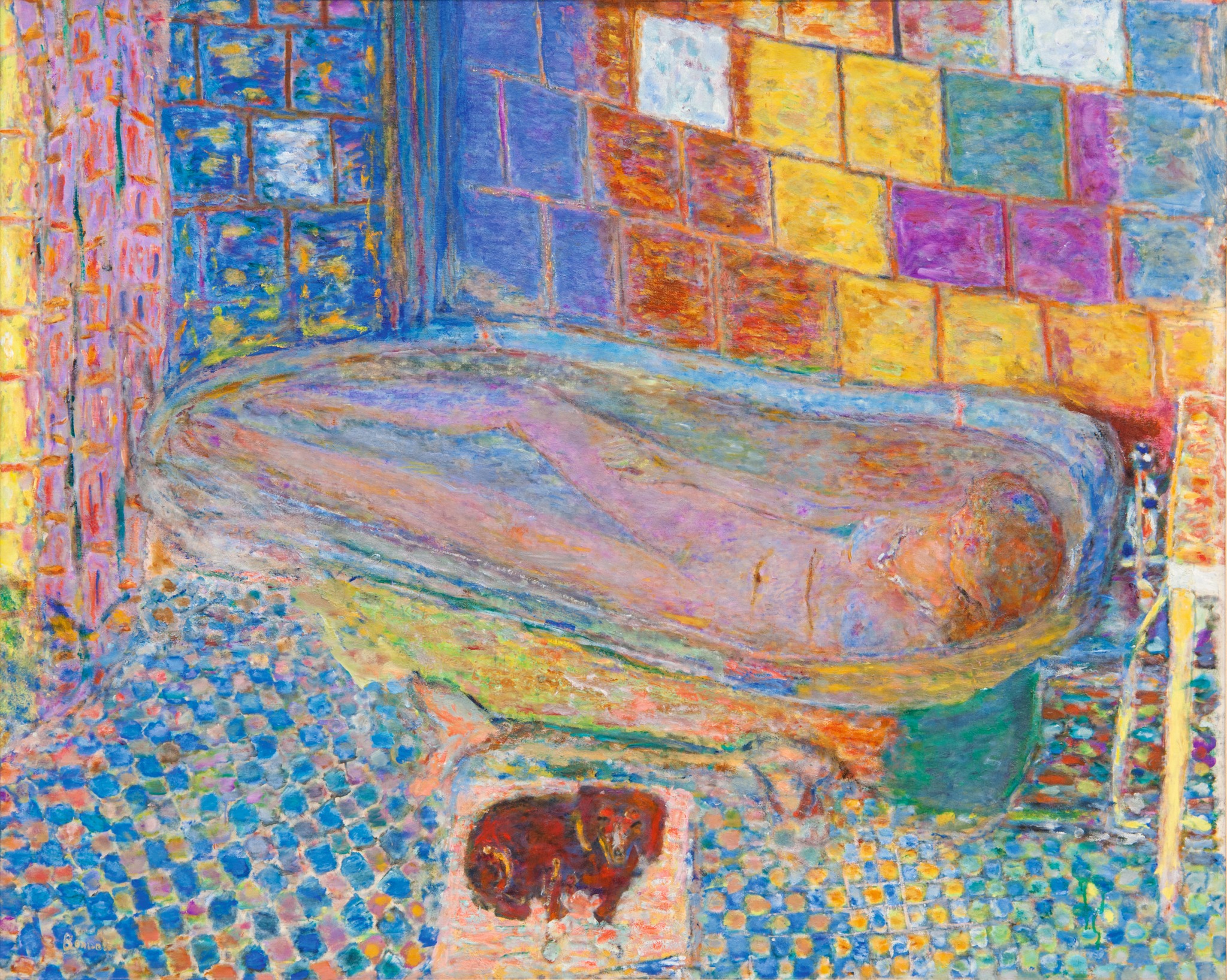
Pierre Bonnard was a prophet. Or, to be more precise, he was a Nabi. The Nabis were an avant-garde group of artists at the end of the 19th and beginning of the 20th centuries who felt that artists could serve as “seers,” capable of being in touch with a higher power and of revealing the invisible. They named themselves after the Hebrew word for “prophet,” navi.
They triumphed the notion that the role of the artist was not to paint the mere representation of what could be seen. It was to express in form and color what the artist’s soul experienced. The Nabis often began their gatherings with the incantation: “sounds, colors, and words have a miraculously expressive power beyond all representation and even beyond the literal meaning of the words.”
While some of the Nabis explored the obscure and the mystical for their artistic themes, Bonnard was entranced by and delighted in aspects of simple daily life: domestic interior settings, scenes of family members reading, sewing, bathing. The writer André Gide coined the term “intimism” to describe the work of Bonnard and others like him. They created art, Gide wrote, “speaking in a low tone, suitable to confidences.”
Unlike the Impressionists, who painted fleeting moments infused with their time-specific feelings of them, Bonnard painted moments embellished with layers of subjectivity. Hidden within the apparent simplicity of the setting were dimensions of perspective, focus and meaning.
Bonnard was keenly aware of the limitations of the bordered canvass to convey all that was present in any moment. He wrote: “The strict cropping of the visual field nearly always produces something false. The second stage of composition consists of bringing back certain elements which lie outside the rectangle.”
“There is a formula,” Bonnard wrote, “which fits painting perfectly: many little lies to create a great truth.” To bring back into the framed scene something that was not visibly apparent, to portray it as other than our eyes and logical mind might perceive it, risks the artist’s credibility and authority as a conveyor of truth. As a prophet.
Pictured here is one of many paintings that Bonnard did of his wife Marthe bathing, Nude in the Bath. Bonnard began it in 1941 and completed it in 1946, four years after Marthe’s death. The scene is contained, intimate…serene even. But Bonnard deprives us of any resolved notion or settled comprehension.
The most grounded and prosaic image in the painting is a dog, who sits anchoring the scene on a rectangular mat formed by static right angles. Everything else pulsates, vibrates and undulates.
The floor flows even more than the water in the tub. The tiles on the walls effloresce, even as the walls themselves seem to breathe. Marthe appears to have almost emulsified. And the vessel that holds her, the bathtub, transforms into a lover, adjusting its embrace to accommodate the bend of her knee and to caress the curve of her head.
It is depiction in fantasy form of a mundane activity that we think happened every day in the Bonnard household. Marthe Bonnard had a tubercular condition that was eased by daily baths. Pierre Bonnard takes us on a dizzying journey of the everyday to reveal more than our own eyes might have seen and our own minds might have comprehended had we been there.
That is the work of the seer, the prophet, the navi. To expand our vision beyond the prosaic description of any moment. To see beyond the apparent, the anticipated, the expected.
Parshat Shemini (“eighth”) is the third portion in the book of Leviticus. Where we may have been enthralled with the stories of Genesis and Exodus, we might find ourselves downshifting in our enthusiasm over the focus and pace of Leviticus. This third book of Torah has no physical journey. The Israelites have halted their trek to the promised land. There is virtually no narrative element. Only a series of ritual protocols, behavioral instructions, and various rules about purity.
The early rabbis, creatively artistic exegetes, reveal for us dimensions in the text that our normal reading eyes might not otherwise have seen. In the portion’s opening, Moses tells Aaron to “come close to the altar” so that he can initiate the sacrificial offerings now that the Mishkan has been built. “Take a calf” as a first offering, Moses instructs his brother.
Simple words. Yet, swirling around them is a complex of events and Aaron’s traumatic reaction to them, note the rabbis. Aaron stares at the calf and recalls with shame his role in making the Golden Calf. He is frozen by his past behavior from acting in the present for the sake of the future. How he was is how he is and will be, he fears.
The Hebrew word Moses uses in urging Aaron to “come close” to the altar is krav. As a verb it means “to draw close.” Its same letters also produce as a noun the word “battle.” Our rabbi-artists disclose that Moses is urging his brother to “go into battle” against the forces within him that are narrowing his view of himself, of what he thinks he is possible of becoming.
Overcoming the shame of the past and fear about the future that disable Aaron from functioning fully in the present would unleash his capacity for intimacy. It would enable him to serve fully in his role as high priest for a God who seeks to dwell among the people and within each person.
Our rabbi-artists help us to see that what may look like the most stalled and boring of all Torah’s books may actually be its most dynamic and loving. Behind the apparency of the prosaic and the motionless lie dimensions of the profound and the dynamic. Torah’s third book is a vibrating story about release from fear and from enslavement to our lower selves. Its gift is a life lived in heightened intimacy.
Do not paint only what your eyes see and your mind comprehends, Bonnard insists. There is movement in all things, vistas beyond our familiar framings. Seek that out with your heart, become a seer, a navi. Paint with love and reveal the way to a future rich in constant becoming.
Join us here at 7:00 p.m. on Thursday, April 9 as we explore the way to the future.
Nude in the Bath by Pierre Bonnard