
More than shared interests, backgrounds and points of view, it may be our strangeness to one another that is the enduring source of our commonality.
View the study sheet here. Recording here.
The Canadian communications theorist Marshall McLuhan pioneered the study of how we communicate affects what we communicate…or, more accurately, how we receive what is communicated. His famous aphorism “the medium is the message” concisely articulated his view that the way we acquire information affects us more than the information itself does.
In 1962 McLuhan wrote The Gutenberg Galaxy. He argued that the technology of print changed human psychology and society more than the content of the books being printed did. It shifted human culture toward linear, logical, and isolated assimilation of information and eroded the communal, multi-sensory, multi-vocal experience of oral culture.
McLuhan anticipated that the new technology of electronic communication, in the form of radio and television, would reverse the isolationism and individualism of the print era. It would collapse space and time, enabling human interaction on a global scale. “The new electronic interdependence,” he wrote, “recreates the world in the image of a global village.”
For McLuhan, however, the global village was no utopian setting in which people would experience and appreciate their shared humanity. Instead, he anticipated that it would bring disparate values, cultures and viewpoints into a clashing encounter, resulting in heightened paranoia. People would retreat into tribal corners. Conflicts would intensify.
“The Global Village,” he remarked in a later interview, “absolutely insures maximal disagreement on all points. It never occurred to me that uniformity and tranquility were properties of the Global Village. It has more spite and envy…The tribal-global village is far more divisive than any nationalism ever was. Village is fission, not fusion, in depth all the time.”
McLuhan died in 1980. He did not live to see the next revolution in communication: the internet and the social media that it birthed…and the promises of a new utopian world its early enthusiasts promoted.
Although the origins of the internet lie in work conducted under the auspices of the Department of Defense in 1969, its real birth began in 1983 with the development of technology that allowed different networks to communicate with each other.
One of the internet’s earliest and most optimistic advocates was a Deadhead. John Perry Barlow was raised on his family’s 22,000-acre cattle ranch in Wyoming. Due to his disciplinary and academic failings, his family sent him to Fountain Valley School in Colorado Springs, Colorado. There he developed a life-long friendship with fellow student Bob Weir, who would co-found the Grateful Dead in 1965.
Over the course of decades running the family farm, serving as Chair of the Sublette County Republican Party and coordinating the 1978 congressional campaign of Dick Cheney, Barlow managed to write 30 songs for the Grateful Dead. He also launched, in 1986, one of the internet’s earliest online communities: WELL (Whole Earth ‘Lectronic Link), whose members were drawn from the fields of music, publishing and technology.
In 1996 Barlow issued “A Declaration of the Independence of Cyberspace.” It was a bold and optimistic envisioning of the internet as a utopian, borderless democratic environment. “We will create,” he wrote, “a civilization of the Mind in Cyberspace, [where] all may enter without privilege or prejudice.” It promised a new, decentralized world with the democratization of all knowledge.
Within a few years, Barlow’s techno-utopianism, which imagined a cross-cultural, free exchange of ideas that could solve all of humanity’s problems, crashed upon contact with a new model for the internet: to make money, enormous sums of it.
When Facebook opened to the public in 2006 it provided users updates from friends in chronological order. Three years later it abandoned that approach and introduced an algorithm that organized posts based on the user’s level of engagement with prior material.
That shift, from chronology to interest, turned social media from a site for the latest news from friends and family into a massive marketplace. Businesses now had data that allowed them to target sales. In 2025 businesses spent over $275 billion on ads across all social media channels and platforms. It is a massive investment, one that counts on social media directing to users material their prior choices indicated they are most intensely interested in.
Increasingly, Barlow’s vision of an unbordered world in which one could encounter new and fresh perspectives, has given way to a dystopia of echo chambers limiting exposure to diverse viewpoints. News, stories and products – and other human beings – have become curated for us. Pre-existing biases are reinforced. The strange has become not a source of surprise and wonder but a threat to our sense of what is true and important…and a potential disruption to the flow of predictable revenue for the commercial sponsors of that curation.
Parshat Acharei Mot-Kedoshim (“after death”-“holiness”) provides an encounter with the strange. The name of this double portion itself prompts a doubletake. Death is the end of life, while holiness is the very motivation behind a divinely engendered life: “You will be holy, for I am holy.” What is the meaning of this encounter between ending and beginning, between decline and elevation?
The book of Leviticus is the middle book of Torah. Parshat Kedoshim is considered by Jewish tradition to be at the heart of Leviticus. And at the very center of it all is verse 18 from chapter 19: “Love your fellow as yourself.” Rabbi Akiva, a late 1st century early 2nd century sage, proclaimed this instruction to be the great principle, the crowning point of Torah. Its pride of physical placement only emphasizes its centrality to Torah’s guidance.
The 13th century rabbi known as Ramban demurred, suggesting that Rabbi Akiva’s declaration “is an overstatement, for a human heart is not able to accept a command to love one’s neighbor as oneself.” Instead, he suggested, the verse means that we are to wish our neighbor well, just as we wish well for ourselves.
The Hebrew offers some intriguing other possibilities. The word for “fellow” is reah. It is formed from the combination of three letters: resh, ayin and hay. One meaning for their combination is the verb “to associate with.” The same combination also creates two other Hebrew verbs: “to pasture, tend” (from which verb the Hebrew noun for “shepherd” is derived); and “to take pleasure in, desire” (from which come the Hebrew nouns “purpose” and “aim”).
Strange, isn’t it, these linguistics siblings – the verbs: associate, tend, and take pleasure in; and the nouns: companion, shepherd, and purpose. What definitional DNA binds them together?
There is more strangeness. The same combination of those three letters also generate the names of two characters we meet in the Bible: Ruth and Reul. The first, a Moabite princess. The second, a Midianite priest.
Ruth chooses to join her destiny to that of the people Israel. Upon joining, she brings a redemptive love to a community that had been starving for it. She marries, bears a child and becomes the great-grandmother of King David.
Reul is Moses’ father-in-law. He demonstrates to Moses the importance of family life, especially for such a busy communal leader. He teaches Moses how to delegate his administrative responsibilities. It is after his other name, Yitro, that the portion which contains the revelation at Mount Sinai and the Ten Commandments is titled.
Two characters who represent strangeness to the Israelites. They are from different backgrounds, have different family stories, different customs than the Israelites. Yet, the Israelites’ encounters with that strangeness enable their community to survive and renew itself.
The encounters also inspire the community to consider new possibilities for themselves. Reul helps Moses to overcome his pharaonic upbringing. A leader can share power and responsibility with others. Ruth challenges tribal fears about the outsider. The rabbis of the Talmud consider the clear Biblical prohibition on Moabites becoming part of the Jewish community and proclaim, “Not always, not in all cases.”
The encounter with the strangeness of another provokes a discovery of one’s own strangeness. That one is not finally formed. That the familiar is merely a cover for undiscovered territory within oneself. That journey into one’s own strangeness takes courage.
No artist chronicled his self-exploration more and in such brutally honest ways than Vincent van Gogh. He painted thirty-six self-portraits over a period of ten years.
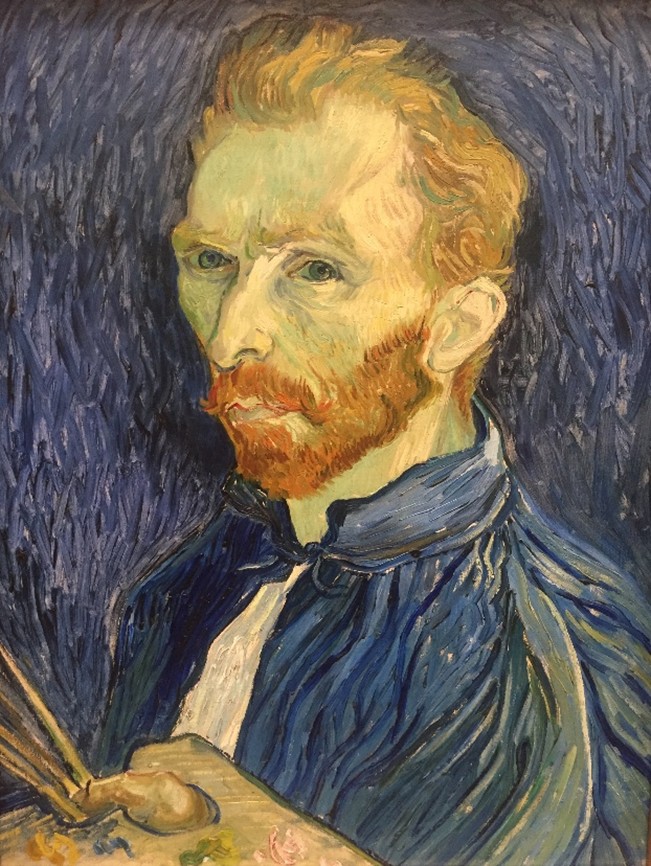
Pictured here is one that he did shortly after suffering a mental breakdown in 1889. He was recovering at an asylum in Saint Remy, determined to confront and reconstruct his identity.
In this self-portrait van Gogh presents himself clearly as suffering. His skin looks as if it is stretched tightly over a skull. His cheekbones, eye sockets and forehead protrude. The ghostly pallor of his face betrays the stress and shock his system has experienced.
To uncover and visually describe his suffering was for van Gogh a self-conscious step towards a reconstruction of his own self-image, towards healing. He wrote to his brother Theo:
“They say – and I gladly believe it – that it is difficult to know yourself, but it isn’t easy to paint yourself either. For the time being, I am working on two portraits of myself…[This] one I started the first day I got up; I was thin and pale like a ghost. It is dark-blue violet, the head whitish with yellow hair…”
Van Gogh is describing the painting displayed here. Yet, even in the midst of his self-described near-death state, van Gogh proclaimed that he was more than his illness. He was also a master painter in the tradition of the greatest. His pose here is identical to one that his hero and fellow Dutchman Rembrandt did more than 200 years prior: palette and brushes in hand, three-quarter profile and the intense gaze of one who knows his purpose and his gifts.
To paint was, for van Gogh, to discover and to heal. And, aware of his strangeness to so many, he wanted his paintings to serve as a point of human connection. In 1890 he wrote to Theo:
“What am I in the eyes of most people? A nonentity or an oddity or a disagreeable person – someone who has and will have no position in society, in short a little lower than the lowest. Very well – assuming that everything is indeed like that, then through my work I’d like to show what there is in the heart of such an oddity, such a nobody. This is my ambition, which is based less on resentment than on love in spite of everything, based more on a feeling of serenity than on passion.”
Van Gogh died that same year. His legacy to us are works of profound honesty and awe-inspiring beauty. He shared with us his self-awareness of his strangeness as a message of human connection…out of love.
More than shared interests, backgrounds and points of view, it may be our strangeness to one another that is the enduring source of our commonality.
Join us here at 7:00 p.m. on Thursday April 23 as we explore to see the strange as oneself.
Self-Portrait, 1889 by Vincent van Gogh