
The Mishkan and its rituals were designed to help us overcome the distance we might imagine exists between ourselves and the Source of all life. That inspires us to know we can do the same with those around us.
View the study sheet here. Recording here.
What we now think of as science – the systematic study of the structure and behavior of the physical and natural world through observation, experimentation, and the testing of theories – emerged in the 17th century. The Scientific Revolution of that era shifted Western thought from philosophical orientations to an evidence-based approach.
A galaxy of rock-star scientists clustered during that period. Among them were: Isaac Newton, Galileo Galilei, Johannes Kepler, René Descartes, Robert Boyle, Blaise Pascal, Robert Hooke, and Christiaan Huygens.
There was one more, whom you may not have ever heard of. And he may have been busier than any of his colleagues: Edme Mariotte. Born in 1620 in Dijon, France, Mariotte was primarily a physicist; but he had a wide range of interests and accomplishments. Independently of Robert Boyle, he discovered the law that the volume of a gas varies inversely with its pressure. In England this is known as Boyle’s law. In France it is called Mariotte’s law.
Mariotte also studied plants. He concluded that they synthesize materials by chemical processes that vary from plant to plant, a theory that was verified long after his time. He observed the pressure of sap in plants and compared it to blood pressure in animals.
In 1676 he published “Discourse on the Nature of Air,” in which he coined the word barometer. He was one of the founding members of the Academy of Sciences, in Paris, in 1666. He participated in the installation of the hydraulic system at Versailles. He conducted experiments on the refraction of light, barometric changes, and on falling bodies. With astronomers Giovanni Domenico Cassini and Jean Picard, he examined navigation and the problem of longitude.
Mariotte was also a Roman Catholic priest and had ongoing ecclesiastical responsibilities as Prior of Saint-Martin-sous-Beaune Monastery in Burgundy.
During the 1660s Mariotte conducted a series of experiments on the human eye. He identified that the area where the optic nerve enters the retina lacks photoreceptors, causing a tiny, permanent gap in vision. This is known as a naturally occurring “blind spot.”
We all have this anatomical location and the consequent gap in our vision. Yet, unless demonstrated to us by an exam, we are unaware that we are not seeing everything that is in front of us. Contemporary scientists have explored how the brain creates a visual illusion by extrapolating from surrounding details and filling in the gap…thus creating a complete picture.
Most recently, researchers have applied Mariotte’s blind spot discovery to the field of human consciousness and inter-personal dynamics. In addition to a physical blind spot, we also have a “bias blind spot.” This is a cognitive bias where we recognize the impact of biases on others’ judgments while failing to see the impact of our own.
Researchers from Carnegie Mellon University and three other universities have developed a tool to measure the bias blind spot. Their studies show that believing you are less biased than your peers has detrimental consequences on judgments and behaviors, such as concluding whether anyone’s advice is useful. An exploration of one’s bias blind spot can expand one’s vision and the opportunities for making good decisions.
Parshat Vayikra (“He called”) is the opening portion to the book of Leviticus. It describes the various offerings and sacrifices to be made in the Mishkan, the immense tent designed as a site for drawing the human and the divine presences closer to each other.
Amid all the detailed instructions about what is to be offered and how, often overlooked is the specification that only unintentional sins are the subject of the Mishkan rituals. Intentional sins (where you knew what you were doing was wrong) and involuntary actions (where you were not acting freely at all) are not part of the Mishkan system. The former cannot be atoned for by sacrifice. The latter do not need atonement.
An unintentional sin is doing something wrong but not knowing that it was wrong. The “not knowing” results from some kind of absence of understanding. An inability to see. A dark spot in one’s knowledge.
The iconic sin committed by the Israelites on their journey out of Egypt is the building of a golden calf to worship. If this was an intentional defiant act, no religious ritual could repair the breach they had created in their relationship with God. If it was the result of missing information, that what they were doing was a violation of a commandment, then atonement would be possible.
Through a series of midrashim, interpretations that fill in gaps in the Biblical text, the early rabbis weave a supplemental narrative, one that compassionately expresses how difficult it is to live perfectly as a human being. The Israelites did not knowingly betray God, they proclaim. They had descended into a state of pathological absence of awareness. Anxiety over Moses’ (and God’s) absence had unleashed an avalanche of unbalanced emotions sweeping away conscious thought and intentional action.
To be human, the rabbis indicate, is not merely to err. It is at times to not hear or perceive clearly. To not see.
Damage has been done by the Israelites’ unconscious and unintentional behavior, but repair is possible. The essential aspect of the repair process is not the bringing of an offering, the rabbis clarify. And it cannot be effected merely by someone pointing out to another that they have done wrong. One must discover on one’s own the error. One must explore their own dark abyss out of which has sprung their variation of a golden calf.
In that dark place one discovers that the anxiety that produced the Egyptian- influenced symbol of control and static imagination can also be understood as a longing for connection with the evolving mystery that is the other. By accepting responsibility, one discovers that the darkness within oneself can produce not only damage but also healing. A new self, a new relationship with the other. There is light in that darkness.
Raquel Sanchez is an artist and poet who has journeyed into and across cultures. Now living in Israel, she grew up travelling between New York, Ibiza, Morocco and Venezuela. Her father was the Venezuelan poet and 1975 National Prize winner for Literature Juan Sánchez Peláez. Her mother is Ellen Lapidus Stern, an American artist.
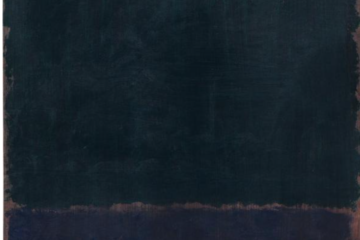
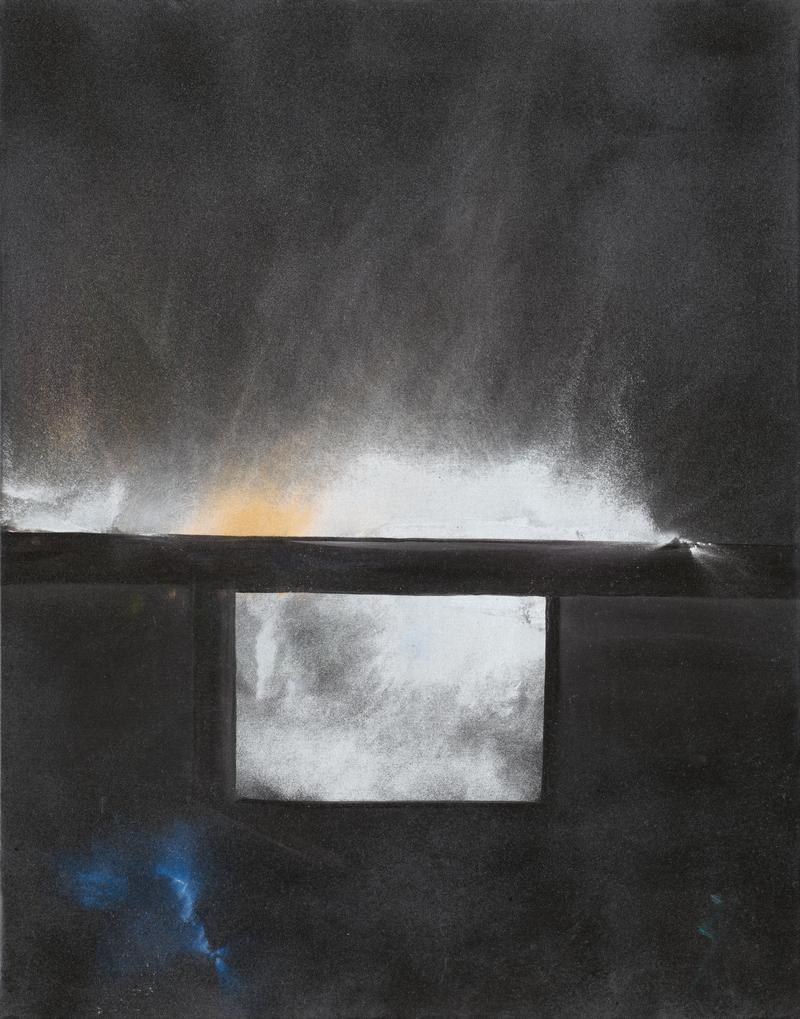
Pictured here is her work A Longing for God, Prayer I (Shav’ah). It is part of a series titled “Light from Darkness.” For Sanchez, darkness is not the absence of light. “There exists,” she writes, “only the light that appears to be not revealed and that which we perceive as being revealed.”
She associates darkness with the pre-cosmic moment evoked in the opening verses of Genesis: “…and the earth was without form and void, and darkness was upon the face of the deep…And God said: let there be light, and there was light.”
“Darkness,” she writes, “is a form of light that we perhaps do not comprehend. Where we see darkness there is always the light and where we see light there is also a form of darkness. Darkness is the foundation of light.”
A Longing for God, Prayer I (Shav’ah) presents a container or perhaps a barrier. Within/beyond it a churning mist holds a light ready to spill forth. What will bring it forth? Do we have the power to induce its birth?
Shav’ah is one of ten different expressions of prayer. It is based on the Hebrew verb “to cry out for help.” The psalmist uses it in Psalm 30:
O Adonai, my God/I cried out (shiva’ti) to You/and You healed me/O Adonai, You brought me up from Sheol/Preserved me from going down into the pit.
To pray may seem as if one is calling upon an external agent to rescue oneself. But the Hebrew word for prayer, t’filah, is built out of the reflexive form of the verb “to judge, intercede.” To pray is to investigate and explore oneself. It seeks action from within.
The Mishkan and its rituals were designed to help us overcome the distance we might imagine exists between ourselves and the Source of all life. They reassure us that an exploration of our internal blind spot will yield an incandescence of renewal. Darkness is pregnant with light waiting to be born.
Join us here on Thursday March 19 at 7:00 p.m. (PT) as we explore light from darkness.
A Longing for God, Prayer I (Shav’ah) by Raquel Sanchez