
We can live fearlessly through tumultuous times by increasing our caring and compassion for others. It is the song of love triumphant.
View the study sheet here. Recording coming here.
On the night of September 8, 1962, the Soviet Union shipped a load of R-12 medium range ballistic missiles capable of carrying thermonuclear warheads to Cuba. A second shipment arrived on September 16. Weeks later a U.S. spy plane photographed Soviet nuclear missile installations on the island. The following week President Kennedy announced the imposition of a naval quarantine around Cuba. The Soviet Union denounced the armed blockade and sent ships to challenge it. The world entered the nightmare of an escalating confrontation between two nuclear-armed super-powers.
Tensions increased over the coming days as Soviet Premier Khrushchev issued increasingly threatening communications and a U.S. U-2 spy plane was shot down over Cuba. Finally, on October 28 the Soviet Union announced that it would dismantle missile sites in Cuba. Three weeks later the United States ended its naval quarantine, and the Soviet Union agreed to remove its medium range bombers from the island. A nuclear exchange was avoided. For the moment.
During those same weeks, a confrontation of a different sort, though seismic in its own way, occurred in Oxford, Mississippi. James Meredith, a Black man and a United States Air Force veteran, had applied in 1961 to attend the University of Mississippi. Twice the state refused his admittance because of his race. Finally, armed with a federal court order requiring his admission, on September 25, 1962 Meredith walked to the front steps of the registration building. There Governor Ross Barnett physically blocked him, having publicly declared on television: “No school will be integrated in Mississippi while I am your Governor!”
Five days later, accompanied by 500 federal marshals, Meredith moved into his dorm room. At 7:30 p.m. a hostile crowd of about 3,000 students formed outside the registration building, which was being protected by the marshals. The crowd broke into a riot, throwing bottles and rocks. The marshals fired tear gas. More than 300 people were injured, and two people were killed. The next day, October 1, after federal forces took control, James Meredith became the first Black student to enroll at the University of Mississippi.
In March 1962, Michael Harrington published a 186-page book, The Other America, which overturned the prevailing narrative about widespread abundance and opportunity in postwar America. In it Harrington focused on the tens of millions of Americans who were stuck in grinding poverty, living lives of misery and invisible to the rest of the country. Harrington’s book upended assumptions about generalized American prosperity and opened American eyes to the presence of poor among them.
The threat of nuclear war. Segregation and the struggle for civil rights. Massive poverty in a nation of plenty. This was the mix of anxieties and worries contributing to the social storm brewing in 1962.
In September 1962, Bob Dylan, 21 years old, climbed to the stage at the Gaslight Café in New York’s Greenwich Village and shared his poetic vision of death, poverty, and injustice impending on America’s horizon. “A Hard Rain’s A Gonna Fall” describes a vista of “dead oceans” and “sad forests,” and “a newborn baby with wild wolves around it;” where there are “guns and sharp swords in the hands of young children.” His eyes see all that, and with his ears, “I heard one person starve, I heard many people laughin’,” and “ten thousand whisperin’ and nobody listenin’.” A tsunami of destruction swells: “I heard the roar of a wave that could drown the whole world.”
As he repeats, verse after verse, there is no escaping the consequences of this unleashed violence, greed and injustice: “it’s a hard, it’s a hard, it’s a hard, it’s a hard, it’s a hard rain’s a-gonna fall.”
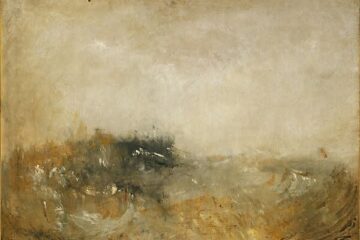
It is a terrible, hard rain – one that lasts forty days and forty nights – that sweeps across Parshat Noach. The text describes this as divine retribution for humanity’s lawlessness, corruption and violence. A flood will wipe out all living existence, except for Noah, his family and pairs of every animal.
The Hebrew word used for “flood,” mabool, causes the medieval commentator Rashi to pause in his reading of the Torah. It is an unusual word, he recognizes. It is hard to determine its verbal root. All Hebrew nouns are built off of verbs. But the precise parentage of this one is indiscernible. He decides to grant it three: the verb to decay; the verb to confuse; and the verb to sweep along. Having achieved some measure of etymological resolution, Rashi reads on.
I, however, find myself infected by Rashi’s sense of mystery about mabool. What exactly is this flood? Is it a massive amount of precipitation? A metaphor for some kind of non-watery destruction? Some kind of uprooting? In his commentary, Rashi mentions approvingly the Aramaic translation of the Torah, which uses the Aramaic word “to bubble up.” He poeticizes: it was a force that caused all things “to float away from their place of origin and to resurface in Babylonia.”
Babylonia. A place of Jewish exile. In this reading, mabool is a dynamic of separation from one’s origins, one’s place of purpose. A more radical question emerges. What or who caused such a flood, such an unmooring from one’s centering? One can read Torah as a story about an external force driving the narrative. It is also possible to read it as an artistic enterprise leading the reader to see himself or herself as the agency in their life. There are floods that I sometimes create. The result of releasing my more selfish tendencies. Yet, if I can injure, I can also repair. I can regain attachment to that which centers me in contentment, true fulfillment. In peace.
Torah’s paradigmatic journey is that from exile to promise. In that narrative, Mitzrayim (Egypt) is the archetype of exile: a place of enslavement, loss of sovereignty, narrowness. The goal, where one can experience and practice settlement, responsibility and fruition, is the “land of milk and honey.” The way to get there is through midbar, the wilderness. In order to reach the land of promise, one must first “make oneself like the wilderness,” instructs an early midrash. A Hasidic commentary advises, “If one wishes to merit the receiving of Torah, one must be naked and completely empty, like midbar.” Torah is here understood as a way of living without anxiety, one anchored in purpose, compassion and peace.
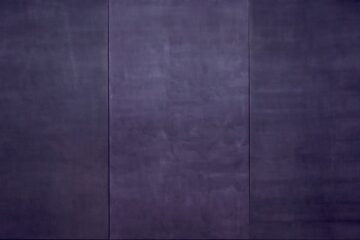
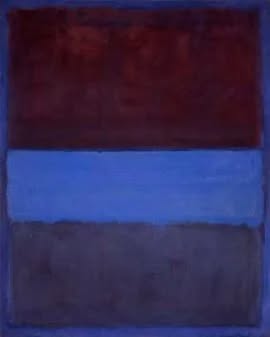
Mark Rothko, one of the greatest Abstract Expressionists, sought not to portray the known world. He invited viewers to explore the unknown world, that of one’s interior self. Follow that path deeply enough and one might experience the sublime. It is a journey that requires a deconstruction of all those defenses we have created in the hopes that they will aid us to successfully navigate a harsh, divided and confrontational world.
Much of Rothko’s work consists of great fields of color, blocks of vibrancy often frayed at the edges and seemingly floating. He informed viewers that his paintings were best viewed at a distance of 18 inches. To shed awareness of oneself as a objective viewer is to become an immersed part of the colors. No longer critic of what is before one but a participating artist in the creative work. Rothko makes no prescriptions about what you must discover. His only hope is that it will be your truth in that moment, and that it will set you free.
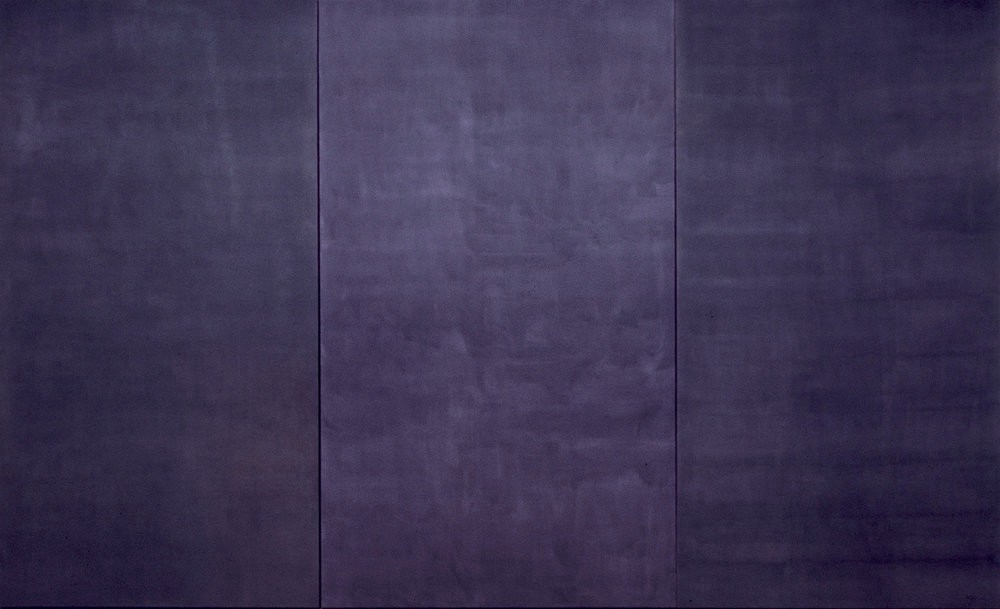
Late in his career, Rothko was invited by Jean and Dominique de Menil, devout Catholics inspired by the inclusive principles of Vatican II, to create a sanctuary where art would facilitate a spiritual experience of human cohesion, integrity and peace. For this project, Rothko created fourteen immense panels in the palette of plums, burgundies and black. Pictured here is one of them. The panels are an integrated part of the entire chapel experience: silent, contemplative…yet demanding. This is not a museum of artifacts or a gallery of merchandise. This is site of sensation, exploration and transformation.
Rothko’s son Christopher has written beautifully about his father’s work in general and about the chapel in particular in his book Mark Rothko from the Inside Out:
The chapel space makes you feel small, like a tiny dust particle in the endless carpet of the universe that in fact you are. Your task, as you face the infinite suggested by the fourteen murals, is to reassert – to find new credibility in – your uniqueness, your reason to exist, your greater-than-dust status.
The silence, the emptiness of both the physical space and the paintings are designed to denude one who enters of both pretensions and safeguards…of ego…so that something honest and whole-some can be born. To, in Christopher Rothko’s words, uncover that which is – in the true sense of the word – awesome. One that makes us face the profound, to live in the momentous and not shrink from the big questions so easily obscured by the noise and the static of our lives.
Hannah Arendt wrote about evil, having attended the trial of Adolf Eichmann. At the heart of evil, she concluded, was the everyday (“banal”) incapacity to escape from the narrow constraints of one’s own perspectives, fears and biases and to feel as another might. Torah describes evil as “crouching at your door; its urge is toward you. Yet you can be its master.” (Genesis 4:7). To not succumb to that ever-present allure requires expanding beyond self…to be one’s brother’s keeper.
Arendt also wrote about love. In Love and Saint Augustine she wrote: Fearlessness is what love seeks. Such fearlessness exists only in the complete calm that can no longer be shaken by events expected of the future….Hence the only valid tense is the present, the Now.
To live fearlessly is to live without being burdened by the past or anxious about the future. It is to live in the present. To live as a presence. To live with the presence of another. It is to remove expectancy and instead to live in gratitude and with offering.
In conjunction with the opening of the Rothko chapel in 1971, Morton Friedman composed a piece, Rothko Chapel, that gives aural presence to Rothko’s visual song. Like Rothko’s paintings, Friedman’s work is designed not to impose but to facilitate our finding our own song. The Torah itself is ultimately a song: “Moses vocalized all the words of this song” (Deuteronomy 32:44). This is Moses’ concluding triumph. He who was born heavy of tongue now sings rapturously. To participate not as a detached critic but as an intimate, as a participating artist with Torah is to find one’s own song there.
Torah provides guidance on how we can avoid creating our own floods: shed your ego; think of others. How can we live through floods created by others? How live through hard rain? At the end of his poem/vision, Dylan sings: I’ll tell it and think it and speak it and breathe it/And reflect it from the mountain so all souls can see it/Then I’ll stand on the ocean until I start sinkin’/But I’ll know my song well before I start singin’.
A healthy spiritual practice is designed to help us find our song, our sacred purpose. Hard rain may come, even perhaps a flood; but if we know our song and sing it well, we can transform our anxieties into triumphant love.
Join us here at 7:00 p.m. (PT) on Thursday October 23 as we explore living through hard rain.