
A healthy integration of past, present and future time perspectives promotes fulfillment of the divine promise of finding a place in the world, of fruition and peace.
View the study sheet here. Recording coming here.
Next week we begin the Yamim Nora’im, the Days of Awe. During that period we tumble through a complex of emotional encounters: wonder as we reflect on the mystery that is creation; apprehension that judgment is a haunting companion; regret for the too many ways we failed to live up to our best selves over the past year; exultation that rebirth and renewal is available to us.
As we make our way through those days, where in the spectrum of time orientation will most of our focus be? How much will we dwell on the past? Will we choose to think more about the demands of the present? Or will we spend most of our attention on the promise of a new life that lies ahead?
Philip Zimbardo was a psychologist and professor at Standford University. He is best known for the 1971 Stanford Prison Experiment, which examined situational influences on behavior. Zimbardo’s later studies explored how an individual’s temporal focus influences their decisions and emotional health. He concluded that people have different time perspectives that reflect their attitudes toward the past, present and future. People unconsciously use those time perspectives as filters to shape how they perceive, store and recall experiences. Doing so affects how they set goals and make choices.
An individual who was fired from a job ten years ago replays in the present his grievance in contexts unrelated either to the original actors or even to employment generally. A student facing an important final exam, chooses instead to enjoy the current moment by hanging out with friends. An intensely competitive business person spends 10 hours a day, including weekends, chasing after and managing projects; for him the future becomes an unending pursuit of more and bigger.
Based on his research, Zimbardo identified six different time perspectives which influence individual – and national – behavior. Of those, he suggested that a balance of three perspectives promoted an optimum psychological well-being: past-positive, which focuses on traditions and strong connections with family and friends and does not dwell on regrets and grievances; present-hedonistic, which seeks current pleasure, sensation and experience; and future, oriented to planning, goal achievement, and delayed gratification.
Following Zimbardo’s studies, Maciej Stolarski and Joanna Witowska, professors of psychology at Warsaw University, formulated the concept of metacognition, defined as the ability to consciously self-regulate one’s focus on the past, present or future: to draw on the past based on present experiences for a goal in the future…rather than being drawn back into the past or stuck in the present at the expense of the future or sacrificing the present for a future ever out of one’s grasp. This skill of consciously adapting and shifting between different time frames leads to a more fulfilled, meaningful and happier life.
Past, present and future time perspectives converge in this week’s Torah portion, Nitzavim (“you are taking a stand”). The opening verses declare: “You are taking a stand here today, all of you…with whoever is standing here with us today…and with whoever is not here with us today.” At the threshold between exile and settlement we are cohered in the present with our past and with our yet-to-be. And in that state of balanced perspectives we “enter into the covenant of God.”
Looking back though Genesis and Exodus, we see that this “covenant” is actually an evolving complex of relationships and responsibilities. God entered into a covenant with Noah, from whom God asked no response. With Abraham, God required a rite of initiation to affirm his affirmation. A third covenant is entered into at Mount Sinai. The covenant announced there is far more extensive and detailed than that executed with either Noah or Abraham. As part of the ritual of acceptance the Israelites at Sinai declared: “All that God has spoken we will do and we will hear.” By embracing the covenant, the Israelites recognize that they are engaging in a future-oriented process of ever higher levels of responsibility and moral accountability.
Yoram Raanan is an Israeli artist. On a windy night in 2016, a sudden fire destroyed his studio, along with over fifteen hundred of his paintings. He writes, “I saw my studio go down in the fire, I witnessed the destruction of forty years of work, but I also recognized something else that night. The burning leaves falling off the trees, which would ultimately ignite the tinder box that is a studio full of canvas, wood and paint, seemed to be little angels, floating down softly in the mountain air.”
He describes the two elements – fire and angels – as “destruction and celestial softness.” The end of things and the inspired birth of new creations. He found himself drawn to a new palette, one both darker and lighter: full of black ash and shimmering gold. Loss transformed into a new sense of urgency. “I feel like my new work is more authentic, that I am taking greater chances,” he writes. “I want it to be more meaningful now.”
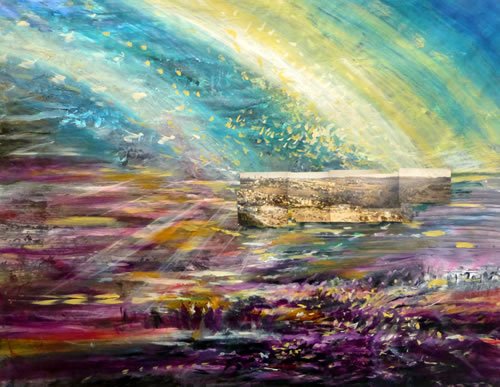
Pictured here is his work Har Habayit. It is inspired by Parshat Nitzavim. The bottom edge is dark, muddy. The upper half sparkles with the sun’s rays, arcing across the canvass like multiple rainbows promising life renewed. It is a scene the artist imagined the Israelites might have experienced as they gazed out from exile and into the land of promise.
Intruding into that Biblical setting are what look like large blocks of masonry bisecting the canvass. Closer examination reveals it to be a collage of photographs of the southern slope of the Temple Mount. A modern medium capturing an ancient yet currently activating site of Jewish meaning. It is the location of the Akedah, the binding of Isaac, and of the First and Second Temples. A memorial of what was. Har Habayit has also served for thousands of years to sustain Jewish imagination of spiritual renewal.
Raanan has written that Nitzavim represents a call to an experience “where past, present and future are meeting.”
At the threshold of a new beginning, that place called divine promise, we stand up cohered with our past, our present and our future perspectives. We respond to the call of ever-expanding responsibility. No longer seeking, we have been, in the words of this week’s haftarah from the prophet Isaiah, “sought out and find ourselves treasured.”
Join us here at 7:00 p.m. (PT) on Thursday September 18 as we explore where past, present and future meet.
Collage on acrylic Har Habayit by Yoram Raanan