
The deep that is beyond the universe itself and is the Source of all life and the deep that is the soul within each of us call unto each other for loving reunion.
View the study sheet here. Recording coming here.
Coal mining in the 19th century covered the communities – and those who produced it – in shrouds of darkness. The skies hung heavy with a toxic black smog. The faces of the men, women and children who worked the mines were covered in soot. Those who labored in the poorly ventilated shafts inhaled such quantities of coal dust that their autopsies disclosed lungs of a uniform color: black.
Borinage is a region in southern Belgium. Its name derives from the local dialect word “bores,” which means mineshaft. By the early 1800’s, the mines of Borinage produced the highest volumes of coal in Europe. But by the 1860’s fierce competition from mines in Britain, France and Germany destroyed that dominance. The people of Borinage descended into a depressive cycle of low wages, long hours and increasingly dangerous working conditions.
In 1878 a 25 year-old Dutchman arrived in Borinage to bring a measure of pastoral comfort and service to its mining communities: Vincent van Gogh. Van Gogh had spent the previous ten years working as a trainee art dealer, a school teacher and a book seller. Throughout this period, van Gogh had become increasingly drawn to the calling practiced by his grandfather, father and uncle – that of Protestant minister. He sought to bring to the suffering God’s words of love and compassion.
Unable to fulfill the requirements of formal study to become a minister, van Gogh accepted from the Belgian Evangelical Committee a commission to serve as a lay preacher. He threw himself into his ministry with a burning fervor. He gave away most of his physical possessions, including his own hut, to those he served . He slept on straw, bound wounds and shared his food and clothing. Families nicknamed him “the Christ of the coal mine.” He drew sketches of what he experienced, less as an artistic expression than as a bearing witness.
In April 1879 van Gogh entered the Marcasse mine in the village of Wasmes. The Marcasse was one of the oldest and most dangerous mines in the area. Death by suffocation, explosion or cave-in was a frequent occurrence. Van Gogh descended a half mile into that dark and deadly world. Guided by a miner who had worked there for over thirty years, van Gogh explored for six hours what he described to his brother Theo as “the most hidden corners of that underworld.”
Immediately afterward, Van Gogh described his experience, its horrors and its revelations, in a letter to his brother:
It’s a somber place, and at first everything around it has something dismal and deathly about it. The workers there are usually people, emaciated and pale owing to fever, who look exhausted and haggard, weather-beaten and prematurely old, the women generally sallow and withered. All around the mine are poor miners’ dwellings with a couple of dead trees, completely black from the smoke, and thorn-hedges, dung-heaps and rubbish dumps, and mountains of unusable coal….
Going down in a mine is an unpleasant business, 500-700 meters deep, so that down there looking upward, the daylight appears to be about as big as a star in the sky….The workers get used to it, but even so, they never shake off an unconquerable feeling of horror and dread that stays with them, not without reason or unjustifiably. Once down there, however, it isn’t so bad, and the effort is richly rewarded by what one sees.
What exactly was it that van Gogh saw that was so richly rewarding?
Three months after his journey down into the Marcasse mine, the Belgian Evangelical Committee terminated van Gogh’s position. It determined that his self-imposed extreme poverty, his giving away of his possessions, including his own bed, constituted an overly zealous approach which “undermined the dignity of the priesthood.”
Devastated at his failure to deliver God’s message of love and ennoblement, van Gogh felt adrift. That winter he walked some 45 miles over the course of a week through freezing rain to the French town Courrieres to see the painter Jules Breton, whose work he admired. Once there, he could not summon the courage to knock on Breton’s door. He turned around and walked back.
But the pilgrimage seems to have had the effect of turning van Gogh to a new way to serve as a messenger of God’s presence and purpose: “Even in that deep misery I felt my energy revive, and I said to myself, in spite of everything I shall rise again: I will take up my pencil, which I have forsaken in my great discouragement, and I will go on with my drawing.”
That marked the beginning of a frenzied period of creativity and extraordinary artistic innovation that would last ten years, until his death in 1890. Van Gogh’s work joined together compassionate observation of others, particularly workers and peasants, an adoration and sense of wonder in the presence of nature, and an intense exploration of his own inner self. He is second only to Rembrandt in the number of self-portraits produced by an artist.
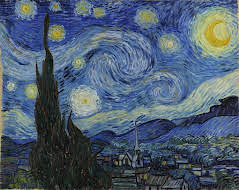
Life with others, intensive self-examination, the power of nature…and the permeating spirit of God. All of that is present in his work pictured here, The Starry Night. Van Gogh painted The Starry Night in 1889 while he was at the Saint-Paul-de-Mausole asylum in Saint-Rémy-de-Provence, France, where he had admitted himself for treatment of his mental health. He painted the view from his east-facing window just before sunrise. But the scene on the canvass is a coalescence of what he saw looking outward, inward and upward. Vistas in nature, in his soul and in the realm of transcendent spirituality.
In The Starry Night van Gogh has used short, thick strokes of paint creating a sense of movement and intensity. A swirling sky. Large circular stars. Flowing clouds. All give an impression of an ever-changing cosmos. Blue and yellow are the dominant colors, conveying both coolness and warmth, serenity and turmoil. The village in the distance is perhaps more evocative of what van Gogh remembered from the Netherlands than what he lived around in southern France. A longing for community, connection and stability. Winding its way upward is a tree, serving as a bridge between earth and heaven.
Is the movement on the canvass an expression of van Gogh’s inner turbulence? Yes. Or perhaps an awed-filled appreciation of God’s dynamic presence? Yes. Is the village a nostalgic artifact? Yes. Or perhaps a dream just out of reach? Yes. Is anguish present? Yes. Is hope? Yes.
When Van Gogh descended into the Marcasse mine, he looked up and all he could see of the sky was a single star. And that was wonderful and richly rewarding. And when he descended into the depths of his own soul, he saw pain…and exquisite joy. The coalescence of life as part of nature and as a soul and as a part of transcendent Being.
Parshat B’reishit tells a story of creation. But creation of what? One reading points to a description of the external world: sun; earth; waters; vegetation; animals. A single word opens up an additional possibility. God hovers over t’hom (deep). The same word is used in Psalm 42 where the poet describes the troubled, taunted soul aching for the living God: “My tears have been my food day and night…Therefore I think of you…where deep calls to deep (t’hom el t’hom).” The deep that is the Presence that is endlessly knowable and endlessly uncontainable and the deep that is the human that is endlessly self-exploring and expanding. As distant from each other as one end of the universe is from another and as close as a word’s breath.
Psalm 42 is attributed to the sons of Korath, leader of a rebellion against Moses. The earth opened up and swallowed the rebels. In the depths of their anguish and despair, the sons of Korath looked up from their abyss and felt a desire to return to holy community. Their psalm is described as one of enlightenment (maskil). Separation produces tears of longing which transforms into renewed hope, as the poet affirms in the concluding verse: “Have hope in God. I will yet praise the Everlasting, my ever-present help, my God.”
Parshat B’reishit shares with us multiple dimensions of creation. The world around us. The world inside of us. The world that is beyond. All the rest of Torah is one story after another describing how all three interpenetrate each other. Hear the call of nature and hear the call of your soul and you hear the call of the endlessly knowable and uncontainable Source of all. All of it together is present on the canvass that is The Starry Night and on the canvass that is Torah and in the canvass that is our lives where deep calls to deep.
Join us here at 7:00 p.m. (PT) on Thursday October 16 as we explore where deep calls to deep.