
Torah challenges our tendency to find a single meaning for any word, any event, any human being. The holiday of Shavuot is a most glorious example of that. We first encounter it in the book of Exodus, where it is described as Chag Ha-Katzir, the festival of harvest. In that identity it celebrates the reaping of the early summer wheat. Grain, a primary source of sustenance, is harvested by a community of people who have slept out in the fields together. Life is renewed. We are grateful.
Later, rabbinic tradition identifies Shavuot as also the moment at Mount Sinai when God appeared before the entire community and shared with them guidance on how to live a life of dignity, responsibility and meaning. In that tradition the holiday is known as Matan Torah, the giving of Torah. Wisdom, a primary source of sustenance, is harvested by a community of people who have gathered at the foot of a mountain in the wilderness. Life is imbued with sacred purpose. We are grateful.
Rabbinic tradition advises us to read a special book on Shavuot, the book of Ruth. It is the story of a community that is suffering from famine, from a lack of bread. Curiously, the name of that community is Bethlehem, House of Bread. That crisis induces a moral deterioration. Wealthier families hide their food, refusing to share it with others. Entering their community is an outsider, a member of an enemy tribe, the Moabites. This is Ruth. Out of love for her mother-in-law, Naomi, she attaches her own destiny to that of the people of Bethlehem. She sows compassion and grace wherever she walks. She marries Boaz. A child is born. The community embraces the stranger. Joy and hope are harvested. We are grateful.
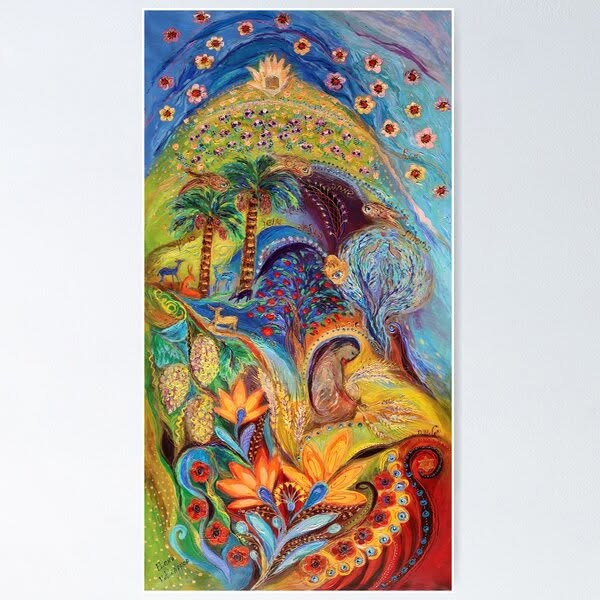
Pictured here is Shavuot by artist Elena Kotliarker. There are fields of flowers, tablets of wisdom, animals, fruitful plants, a woman gathering in stalks of grain. Nature, divine guidance and Ruth the Moabite’s grace are all present.
So much to harvest. So much to be grateful for.
Chag Sameach.
Rabbi Moskowitz
Shavuot by Elena Kotliarke