
A poetic life pierces the myth of inevitability and unlocks chambers of possibility.
View the study sheet here. Recording here.
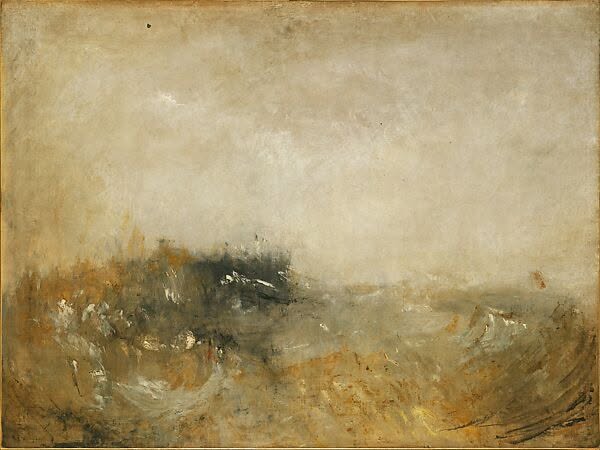
Rough Sea by J.M.W. Turner
J.M.W Turner was an art prodigy. Born in 1775 to a father who was a barber and wig maker and to a mother who came from a family of butchers, Turner showed artistic talent from an early age. As a young boy, he drew scenes of town and countryside, which his father exhibited in his barber shop and sold for a few shillings apiece.
At the age of 14, he entered the prestigious Royal Academy of Arts. Seven years later, at age 21, he achieved recognition and critical acclaim for his first oil painting, Fishermen at Sea. When he was 27, he was elected a full member Royal Academician, making him the youngest in the institution’s history.
Turner quickly developed a lucrative career painting works for aristocratic patrons. He painted scenes in a traditional, highly detailed topographical and historical representative manner. However, over time he shifted to capturing immediate sensory perceptions and the raw, turbulent forces of nature. Those relied less on detail and more on light, color and atmospherics of the setting.
While many of his established clientele were bewildered by this turn from detail to suggestion, art critic John Ruskin defended Turner’s bold new approach as descriptive of the sublime element in a scene.
During the last five years of his life, Turner produced a body of work in which objects virtually dissolved, merging fluidly into swirling skies and water. Instead of using colors which might ground objects in a recognizable reality, he chose ones which made light itself the primary subject. Many of his works from this final period describe a dynamic vortex at the center. The viewer is pulled into a disorienting spin.
Turner’s greatest champion, Ruskin, considered those later works a disintegration of his genius. He attributed their strange devolution of form into chaos to Turner’s declining physical and mental health. In his book Pre-Raphaelitism Ruskin wrote: “In 1845, his health gave way, and his mind and sight partially failed. The pictures he painted in the last five years of his life are of wholly inferior value.”
Pictured here is a painting from his final years, Rough Sea. It presents very little in the way of identifiable detail. The dark form at the center could be a seawall or a harbor. But what is most pronounced is a sense of the power of the sea and the merging of water and air at what might be a horizon line.
Tate Britain, where Rough Sea is now housed, officially catalogues the work as “unfinished.” The Tate bases this categorization on the grounds that Rough Sea “was found in his studio after his death, was never exhibited or titled by him, and lacks the fine, precise descriptive details he reserved for completed public works.”
It might be, however, that Rough Sea is consistent with all of Turner’s most highly acclaimed and valued works. That it is an expression of something he experienced and which he described in all the fullness and fulfillment available to him with canvass and brush and paint. Perhaps he saw something incapable of finite description, something without borders, without definition. Something perceived by a sense other than the eyes.
In Parshat Nitzavim-Vayeilech (“standing”-“he went”) Moses continues to sum up lessons that the Israelites need to carry with them from their forty-year-old journey as they prepare to cross over into the realm of sovereignty and responsibility. His final lesson takes the form of a poem/song. Why a poem?
Adrienne Rich in her book What is Found There: Notebooks on Poetry and Politics wrote: “Poetry can break open locked chambers of possibility, restore numbed zones to feeling, recharge desire.” Perhaps Moses chose poetic form for his final message because he understood its unique power to reach the heart and inspire renewed purpose.
Naphtali Zvi Yehudah Berlin (known as the Netziv) was a 19th century Lithuanian rabbi and scholar. In his commentary on the Torah, he wrote that all of Torah could be called a poem because “it has the nature and character of poetry, for it is speech in enigmatic language.” It enlists us in the project of meaning making. Perhaps Moses conveyed his lesson as a poem because he wanted to emulate Torah’s power to stimulate innovative, interpretive thinking.
Both Adrienne Rich and the Netziv compellingly advocate for the power of poetry to disrupt stagnant thought and nourish curiosity. I think there is also something deeply personal for Moses about his choice of literary form. Moses’ personal journey has been about learning how to speak. At the very beginning of his story, he had described himself as “heavy of tongue.” This was not a physical defect. It had to do with the type of language he used.
Moses grew up in Pharaoh’s palace as a prince of Egypt. His first language was that of power and its ostentatious display through the construction of towering statues of self-importance and enormous buildings dedicated to human immortality. This was not a language suited to lead a slave people to freedom and covenantal responsibility.
Once exiled from Egypt and reduced in status to that of shepherd, Moses began the process of unlearning the palace language of power and materialism. His education began in the desert, before a bush that was aflame yet was not consumed. Out of that intangible incendiary element a voice spoke, awakening Moses to himself.
The lesson reached a climax months later, right after the incident of the golden calf. Moses pleads with God, “Oh, let me behold Your Presence.” God responds, “You cannot see My face; to be human and live is to not see My face.”
Moses’ journey is to learn a way of communicating that does not depend on stable, finite form. That is the language of poetry. It destabilizes and restores vibration to settled meaning. It pierces prose and provides new possibilities for words we thought we knew with certainty and finality.
Wallace Stevens wrote, “the poet is the priest of the invisible.” The poet helps us to experience what we sense to be true, even if we cannot see it.
At Mount Sinai the divine voice proclaimed, “You shall be to Me a kingdom of priests and a holy nation.” We are commissioned as poets, as singers of songs about what exists beyond what we can see and touch, of possibilities that do not yet exist. It is the language of those on a journey of liberation.
A song that intones into reality possibilities that do not yet exist is what the prophet Isaiah sings in this week’s haftarah:
“God has sent me as a herald of joy to the humble. To bind up the wounded heart. To proclaim release to the captives, liberation to the imprisoned…to provide a cloak of praise instead of a dim spirit.”
Those who embrace that song, who heal from their despondency and despair, become those who “will rebuild ancient ruins, restore wastelands of old, who will renew ruined cities, generations of desolation.”
To be priests of the invisible is to paint and write and sing and live in a way which restores people from their wanderings, renews lands laid waste by violence and greed, and which empowers people to build a new world of freedom and responsibility.
If Turner’s painting is to be considered unfinished, it is because he was showing us that which has no end: the sublime, the inspiration to make this world one where the divine can dwell.
Join us here at 7:00 p.m. (PT) on Thursday,September 3 as we explore priest of the invisible.
Rough Sea by J.M.W. Turner