
View the study sheet here. Recording here.
The book of Numbers is about walking…38 years of walking. It opens with the Israelites packing up and arranging themselves into a line of march by their respective families and tribes. Everything seems very organized and well-ordered. The book of Numbers then proceeds to narrate the communal turbulence that deconstructs that organization and order.
By the end of the 38 years, all of those who started out will have died. Does that mean the physical death or the spiritual transformation of those who journeyed?
The book of Numbers ends with “These are the commandments and regulations that God enjoined upon the Israelites.” The book of Deuteronomy begins with “These are the words that Moses addressed to all Israel.” I find that transfer of speakership from God to Moses interesting.
One of the opening narratives of the book of Number is about the sotah, a woman who has been accused by her husband of having committed adultery. The focus of the text is on the husband’s jealousy, not the woman’s behavior. The wife has no agency and virtually no voice in the episode. She is led by the priest through a humiliating and gruesome ritual to establish her guilt or innocence.
One of the closing narratives of the book of Numbers is about five sisters who protest the unfairness of their not receiving the right to inherit their father’s land, in the absence of male heirs. They are vocal about the righteousness of their case, which receives divine approval.
These two stories frame the book of Numbers. Both concern matters of uncertainty and address issues of male dominance. The passivity of the sotah is replaced by the bold assertiveness of the five sisters.
What has happened on this journey across the wilderness?
Rainer Maria Rilke went on his own spiritual journey, about which he wrote a collection of poems, Book of Hours: Love Poems to God. From that collection here is “Go to the Limits of Your Longing”:
God speaks to each of us as he makes us,
then walks with us silently out of the night.
These are the words we dimly hear:
You, sent out beyond your recall,
go to the limits of your longing.
Embody me.
Flare up like flame
and make big shadows I can move in.
Let everything happen to you: beauty and terror.
Just keep going. No feeling is final.
Don’t let yourself lose me.
Nearby is the country they call life.
You will know it by its seriousness.
Give me your hand.
Elsewhere in Book of Hours, Rilke wrote: “I am the rest between two notes/which are somehow always in discord/because death’s note wants to climb over/but in the dark interval, reconciled/they stay there trembling/And the song goes on, beautiful.”
Rilke is “the rest between two notes” which are “in discord” but which in a “dark interval” are reconciled. Their reconciliation produces a “trembling” and a beautiful song. I remember the Israelites “trembling” at Mount Sinai. Was that also due to being a rest between two discordant notes that are reconciled in a “dark interval”?
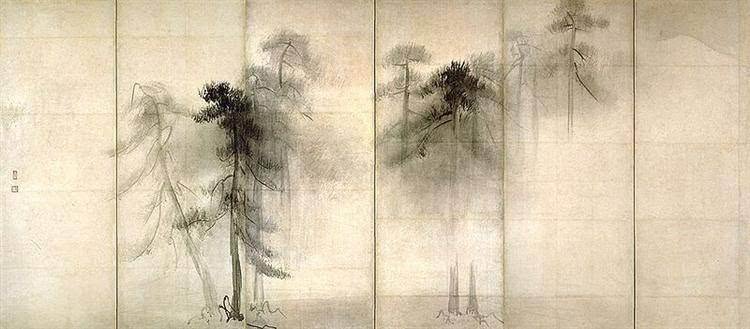
Hasegawa Tōhaku was a 16th century Japanese artist. He is considered a master of the Japanese aesthetic of Ma, which roughly translates as “negative space.” It focuses on the gap or pause which gives new shape and meaning to the whole.
Pictured here is Hasegawa Tōhaku’s painting Pine Trees. It is monumental in size, about 5 feet high by 11 ½ feet wide. It shows a grove of trees emerging from/receding into a mist. The piece relies on voids to convey meaning.
The word Ma is composed of two Japanese characters: that for “door” and that for “sun.” Combined they create the image of a structure inside of which is incandescence. In between the two is a gap, what gives meaning to the two characters.
In Hasegawa Tōhaku’s painting the pine trees form the landscape. The empty space is the landscape.
The books of Exodus, Leviticus and Numbers provide an array of laws, decrees and instructions. They provide a structure for the subject of Torah’s artistic attention: the open space that is the wilderness through which the Israelites will journey for 40 years.
The emptiness of the wilderness hints at the kabbalistic notion of tzimtzum: God’s withdrawal of Godself, leaving a vacated space from which the world and its manifold divisions may emerge. That, according to kabbalah, is the dynamic of creation. And the wilderness is a replication of that generative vacated space.
Early rabbinic midrash describes human beings as also containing vacated spaces, those interior landscapes of the unknown and unexplored. One such midrash, spinning on a verse from Jeremiah (“Can anyone hide himself in secret places?”), has God proclaim: “I created you, and I made you full of secret cavities.”
These clefts in the solidity of the human psyche are Rilke’s “dark intervals.” They are sites of uncertainty, destabilization…the yet-to-be reconciled. It is where doubt dwells and where new possibilities of the self incubate.
In the Hasidic tradition, that area where certainty collapses and doubt grows is where new life can emerge, one articulated in: the beauty of an integrated life, sacred meaning, and love. In spiritual terms, it is the site where one experiences heightened intimacy with the Source of all life.
The book of Numbers narrates this journey into the vacated space. We will bear witness to human complaint, fear, rebellion, and collapse. Its opening story is about male anxiety. It closes with one about female determination for justice in the cause of continuity out of faith in a divinely promised future.
How does the book of Numbers end? One reading is that all who started out on the journey have died by its conclusion. But rabbinic tradition, reading the Hebrew closely, proclaims that only the men died. The women emerged from the wilderness alive. The aspect of the people who most resisted the death culture of Egypt, who sang and danced an immediate celebration at the crossing of the sea, who refused to participate in the creation of the golden calf, who was a source of water throughout the wilderness…that aspect emerged by arrival at the promised land’s border.
Torah does not narrate the journey’s conclusion, only the arrival at the border. It is a journey that every generation and each one of us is called to embark upon. When we do so, it is wise not to mistake the solidity of the trees as the focus of the landscape and instead plunge into the uncertainty of the mist.
Join us here at 7:00 p.m. on Thursday May 28 as we explore secret cavities.
Pine Trees by Hasegawa Tōhaku