
View the study sheet here. Recording here.

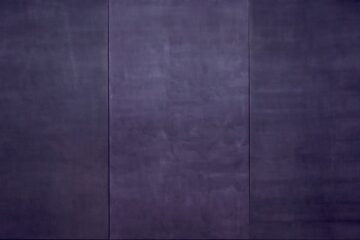
Untitled (Black Blue Painting), 1968 Mark Rothko
This week I am reading a compelling book. At about 25,000 words, it is only one-fifth as long as The Odyssey. Still, it is filled with a dimension of the heroic, a sense of the tragic, and a tale of a nation on the move. It is Deuteronomy, the fifth and final book in the Torah.
In the course of the national journey from Egypt to Cannan, the main protagonist, Moses, has been engaged in a heroic struggle to overcome impediments to his own self-realization and fulfillment. Burdened with a “heavy tongue,” with difficulty speaking, his personal journey has been to discover his capacity to articulate, to communicate.
Deuteronomy seems to represent Moses’ triumph over this impediment, as the entire book is one long speech by him.
This triumph, however, is offset by profound tragedy. At the end of the book Moses is denied the very reward to which he had led others: entry to the promised land. In the final chapters, we witness Moses gazing from the heights of Moab upon the rich and fertile land of Canaan below. It is on those heights, in sight of the divine promise, that Moses dies.
Torah’s language, however, ambiguates the nature of Moses’ speech pathology. And what that ambiguation hints at clarifies the truly tragic nature of Moses’ denied entry to the promised land.
At the start of his commission to free the Israelites, Moses blames his speaker’s block on the failure of the Israelites to listen to him. He can’t speak because they don’t know how to listen. That contrasts with how well Pharaoh listens to him. Pharoah is well attuned to Moses’ message. He understands clearly its subversive impact on his power.
Moses’ speech impediment may have less to do with his ability to speak than with whom he is speaking. Moses, a prince of Egypt, understands the palace. The multitude is what is strange to him. His relationship with the multitude throughout their journey together will be characterized by distance, suspicion and frustration.
Does Deuteronomy represent Moses’ transcendence of his alienation from the people, or is a thirty-three-chapter long speech a confirmation of it? Has he learned the creative, generative power of language or only mastered the palace’s power of dominating all other speech?
The reason that Moses is barred from entering the promised land was made clear in the book of Numbers. At the waters of Meribah, Moses had struck a rock instead of talking to it as God had instructed him in order to get water from it for the people: “Therefore you shall not lead this congregation into the land that I have given them.”
Later, when Moses describes in Deuteronomy why he will not be able to enter the promised land, however, he provides a very different reason: “Because of you God was incensed with me too and said, ‘you shall not enter either.’” The tragedy of Moses not being allowed to enter the land is not the denial itself. It is that his fate resulted from a tragic flaw in his character: his lingering suspicion and mistrust of the multitude.
This is a flaw that had emerged at the waters of Meribah. There, “the community was without water.” Instead of speaking to the rock, Moses yells at the people, “Listen, you rebels, shall we get water for you from this rock!” He then strikes it with his staff.
What was so critical about that moment at Meribah that Moses’ failure to follow instructions resulted in the harsh punishment that it did? God’s specific design had been for Moses to “speak to the rock before the eyes of the people; it will then give water.” This was to be a visual event. They were to see something, something life-giving.
The power of the visual opens this week’s Torah portion, Re’eh (“see”). It begins with the verse, “See I am giving you this day blessings and curses.” Why start the verse with “see”? Why not just with the words “I am giving you this day blessings and curses”?
Visual images have potencies that words do not. The human brain processes them faster and retains them longer. They provide an entirely different level of stimulation. Paintings offer the viewer the opportunity for greater control and engagement. Books propel us across a page, and in a unidirection: from front to back. Paintings insist on no direction. Our eyes roam. Paintings are not read. They are gazed upon.
Color, form, shape, line, tone, texture, spacing. These elements of a painting have no agreed-upon meaning. Writing uses symbols that have accepted meanings and utilizes grammatical rules in order to be coherent. Written text is linear. We encounter it in the order prepared and controlled by the author. The art of a painting is simultaneous. It is all present all at once in the moment.
Visual works of art are inherently more ambiguous than written ones. As a consequence, they create a very different relationship with the viewer. Abstract art in particular promotes the role of the viewer as an active participant in the making of meaning. Absent are identifiable figures and objects to orient and guide us.
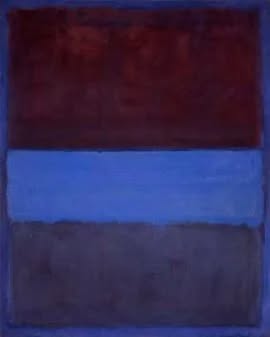
Pictured here is a painting by Mark Rothko. As with most of his work, it has no title. Rothko did not want to influence our experience of his art. This piece is dominated by inky bluish hues floating above a wavering brownish line. It is evocative of the painting Monk by the Sea by early nineteenth German Romantic artist Caspar David Friedrich. That piece presents a sky in ribbons of grey-blue, a slash of black for a troubled sea, at the bottom whisps of brown for a dune…and, slightly off center, a figure, a monk, facing the sea, reflecting on what is before him.
While both paintings share related colors and shapes and a sense of expanse, Rothko has removed the human figure. Now we are the one confronted with something that is infinite and vast. Rothko shifts us from wondering about what the monk may be experiencing to exploring our own response to the expanse. Anxiety? Awe? Desperation? Hope? Sadness? Grandeur?
Rothko wrote, “A picture lives by companionship, expanding and quickening in the eyes of the sensitive observer.” The author of a visual image surrenders a degree of control over meaning and invites the viewer to be a participant-creator.
About the purpose of a painting, Rothko said, “A picture must be miraculous.” Commenting on Rothko’s intention, Italian philosopher Dr. Federico Campagna wrote, “The miracle is the moment in which you’re capable of seeing inside an object, something that is in no way detectable. In that object, you see something beyond words, beyond language and beyond understanding.”
As the Israelites camp at the threshold of the promise, Torah urges them to “see.” To use their interpretive skills, their imaginations. To make their own choices, have their own responses to the vastness before them. To become participant-creators.
The Hebrew for “see” at the opening of Parshat Re’eh is in the imperative singular form: “you [second person singular] see!” But the pronoun “you” as it appears later in the sentence (“I am giving you this day blessings and curses”) is in the plural. Why this grammatical contradiction between verb and indirect object?
Torah encourages each individual to uniquely imagine, confident that such an unleashing of individual initiative and creativity will grow a stronger community. It is the miracle of seeing.
Join us here at 7:00 p.m. on Thursday, August 6 as we explore the miracle of seeing.
Untitled (Black and Blue Painting) by Mark Rothko