
The awareness of what we share with one another doesn’t lessen what we each have. It expands it.
View the study sheet here. Recording here.
Georg Tobias Ludwig Sachs was born in 1786 in St. Ruprecht, Carinthia, a small mountain village in the Holy Roman Empire. Today it is part of modern-day Austria. Between his birth and 1795 three more children were born into the Sachs family, a boy and two girls. In 1797 Georg’s youngest sibling was born, his sister Ellen. Georg and Ellen shared a condition not found in any other member of their family: albinism.
Albinism is a rare genetic condition which causes little to no melanin pigment to be present in the skin, hair and eyes. It produces very pale features, light-colored irises and photophobia (heightened light sensitivity).
Georg Sachs became a doctor, and in 1812 he wrote, in Latin, his medical dissertation. He titled it “A Natural History of Two Albinos, the Author and His Sister.” It would be his only published work. Two years later he died, reportedly of psychogenic fever, a stress-induced, psychosomatic condition.
Sachs’ dissertation is a scientific study of the condition and causes of albinism. However, what captured the attention of many in the scientific community was a brief detour discussion of another condition he and his sister shared: the perception of words, numbers and musical notes as colors.
He described with detailed specificity how each of those written or aural symbols produced distinct color stimulations. The letter A generated vermillion, while the letter F communicated dark gray. Musically, he reported that a first quarter tone “is seen quite clearly by the ash gray color.”
Most peer reviewers argued that the phenomena Sachs described resulted from an eye condition. Sachs insisted otherwise: the source of color generation was not the eye but the mind.
It would be another 80 years before a German researcher, Edmund Parish, gave a name to the condition Sachs had described: synesthesia, constructed from the Greek roots “syn” meaning union and “aesthesis” meaning sensation. It is a “union of the senses.”
To identify this cross-mingling of senses not as the failure of a particular sensory pathway or as a disorder of the eye but as an integration of one’s sensory capacity points positively to more expanded ways of perceiving our world.
Lawrence Marks, Professor of Epidemiology and Psychology at Yale School of Public Health, wrote in his book The Unity of the Senses: “To comprehend…that there are correspondences between dimensions of auditory and visual experience…is to discern, however dimly or remotely, that amidst the diversity of sensory perceptions, there is unity.”
Wassily Kandinsky, born in 1866 to musical parents, was playing both piano and cello by the age of five. He also took great pleasure in drawing. However, at the insistence of his parents, he studied law and eventually became a member of the Moscow Faculty of Law.
Two events in 1896 changed his life. He saw an exhibition of French Impressionists, and he heard a production of Wagner’s Lohengrin. Monet’s paintings in particular made him realize that the power of art did not rely on objects being recognizable. And while listening to Lohengrin he “saw all my colors in spirit before my eyes.” Kandinsky abandoned his law career and moved to Munich to become an artist.
Kandinsky’s experience at the production of Lohengrin was not the first time he had crossed his auditory and visual senses. “As a thirteen or fourteen year old boy,” he wrote, “I saved enough money to buy myself a paintbox containing oil paints. Sometimes I could hear the hiss of the colors as they mingled.”
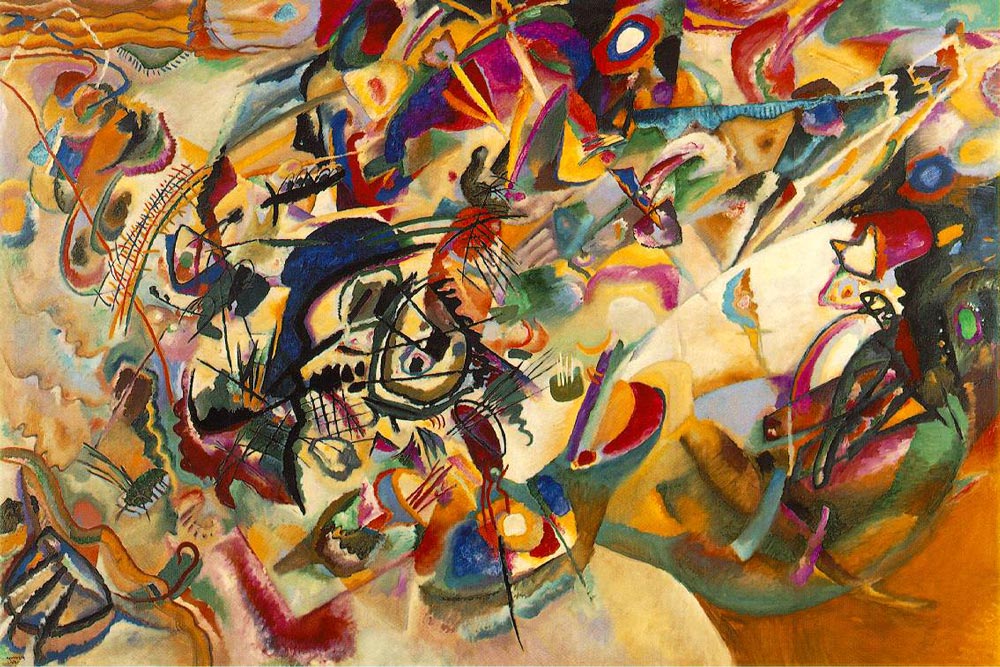
Pictured here is his work Composition VII, painted in 1913. The canvass is awash in color and movement. Inspired by the polyphonic music of Arnold Schoenberg, Kandinsky’s piece supports more than one motif. At the center is cosmic convulsion which reveals a cosmic harmony.
“Technically, every work of art comes into being,” he wrote, “in the same way as the cosmos – by means of catastrophes, which ultimately create out of the cacophony of the various instruments that symphony we call the music of the spheres.”
Kandinsky’s synesthetic condition and its reflection on canvas is a form of confusion that leads to an expanded perception of the phenomena we encounter every day.
Such a confounding cross-mingling of senses happens in Parshat Yitro (“Jethro”). The people are assembled at Mount Sinai. They “saw the sounds and the lightning and the sound of the shofar…They saw and they vibrated.”
This vibrational moment is one of attunement. Gifted instruments that they are, the people are being summoned to tune themselves up to their highest level. They are convoked into an ensemble to broadcast a score with a libretto sparkling with words of freedom, responsibility and love.
The synesthetic aspect of the Mount Sinai moment is central to the expansion of the people’s perception of themselves and their mission. Though they remain at the foot of the mountain, they are being lifted higher than ever before.
Rav Kook, the early 20th century kabbalist and chief rabbi in the land of Israel, wrote about Mount Sinai’s synesthetic dynamic: “At their source, sound and sight are united. Only in our limited, physical world, in this disjointed world, are these phenomena disconnected and detached. If we are bound to the present, if we can only perceive the universe through the viewpoint of the temporal and the material, then we will always be aware of the divide between sight and sound.
“The prophetic vision at Mount Sinai,” Rav Kook continued, “granted the people a unique perspective, as if they were standing near the source of Creation. From that vantage point, they were able to witness the underlying unity of the universe. They were able to see sounds and hear sights. God’s revelation at Sinai was registered by all their senses simultaneously, as a single, undivided perception.”
To make clear the purpose of this synesthetic experience at Mount Sinai, the early rabbis chose as the haftarah, the supplemental reading, for Parshat Yitro verses from the prophet Isaiah…including this: “I heard the voice of God saying, ‘Whom shall I send? Who will go for us?’ And I said, ‘Hineni/Here I am! Send me!”
The divine call is always. It is every day. Here I am! Send me! My soul vibrates with renewed purpose.
Join us here at 7:00 p.m. (PT) on Thursday February 5 as we explore to set the soul vibrating.
Composition VII by Wassily Kandinsky