
The path of patience, effort and challenges may seem longer than one based on shortcuts and easy choices. In the end, it is shorter in arriving at our goal: knowledge of self and our place in the world.
View the study sheet here. Recording here.
In 1958 Edward Albee wrote his first play, The Zoo Story. It is a one-act work, which he wrote in three weeks and which runs about an hour in length with no intermission. The cast consists of two strangers, Jerry and Peter, who have a chance, intense encounter on a park bench in New York City. Within the play’s one hour, self-satisfied conventionality and desperate alienation clash. Impoverishment and success fiercely circle each other on a gentle Sunday. A confrontation over occupation of the bench ends in a fatal stabbing.
The play was pivotal in reshaping American drama toward short, intense explorations of the alienation and misery underlying the apparency of material wealth, personal happiness and fulfillment in post-war America. Yet, the play’s route in achieving that level of influence and recognition was rather roundabout.
New York producers initially rejected the play. Albee sent it to a composer friend in Italy. That friend sent it along to a friend of his in Switzerland, who recorded it on tape, playing both characters, and shipped it off to someone he knew in a publishing house in Frankfurt. That individual convinced a producer in Berlin to stage it there, where it premiered in September, 1959.
Finally, in 1960, The Zoo Story came home, to New York City…the place of its birth and the setting for its drama. The Zoo Story opened at the Provincetown Playhouse, located at 133 MacDougal Street. Just .3 miles from where Albee had written it, in his Greenwich Village apartment at 238 W. Fourth Street.
At one point in the play, Jerry, the more alienated and desperate of the two characters, says: “Sometimes a person has to go a very long distance out of his way to come back a short distance correctly.” This is a statement about more than a geographical journey. Jerry, disheveled and disturbed, challenges tweedy, intellectual Peter about his conventional and easy life choices. One must, Jerry pushes, encounter extreme, even painful, experiences to fully understand oneself and rise above separation so as to honestly connect with others.
Abdullah Al Saadi is an Emirati artist. In 2024 he represented the United Arab Emirates at the 2024 Venice Biennale, with an exhibition titled Sites of Memory, Sites of Amnesia. That exhibit consisted of eight multi-disciplinary works that mixed together paintings, drawings, found objects, photographs, notebooks, and videos. All of that material journals his experience of traveling across the Arabian Peninsula. To trek across that geography honors the ancient culture of nomadism. But Al Saadi’s creative expression of that journey is no mere record. It is his insight into his own wonder of discovery of who he is in that primal dimension of sand and rock and water.
A decade before his exhibition at the Venice Biennale, Al Saadi left behind the comfort of his studio and went on a slow, meditative trek across the East Coast of the Emirate of Sharjah. Along the way he conversed with dogs, donkeys, goats, ibexes, stones, and grains of sand. He discovered a dimension of himself in surrender to that which is outside of his control – nature – but of which he is a part.
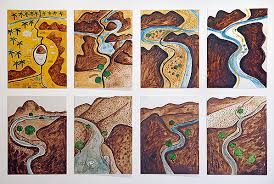
Returning as more than he had been before, he assembled his discoveries of his new self as both distinct from and integrated with the animals and plants and rocks and waves of sand into a collection of 151 mixed media pieces. He titled the work Camar Cande’s Journey. Camar Cande is the name of his donkey. It means “White Sugar.”
Pictured here are eight of the watercolors from Camar Cande’s Journey. The way is across desert, over mountains and across waterways. There is emptiness and abundance. Paths twist and turn. Each moment of departure brings Al Saadi closer to home. Only upon arriving does he discover that home is his new self. Afterwards, Al Saadi said, “Sometimes you have to go a long way to come back a short distance.”
The journey to the divine promise of sovereignty and responsibility takes a curious turn in Parshat Beshalach (“when he let go”). God leads the people not on a direct, shorter route to the land of Canaan. Instead, God causes them to turn by the way of the wilderness and through the Sea of Reeds. It is a much longer path. A quick arrival seems to be inconsistent with the mission of reaching sovereignty.
The Talmud shares a story of a rabbi who asks a young boy which path to take to get to the city. The boy replies: One path is short and long, and one path is long and short. The rabbi chooses the short and long path. He reaches the city quickly but is unable to enter it because it is surrounded by gardens and orchards. The rabbi returns and challenges the boy for having suggested the shorter route. “But didn’t I tell you that it was also longer?” the boy responds.
In the Hasidic tradition, the city is one’s own self. To become an inspired, connected to all life being one needs a path of deep self-exploration, discovery and transformation. It is a long journey. But where one has to go is short, very close. It is within oneself.
The most direct route out of Egypt for the Israelites was also the easiest way to return there. Without the challenges that promote maturation of spirit, ethics and heart, it would be all too easy to become the very oppression they sought to leave behind. The goal of the long, shorter way is not just to arrive at a place – an external goal. It is to arrive at oneself.
Join us here at 7:00 p.m. (PT) on Thursday January 29 as we explore the long, shorter way.
Camar Cande’s Journey by Abdullah Al Saadi