
To move from fear to awe is to free ourselves of an isolating focus on self, loss and inadequacy and to embrace the power of wonder, mystery and hope.
View the study sheet here. Recording here.
Dacher Keltner is a professor of psychology at the University of California, Berkely, and the founding director of the university’s Greater Good Science Center. Three years ago he published his book Awe: The New Science of Everyday Wonder and How It Can Transform Your Life. In it he explores the personal emotional and social moral benefits of experiencing “something vast that transcends our understanding of the world.” Feelings of awe, he writes, shift attention away from the self and toward what is around us – to being, in the words of Jane Goodall, “amazed at things outside the self.”
Dr. Keltner’s research suggests that awe has great personal health benefits, including calming down our nervous system and triggering release of oxytocin, a hormone that promotes positive feelings. He found that awe activates the vagal nerves, clusters of neurons in the spinal cord that regulate various bodily functions, slow our heart rate and relieve digestion and deepen breathing.
Awe also seems to affect that part of the cortex involved in negative self-talk, that critical voice in our head telling us that we are not smart, beautiful or rich enough. Judith Moskowitz (no relation), Chief of Intervention Science at Northwestern University of Feinberg School of Medicine, has studied how awe can help people cope with stress by redirecting a default focus on self.
These and other studies point out that our encounter with the unknown, with loss, with the end of the familiar can produce alternative responses: fear or awe. How can we choose awe rather than fear as a pathway out of such encounters?
Elena Degendardt was born amid the vast plains and harsh winters of West Siberia. She eventually moved to Western Europe. After receiving degrees in philology and linguistics, she had a successful international career in literary research, teaching and translating. In 2017 she became a full-time artist.
When she was a child, she had an accident causing her to almost drown. As a result, she writes, “my attitude towards the sea had been the one between awe and fear.” The year she became an artist she moved to the island of Malta. “On Malta, I found myself surrounded by the sea so enormous and omnipresent – there was no escape.”
To directly address her fears she began to paint the sea and its powerful waves. “Painting waves, that both mesmerized and horrified me, became my way of dealing with and overcoming the deep water anxiety.”
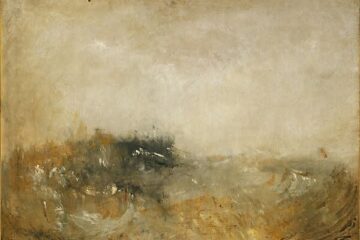
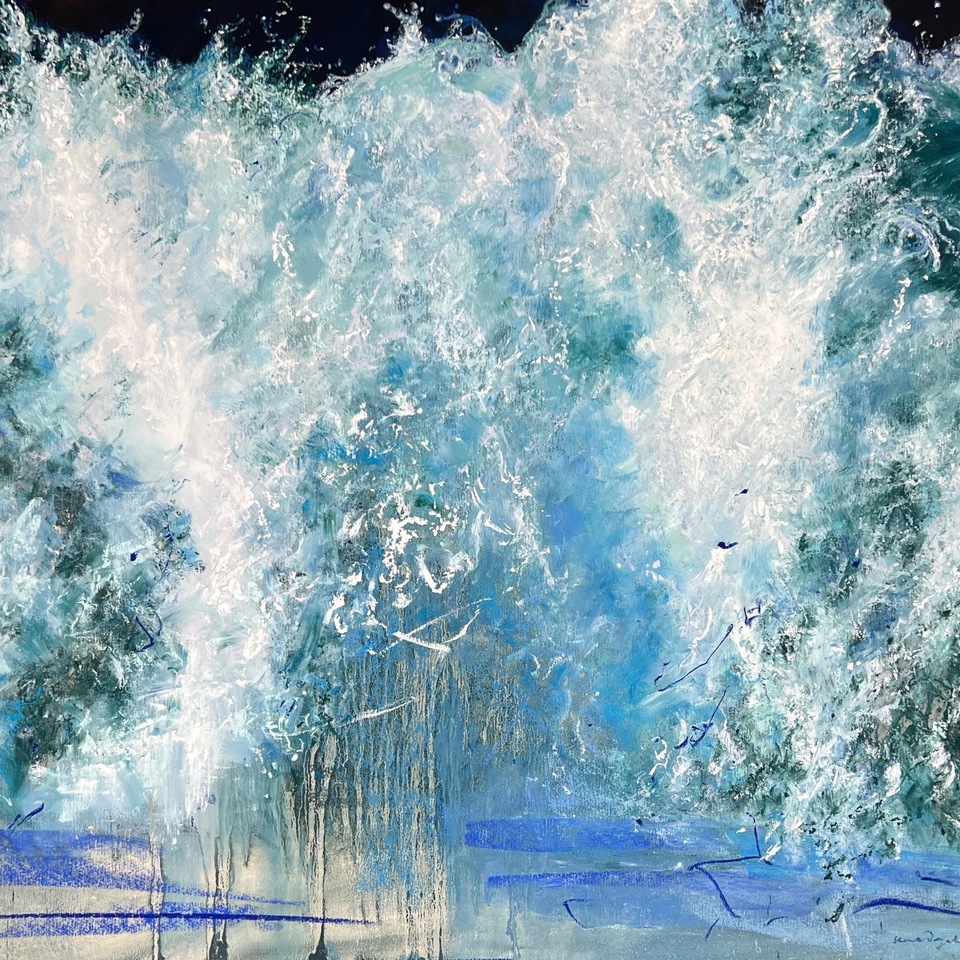
The creative result of that confrontation with her deepest anxiety was a series of paintings, one of which, Between Awe and Fear, is pictured here. Powerful, enormous waves crash across the breadth of the canvass. At the very top is a band of black, evoking the swallowing abyss that is the sea. The bottom third reveals patches of blue, reminding us of the pacific waters that entice us in for play and relaxation.
“Painting breaking waves,” she writes, “is also an attempt to hold that fleeting moment of time when the dark, almost menacing waters of the stormy sea reveal unbelievable colours and shapes.” Her painting navigates the death and the beauty that are both ever present.
Degendardt is now an all-weather swimmer. She immerses in that which terrified her, not just as an observer but as an engaged participant. “I must feel the sea, taste it, breathe it in, carry it within me to be able to work in the studio, no matter if I actually work on a sea-related project or not.”
Fear and awe occupy the same space in a sign that is a Hebrew word. The word yir’ah can be translated as either “fear” or “awe.” Fear is a defensive response, a retreat, that can only imagine loss, pain and the diminishment of one’s status. It heightens our sense of vulnerability and isolation.
Awe, by contrast, is “the sense of wonder and humility inspired by the sublime or felt in the presence of mystery” (Abraham Joshua Heschel). It expands our perspective, our sense of what is possible.
In Parshat Bo (“come”), Pharaoh, Moses and the Israelites are all challenged on how to respond to the tectonic shifts in the social order triggered by a Presence that insists on freedom and responsibility as fundamental building blocks.
Pharaoh responds in fear, aware only of what he will lose. His refusal to let go condemns him to become ever more closed off, hardened and, eventually, brittle.
Moses is divinely instructed to “come” to Pharaoh. The primary Jewish mystical text the Zohar notes that the use of “come” instead of “go” indicates that Moses is being called to an encounter that is located inside of rather than outside of him. He needs to confront his own fear of the totality of evil that Pharaoh represents. Moses once lived where Pharaoh lives, in the royal palace. Moses must journey into the dark recesses of that experience. The word “come” hints he will not travel alone. The divine will be with him.
The portion opens with God’s announcement that God placed otot (“signs”) in the midst of Egypt. The same Hebrew word produces in another formulation the word “letters.” Letters, words are primary sources of life, as we learned from the story of Creation. The Hasidic sage Sefat Emet advises that the task of the Israelites is to search out those letters, placed in Egypt as “hidden treasures” with their creative potential, and redeem them. To draw them out of the darkness and enable them to create new life.
The mission of doing so will teach the Israelites that holiness dwells everywhere, waiting only for human excavation and elevation. It dwells even within those who have been subjected to the degradation of slavery.
There is even the hint in the text that this redemptive search will benefit not only Israelites but also Egyptians. Torah first identifies Egyptians as “neighbors” and then “friends” of Israelites. By the time the Israelites are ready to depart, Egyptians view them through a lens of “grace.”
Pharaoh’s self-hardening will end his appearance in Torah’s story by next week’s reading. Moses’ evolution toward identity, purpose and fulfillment will find resolution in Deuteronomy.
The mission of the Israelites to redeem from a dark, brutal and fear-driven culture hidden treasures of holiness continues past the last pages of the Jewish Bible and into the lives of succeeding generations. And now into ours, as we too are challenged to move from fear to awe. A transformation that holds out hope not only for ourselves but also for the entire society where we dwell.
Join us here at 7:00 p.m. (PT) on Thursday January 22 as we explore from fear to awe.
Between Awe and Fear by Elena Degendardt