
Parshat Shemot (“names”) begins straightforwardly enough. It lists the names of Jacob’s sons who traveled down to Egypt with him. Within eight verses something has gone wrong. Pharaoh does not know Joseph, the one who saved Egypt from destruction. Israelite reunion and elevation quickly devolve to namelessness, to enslavement…to death. What can provide a new revival for Israel?
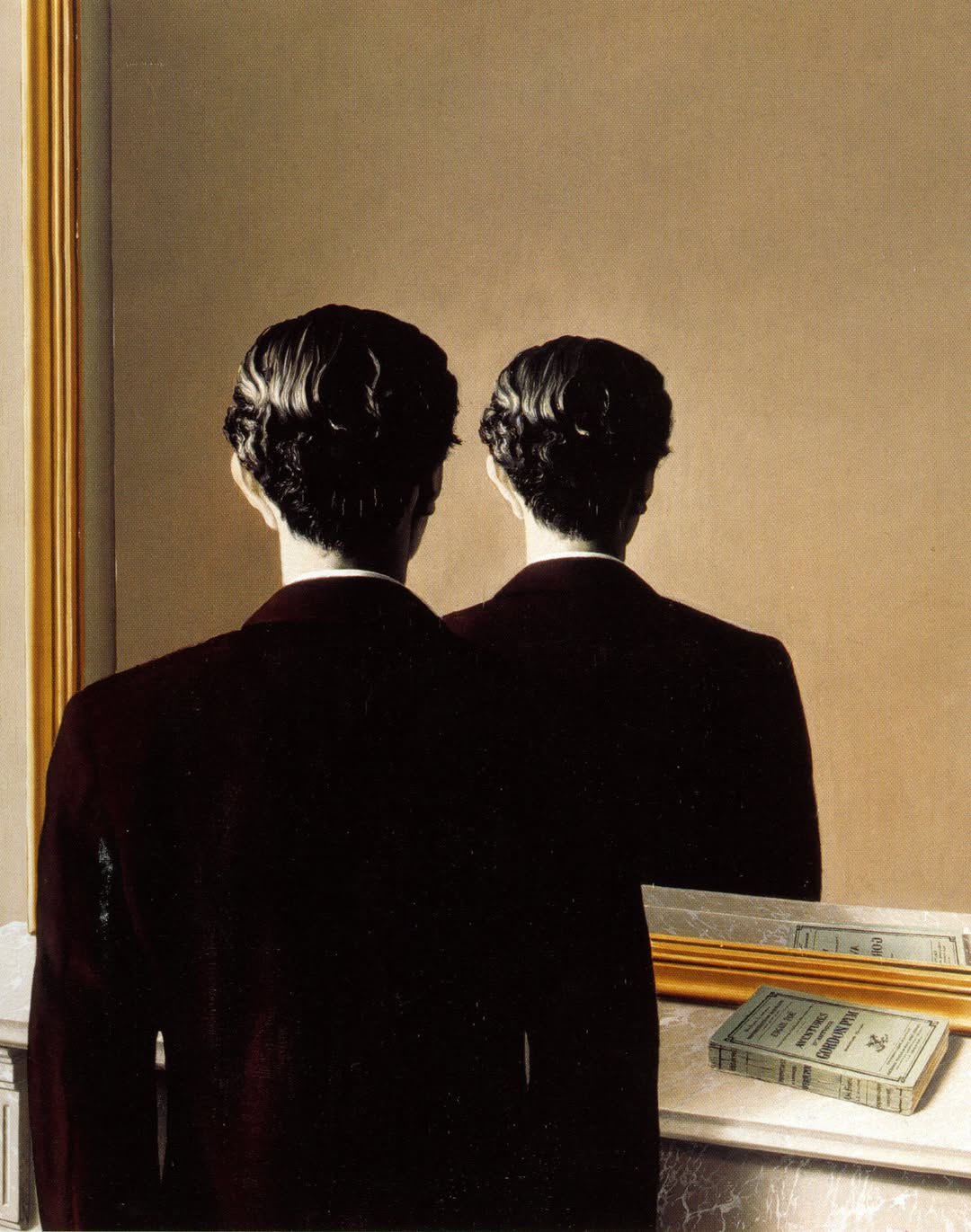
Pictured here is a painting by the Surrealist artist René Magritte, Not to be Reproduced. Identification of one’s self cannot be achieved through mere reproduction of what one expects to see. How to solve this mystery? Perhaps the book on the shelf will offer a clue.
The book is The Narrative of Arthur Gordon Pym, a novel by Edgar Allan Poe. It purports to be Pym’s eyewitness account of his journey to the South Pole. But Pym’s straightforward reporting veers into the strange. He reassures us that he is the real author of the book and not that “Mr. Poe,” who is only the editor of the work. Both Pym the narrator and Poe the editor admit to questions about the truth of Pym’s tale. The assembling of Pym’s precise steps has only led to a dissembling of the journey’s meaning.
In Parshat Shemot, the main protagonist, the one born without a name, is released as an infant upon a river’s current, elevated to Pharaoh’s palace, and exiled into the desert, where he encounters the strangeness of a bush burning without being consumed.
Stunned by the mystery of it all, he learns that he is a descendant of Abraham, Isaac and Jacob. That the One Who Speaks out of the mystery will be with him. And when he asks what is the One’s name, he receives the answer: Ehyeh Asher Ehyeh (“I was I am and I am becoming”). The verb “to be” is both the source of profound mystery and its meaning. So simple, yet so complex.
Moses will be reminded of all this when, agonizing over his ability to lead others into the divine promise of a place in the world, he begs to see the One’s face. Instead, he hears the answer, “Not My face, but My back you may see.” Revival is not a subject of reproduction. It is a matter of the mystery of being.
In gratitude for being with family and for being with all of you,
Rabbi Steven Moskowitz
Not to be Reproduced by René Magritte