
It is not those who profess perfection who create a better world. It is those who bear witness to their own imperfections who are the builders of civilization.
View the study sheet here. Recording here.
Something there was that did not love that wall. That wanted it down. East Germany had constructed it, a 96-mile-long barrier across Berlin, in 1961 to prevent its citizens from fleeing political oppression and economic deprivation for the freedom and opportunities of the West. From the day that the Berlin Wall was built voices sought to shatter it.
On June 26, 1963, President John F. Kennedy stood right in front of the Berlin Wall and proclaimed; “Freedom has many difficulties and democracy is not perfect, but we have never had to put up a wall to keep our people in, to prevent them from leaving us.” He denounced the wall as “an offense not only against history but an offense against humanity, separating families…and dividing a people who wish to be joined together.” Kennedy concluded, “Freedom is indivisible, and when one man is enslaved, all are not free.”
Twenty-four years later, President Ronald Reagan stood on a platform just across from the Brandenburg Gate, located immediately behind him in East Germany. In the middle of his speech, Reagan challenged Mikhail Gorbachev, head of the Soviet Union, “Come here to this gate! Mr. Gorbachev, open this gate! Mr. Gorbachev, tear down this wall!”
The Berlin Wall ended up being torn down, not by Gorbachev but by the German people. On November 9, 1989, shortly before midnight, crowds of people stormed the wall and chipped away at it with sledgehammers and chisels. Shouting “Tor auf! Open the gate!,” they began tearing down the concrete panels that had separated them from one another for twenty-eight years.
Inspired by the crowds determined to shatter the barriers to freedom, Leonard Cohen wrote the song “Democracy,” which he released as part of his 1992 album “The Future.” In it Cohen sings: “Democracy is coming to the USA/It’s coming through a crack in the wall.” Wait. Democracy “is coming to the USA”? Isn’t it already here? Didn’t he mean that it is coming to East Germany?
The song expresses an affectionate optimism for the future of the United States, despite some of the shadow layers of its history. In an interview about “Democracy,” Cohen explained: “It’s a song of deep intimacy and affirmation of the experiment in this country.” He understood that democracy is a dynamic, ever-unfinished project requiring a constant chipping away at the walls of division, injustice and constraint.
“Future” has another song about shards and cracks. But rather than by any historical event, that song, “Anthem,” was inspired by Kabbalah. In it he sings, “There is a crack, a crack in everything/That’s how the light gets in.” Cohen’s song shares the Kabbalistic myth that in the course of Creation divine light filled vessels which shattered, scattering sparks of light. Kabbalah views that shattering not as a flaw but as a necessary spreading of divine energy and beauty.
That myth and Cohen’s song are celebrations of imperfection, a precondition for human access to the divine. Opposition to the tyranny of perfection underlies much of Torah. The story of the Garden of Eden reveals that paradise is an inhospitable environment for humans. The protagonists in Torah’s tales are all flawed human beings. The promised land turns out not to be the perfect land. Homes can become infected with a scaly affection. The poor “will never cease from the land.” This imperfection is not a cause for despair. It is the source of the divine light and healing to be unleashed by those who rise to the occasion.
In “Anthem” Cohen sings, “Ring the bells that still can ring/Forget your perfect offering.” Rather than wait for an impossible perfection, we are called upon to use our flawed selves to bring a measure of healing into the world. We are “the bells that still can ring.” Reflecting on “Anthem,” Cohen said that all of us are shattered, imperfect human beings, full of fissures; “But that’s where the light gets in, and that’s where the resurrection is and that’s where the return, that’s where the repentance is. It is with the confrontation, with the brokenness of things.”
Shattered individuals, members of a fractured family, confront one another in Parshat Vayigash (“he drew near”). Joseph, so self-estranged that his brothers do not even recognize him, stands before them. They have been accused of theft and betrayal of the Grand Vizier of Egypt (the unrecognizable Joseph). The brothers tremble.
Stepping forward to address the Grand Vizier is Judah. That responsibility should have been Reuben’s, the eldest. But Judah is the one who years before had been shattered and humbled by his mistreatment of his daughter-in-law Tamar. Through her judicious and discrete guidance, she had helped him to confront, acknowledge and turn from his dark impulses.
The Grand Vizier/Joseph feels the goodness that can emerge from one who has known and overcome selfishness and cruelty. Joseph’s walls of self-protection break. The estranged self that was Zaphenath-paneah, the name given to him by Pharaoh, is no more, He cries out, “I am Joseph!” It is a resurrection of sorts.
The brothers, stunned, weep. The living waters of tears pour forth, reviving souls that had been dead since that terrible moment of the pit and the brothers’ sale of Joseph into slavery. Hearts that had been scarred over with guilt and trauma are cracked open, revealing a latent generosity that generates new life.
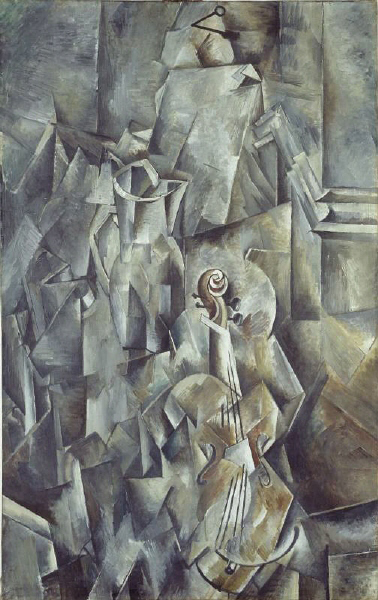
To shatter the superficial façade of a single plane of perspective is at the heart of the Cubist artistic enterprise. It was a rejection of the Renaissance pursuit of perfection, of the ideal form, which had dominated Western art for five hundred years. Instead of perfection, Cubist artists sought to uncover as full of an object’s presence as possible by breaking it apart. They fractured images into building blocks of their geometric forms. In doing so, they revealed the dynamic arrangements and multiple dimensions that constitute any object…or person.
Pictured here is George Braque’s Still Life with Violin and Pitcher. The body of the violin is viewed straight on with the strings facing us, but the neck torques to the side. The empty space around it is shattered into facets. Intervals no longer exist. Only by cracking that space open do we discover its inherency: a fullness rich with substance and volume. All along, what might have appeared to us as insignificant vacancy is revealed to be mass and energy.
When Leonard Cohen first wrote “Democracy,” he included several verses that were more politically pointed. He left those out of the final recorded version. Years later in an interview he noted, “I didn’t want to start a fight in the song. I wanted a revelation in the heart rather than a confrontation or a call-to-arms or a defense.”
Absolute certainty, a claim of perfection, does not promote “a revelation in the heart.” That is better achieved through doubt and an examination of what one is missing. That pursuit of absence is integral to American democracy. Our founders wrote in the Preamble to the Constitution, “In order to form a more perfect union…” Not a “perfect union” but one that was “more perfect.” They understood that the enterprise would remain forever unfinished. Our task is, in the words of Torah, to “pursue justice.” Sitting outside Independence Hall in Philadelphia is the iconic symbol of American freedom and democracy: a bell with a crack.
At the end of a meal it is Jewish custom to recite blessings for what sustains us. One of those is the borei nefashot blessing: Blessed be You, Adonai, our God, Source of all existence, who creates many living souls and their deficiencies, for all You created. What comes alive through their deficiencies is the soul of every life and all life. Blessed be the life of the worlds.
Why give thanks for humanity’s deficiencies? What does it mean that life emerges through deficiencies? The late 19th century rabbi Chofetz Chaim explained that everything with a soul is in need. To survive requires that we reach out to one another. Built into the very foundation of society is the need to help one another. To imagine ourselves as self-sufficient, as perfect, is to undermine that foundation. It is those who bear witness to their own imperfections who are the builders of civilization. So, “Ring the bells that still can ring /Forget your perfect offering/There is a crack, a crack in everything/That’s how the light gets in.”
Join us here at 7:00 p.m. (PT) on Thursday December 25 as we explore ring the bells.
Still Life with Violin and Pitcher by Georges Braque