
Memories are constructed framings of what we have experienced. Our brains can reframe those which hold us back from fulfilling ourselves. Shattering can be the beginning of hope.
View the study sheet here. Recording here.
After a series of train crashes in Great Britain in 1866, numerous individuals came forward to complain of a range of ailments which they said had resulted from those incidents. They made such claims despite not having any observable physical injuries. Among their symptoms were: loss of memory, poor concentration, sleep disturbances, anxiety, irritability, headaches, and hearing problems. They sued the railroads for damages. The railroads called them frauds.
What made the claims even more extraordinary was that some of them were made by individuals who had not even been in the accidents themselves. They had only observed them.
That year British surgeon John Eric Erichsen gave a series of lectures on the symptoms, which he published in his book On Railway and Other Injuries of the Nervous System. In it he legitimized the symptoms by stating that they indicated a peculiar progressive spinal disorder, similar to spinal concussion, which he called “railway spine.”
While Erichsen’s work gave legitimacy to ailments in the absence of any observable injury, it still identified the source of them as a physical trauma: spinal concussion. Practitioners in the newly developing field of psychology argued that the psyche itself could be the source of such an illness. The debate raged over the next several decades.
World War I introduced on a more massive scale an incapacitating condition absent any discernable physical injury. Soldiers presented instances of amnesia, tremors, paralysis, and mutism. The prevailing view at the time was that physical exposure to intense artillery and gas attacks caused them. The term used to describe such a condition was “shell shock.”
Shell shock as a diagnostic term was replaced during World War II by “Combat Stress Reaction.” It was more commonly known as “battle fatigue.” Some military leaders, most famously Lieutenant General George S. Patton, did not believe “battle fatigue” was real.
Research into symptoms presented by returning Vietnam War veterans finally resulted in the formal recognition of a medical condition that originated in how the brain processed witnessing or experiencing a traumatic event. In 1980 the American Psychological Association added Post-Traumatic Stress Disorder (PTSD) to the Diagnostic and Statistical Manual of Mental Disorders (DSM). Today, PTSD is linked not just to battlefield encounters. It can develop in survivors of sexual violence or domestic abuse; those who have been bullied; refugees fleeing chaos, famine; and those who have witnessed a mass shooting.
Ancient literature reveals that such a disorder has been a part of the human experience since the very beginning of human history. Its effects can be crippling, both for the one suffering from it and for that person’s family. We see an example of it in this week’s Torah portion, Miketz (“after”). It is a story about Joseph, now second in command of all Egypt, and his confrontation with his brothers, who had sold him into slavery.
Embedded in the Hebrew are insights about the layers of psychic dynamics at work. The very name of the portion signifies the trauma that has occurred. The word miketz is based on the verb “to cut off.” At a simple level it is used in the Bible to mean “at the end of a period of time.” But its root hints at something violent, “to cut in pieces.” Joseph was violently torn from his family by his brothers. His cloak was shredded and dipped in the blood of a slaughtered animal and presented to his father Jacob as evidence that a wild animal had killed him. Jacob wails, “My son has been torn to pieces!”
In our portion, the brothers go to Egypt in search of food during a famine in their homeland. They seek assistance from the one in charge of food distribution, Joseph, whom they do not recognize because of how transformed in appearance he is. But Joseph recognizes them.
A surface reading of that encounter can make it seem that Joseph is in full control of all his faculties and coldly maps out a plan of retribution. But a closer look reveals the shattered state of Joseph’s memory and the intent behind his subsequent actions.
When he first sees his brothers, Joseph does not immediately call to mind their having tossed him into a pit to be sold into slavery. Instead, he “recalls dreams that he had dreamed about them.” What are those dreams? The medieval commentator Rashi suggests they are the dreams he had as a youth, when he imagined them bowing down to him. The dis-order of Joseph’s memory indicates less a clearheaded plotter than a wounded soul unconsciously working through a childhood trauma. He seems engaged less in a cold calculation of revenge and more in some kind of stuttering reclaiming of youth.
In that initial confrontation, the text says that Joseph spoke kashot to his brothers. Most translations render this as he spoke “harshly” to them. But that Hebrew word as an adjective also means “difficult,” “problematic,” as in “the difficult (kasheh) matters they would bring to Moses to decide” (Exodus 18:26). Students of Rashi’s commentaries often ask “mah kasheh l’Rashi ?” (“what is the difficulty in the text before him that causes Rashi to explore it?”) In that sense, we can read our text as: “Joseph was struck by and sought to explore the confoundment he sensed as he read his brothers.” Joseph is perplexed. His brothers have stirred a curiosity in him. And he needs to find the meaning of it all.
Joseph intentionally “makes himself strange” to his brothers. But they already did not recognize him. What is this additional “estrangement”? Rabbi Nachman, the Hasidic rabbi who focused much of his work on psychological healing (including that of his own perhaps bipolar disorder), wrote about the importance of deconstructing one’s memory of events (his term is a “primal forgetting”) in order to reconstruct one’s memory so that one can live more fully and freely in one’s present and into one’s future.
Modern neurobiology and trauma psychology now acknowledge the brain’s capacity for memory reconsolidation. It is the process by which the brain retrieves a memory, destabilizes it, reframes that memory and sends that new framing back into long term memory.
It is how we remember experiences that affects our psychological health. And our memories are not necessarily fixed. They can be changed long after their storage. Memory can be edited and rebuilt so that healing happens. Such active reshaping of our memory is, writes Rabbi Nachman, “the only basis for hope of recovery.”
Anne Stine is a mixed media artist. She was born and raised in Fairfax, Virginia, in the same farmhouse where her father was raised during the Great Depression. The fields and countryside around her have always provided her with the greatest source of inspiration…and companionship. She is rooted in history and memory. Yet, her exploration of nature has taught her that organic life moves, is unstable and contains layers, only some of which we may be consciously aware of at any given moment.
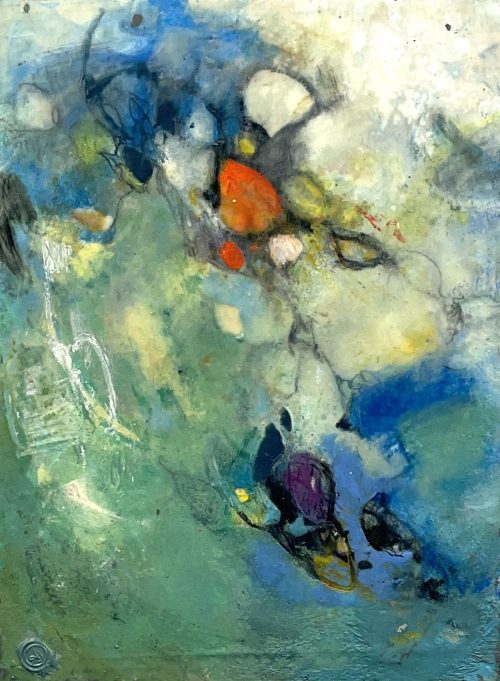
Presented here is her painting Between Then and Becoming. It is part of a series she did titled “Deep Memory: Mysteries Beneath the Surface.” All of the pieces in the series are abstract encaustic paintings. Encaustic is an ancient medium made from a blend of molten beeswax, damar resin and pigments. Applied while warm, each layer is fused with a blowtorch, creating textures and luminous surfaces.
She writes that all of the pieces in the series “speak to the layered, unstable, and ever-shifting nature of remembrance.” They treat memory “not as a fixed narrative, but as a living, fluid process, constantly reconstructed through acts of layering, erasing, obscuring, and revealing.”
Of Between Then and Becoming in particular, she writes that it is about “that in-between space where memory shifts and reshapes itself. I wanted the colors and forms to feel like moments caught mid-change—not quite past, not yet future. It’s a reflection on how memory isn’t fixed, but always moving, always becoming something new.”
It was not until 1980 that science formally recognized as a medical disorder an injury produced by how the brain processes and records trauma experienced or witnessed. It has only been in the past few decades that neurosciences have explored the capacity of the brain to integrate new information and adapt memories to current contexts (memory reconsolidation).
Parshat Miketz and the portion that follows allow us to bear witness to an individual awakened to deeply buried pain and his struggle to reconstruct his memory of it…for his well-being and for the healing of an entire family.
The early rabbis played with the reconstruction of memory too. The story of the Maccabees does not even appear in the Jewish Bible. It was non-remembered. Oil lasting for eight nights is not mentioned in either Book of Maccabees, both written shortly after the historical events. It shows up for the first time more than five hundred years later, in the Talmud. A new memory!
It is possible to recall the events celebrated by the holiday as shaped primarily by armed conflict, violence and the power of the sword. Instead, the rabbis have us read for the Shabbat during Chanukah verses from the prophet Zechariah: “Not by might, not by power, but by My Spirit.” They are words heard by someone awakening from a deep sleep. They become our new memory about the source of our resilience.
To rid ourselves of maladaptive memories – those which inhibit our ability to live healthy lives rich in companionship, love and fulfillment – may require a shattering of what we have relied upon in the past; but it offers a “hope of recovery” and the way forward into a more luminescent present.
Join us here at 7:00 p.m. (PT) on Thursday December 18 as we explore shattering and hope.
Between Then and Becoming by Anne Stine