
The blessing of uncertainty is the opportunity to discover what lies beyond the limits of who we currently are.
View the study sheet here. Recording here.
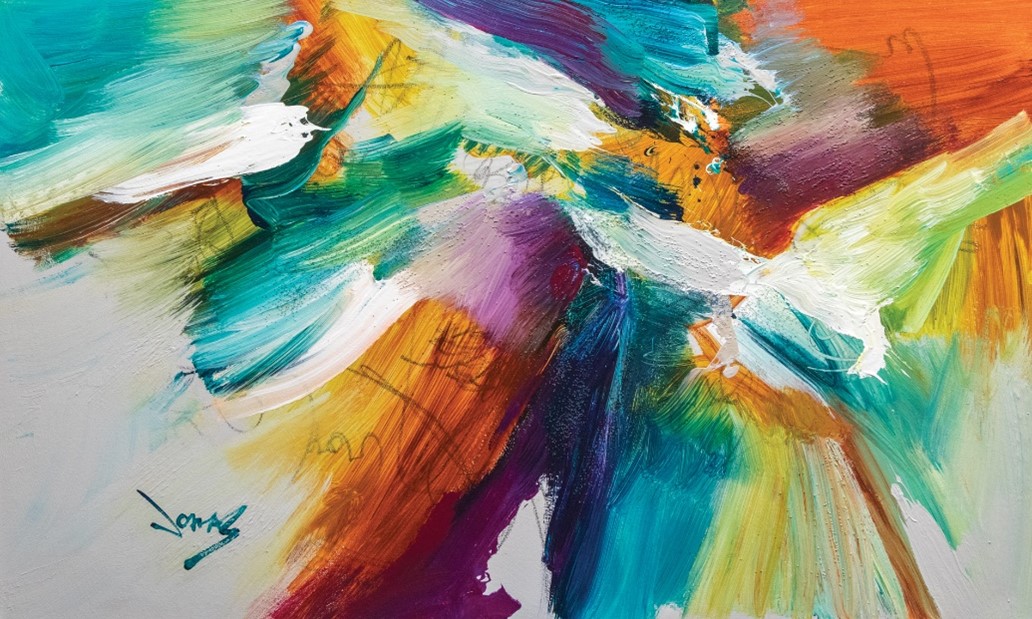
“I work from not knowing.” That is how artist Jonas Gerard described his creative process in a video he made during the Covid-19 pandemic. In that video, titled “The Art of Allowing,” he acknowledged the anxieties that people felt during that crisis: what will happen to me financially, to my career, to my social relationships? Surrounded by his vibrantly colorful paintings, Gerard said: “Not knowing is actually a good place to be. The beauty of uncertainty is that it is a place where everything is open. I approach life the way I approach a painting. I don’t know what I’m doing. We’ll discover it together.”
Gerard was born in Casablanca, Morocco to parents of French and Brazilian ancestry. Coursing through his work is music: the Moroccan tribal music of his childhood; the propulsive jazz of his Greenwich Village days; the French café music and Brazilian sambas of his ancestry; and the Afro-Cuban rhythms that pulsed outside his Miami studio.
Those primal and improvisational musical traditions supported Gerard in his visual work to unleash an experience rather than to control its outcome. Much of his work was done during live painting performances, where he painted in front of an audience while music played in the background, creating a dynamic, participatory and revelatory event: “I usually begin a new painting with random brush strokes of color, then work unpredictably and intuitively, responding to the rhythm of the music and the direction the painting suggests to me.”
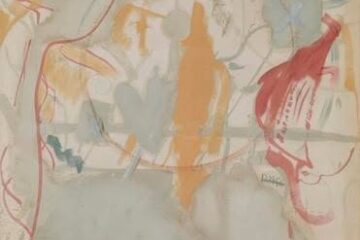
Pictured here is Gerard’s painting Embracing Uncertainty #5. There is a sense of flight, of spontaneity. Gerard wrote, “One of my teachers once said to me ‘your brushes are very smart, why don’t you let them do the work?’” Perhaps the paint brushes themselves created the piece in a flurry, and Gerard merely held onto them for dear life.
This sense of letting go, of listening to and birthing the painting that already exists within himself, is central to Gerard’s art. He wrote, “Uncertainty is a great blessing if you can flow with it. If you’re stuck on your determination…on your outcome…then uncertainty doesn’t have a chance and miracles can’t happen.”
The connection between uncertainty and miracles is profoundly present in the music of John Coltrane. His innovative “sheets of sounds” unleashed and re-formed chord progressions and scales in the search for spiritual depths. His 1965 album A Love Supreme is an ecstatically aching journey of a soul’s struggle beyond the limitations of self to an experience with the divine.
A Love Supreme’s fourth and final movement, titled “Psalm,” is a devotional text addressed to God. Coltrane actually composed a written text for Psalm and played a note for each syllable of his text. The concluding text/music prays out: God breathes through us so completely/so gently we hardly feel it… yet/it is our everything/Thank you God/ELATION–ELEGANCE–EXALTATION/All from God/Thank you God. Amen.
Patti Smith, who has bared her soul in her own music, acknowledged the path of spiritual/tuneful honesty that Coltrane paved for her: “As a performer, one has a mission, like Coltrane, to take your solo out to talk to God.”
Jonathan Bliss is a concert pianist who has struggled with classical music’s emphasis on perfection over improvisation. In a recent New York Times essay he refers to Patti Smith’s words about John Coltrane and notes, “Classical musicians are not trained to talk to God. We are trained not to make mistakes.”
That focus on not making mistakes, on emphasizing perfection, he observes, has become pervasive in our culture and constrains our capacity to solve profound problems: “Our society faces serious, complex problems that cause real suffering and that pose serious threats. Finding solutions to those problems will involve imagination and courage, qualities that flourish only when we embrace uncertainty and acknowledge all that we do not, and perhaps cannot, know.”
Parshat Vayishlach (“he sent”) takes us into moments of intense anxieties and distress in the life of Jacob: a confrontation with his brother Esau; the rape of his daughter Dinah; and the death during childbirth of his wife Rachel. Up to this point we have experienced Jacob as skilled strategist, negotiator and planner. The arts of someone ever seeking a life of control and dominance.
Now, however, as he awaits the arrival of his brother, whom he has not seen in the twenty years since he tricked their father in to giving him the ancestral blessings that normally should have gone to his older brother, Jacob shakes with worry. When he is informed that Esau is on his way with four hundred troops, Jacob describes himself as shattered into “two camps.” Surely, Esau is out for revenge. How can he survive this moment?
And then Jacob does something uncharacteristic. Jacob, who had schemed to get the family wealth, who had bargained with God for food and clothing, who had devised a way to secure the best of his uncle’s herd, separates himself from all his wealth. He causes “everything which was his” to cross over to the other side of the river. As a result, “all that remained was himself” as he awaited his brother’s arrival.
Vulnerable, shed of his protective layers, Jacob opens himself up to uncertainty. Some kind of wrestling with the divine takes place. He emerges wounded, but blessed with a new sense of self…of who he could be. His transformation will not be final. There will be more challenges ahead for Jacob. Isn’t that the way it is for all of us?
But Torah has taught us something about the crippling effects of trying to always have control over our life. The Hebrew used to describe Jacob’s initial feeling is that he is tzarar: cramped, bound up, restricted. A version of the same word appears later in Torah for the site of Israelite exile and slavery: Mitzrayim (Egypt). Egypt is a nation of great wealth, power and world domination. Yet, it is described as a narrow, restricted place. Its excessive pursuit of control and material wealth has crippled its capacity to evolve, adapt and survive.
In a discussion about blessings, the Talmud notes that “blessing is found neither in matter that is weighed nor in matter that is measured nor in matter that is counted; rather, it is found in matter concealed from the eye.”
The blessing of what cannot be seen, of uncertainty, is the opportunity to discover what lies beyond the limits of who we currently are. Like Jacob, we can let go of our layers of protection and become transformed. Like Jonas Gerard, we can forgo our preconceived outcome and create a new work of art. And like John Coltrane we can take our solo out to talk with God and experience elation, elegance, and exaltation.
Join us here at 7:00 p.m. (PT) on Thursday December 4 as we explore the blessing of uncertainty.
Embracing Uncertainty #5 by Jonas Gerard