
To be alive is to pierce the veil of separation and to behold the weave of the world.
View the study sheet here. Recording here.

“I am afraid of death, so I wander the wild.” So spoke Gilgamesh, the mighty king of Uruk, as recorded in the 4,000 year-old Epic of Gilgamesh. Driven to a state of terror of mortality after witnessing the death of his close friend Enkidu, Gilgamseh goes on a quest to find Utnapishtim, the survivor of the Great Flood, who had been granted immortality. From Utnapishtim, Gilgamesh learns that permanence is an illusion and that death is the natural course of human life. His journey teaches him to find meaning not in an afterlife but in his accomplishments while alive. He returns home and records his story, which he hopes will be eternally remembered.
The telling of one’s story became one of the prime human responses to the reality of death. It is a form of symbolic immortality, the imagination of living on through creative works of art, communal contributions, and devotion to family and friends. The work of our lives.
Human beings also developed an alternative approach to the inevitability of death: literal immortality. This is the belief in a non-physical existence where consciousness, and perhaps one’s physical self, would continue. Systems of literal immortality lie at the heart of many religions.
The growing secularization of life over the past several decades has undermined the power of literal immortality beliefs to serve as a curative to a fear of death. Increasingly, researchers have begun to report on the condition of death anxiety. Recent studies published by the National Institute of Health note a significant upswing in death anxiety during the COVID-19 pandemic.
Some of those studies have also reported a correlation between heightened levels of closeness that subjects experienced with members of their community, workplace or family and lower degrees of death anxiety. To feel integrated into the lives of others lowers one’s fear of death.
Hilma af Klint, born in 1862 in Solna Sweden, was an artist who crossed innumerable boundaries. She was a skilled botanical illustrator who produced detailed renderings of plant life and also created abstract paintings five years before the pioneer in that genre, Wassily Kandinsky, produced a single one. She experimented with drawing guided by the unconscious decades before the Surrealists embraced that approach.
She was drawn to the scientific developments of her time, including X-ray technology, electromagnetic waves and telegraphy while she simultaneously immersed herself in the world of the occult and conducted séance sessions. As a member of the Theosophy Society, she viewed the body and the soul not as contending demands but as complementary paths to the same spiritual truth.
In 1919-1920 af Klint produced a series of works titled Native Studies. The watercolors in that series are intricate renderings of plants, insects and birds. On each sheet she added often obscure and occult notes on the human characteristics of each of these. For af Klint there is a connective tissue “between the plant world and the world of the soul.”
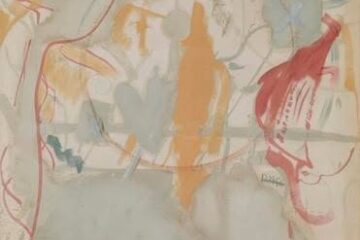
Two years later af Klint produced a series of watercolors titled On the Viewing of Flowers and Trees. Unlike the meticulously realistic images in Native Studies, those in the new series were non-representational, abstract. Pictured here from that series is Birch, a blurry wet-on-wet watercolor presenting a bright red orb. At its the center is another point of radiance.
The experience shared by af Klint in Birch is that of staring at an object for so long that it becomes unfocused and strange. In that blurred eyeing is a hidden truth, one that lies beyond the clear image familiar to us that we have taken for granted. The great search for truth takes us beyond polarities and dichotomies, beyond permanence and linearity. It takes us to the unity of all existence. To go on a journey to such unity requires us to abandon static selves and our attachment to lives unfolding in sensical narratives.
Parshat Chayei Sarah (“the life of Sarah”) challenges our insistence on sensical narrative. By the time we read the portion’s opening words, which give it its title, Sarah has already died. As if to mock our rigidity (“it should start, ‘Sarah died at the age of 127’!”), the first verse ends the way it began: “the life of Sarah.” What is the life compacted in the seven words in between the repeated phrase that bookends the verse? Why is her death conflated with her life?
The portion proceeds to recount Abraham’s purchase of a cave as a burial site for Sarah, his sending of his servant to find a wife for Isaac, his servant’s encounter with Rebecca and meeting with her family, the marriage of Rebecca and Isaac, Abraham’s remarriage, his fathering of more children, and Abraham’s death. What does any of this have to do with Sarah’s life?
Words from other texts of Jewish wisdom hover over Parshat Chayei Sarah. Their voices urge us to read beyond the literal. First, are those from wise King Solomon and his late-in-life composition Ecclesiastes: “Those who live have something to look forward to…but the dead know nothing.” Well, that makes sense: life is over for the dead, while those who live can still hope.
But the Talmud explains: “The ‘living,’ those are the righteous, who even in their death are called living. The ‘dead who know nothing,’ those are the wicked, who even during their lives are called dead.” The “living” is an adjective for those who live righteously; it has nothing to do with physical life or death. To be “dead” is to live wickedly. In the words of the Hasidic Rabbi Ya’akov Leiner: “Death speaks of absence. The dead harbor no more hope of being alive. They feel hopeless and utterly despairing – in that subjective sense they are dead.”
All those voices expand the dimension of Parshat Chayei’s written text: Sarah lives still! What she devoted herself to bears ongoing fruition. The family journey to elevation and promise and blessing continues.
The portion ends with the death of Abraham. It describes him as “dying at a good ripe age, old and satisfied.” Satisfied? He was promised that he would become a great nation, the father of many nations and that he would inherit a great land. None of those promises have been fulfilled by the time of his death. The Hebrew word rendered as “satisfied” comes from the verb that produces the noun “abundance.” Of what does Abraham have abundance? In Solomon’s Ecclesiastes verse quoted above, the phrase “those who live” is best translated literally as “those who are joined to all.” Sarah and Abraham are “those who live.” They walked a path of connecting with all of life, attaching themselves to a Being that is the source of all existence.
America has such a sense of inter-being within its spiritual, moral heritage. Walt Whitman sang robustly about the harmony of the unique and the universal, of our sharing a destiny with one another: “I celebrate myself, and sing myself/And what I assume you shall assume/For every atom belonging to me as good belongs to you. (“Song of Myself”).
And from a jail cell in Birmingham, Alabama a 34 year-old minister sang out these words: “In a real sense all life is inter-related. All men are caught in an inescapable network of mutuality, tied in a single garment of destiny. Whatever affects one directly, affects all indirectly. I can never be what I ought to be until you are what you ought to be, and you can never be what you ought to be until I am what I ought to be…This is the inter-related structure of reality” (Martin Luther King Jr., April 16, 1963).
To live is to pierce the veil of separation and to behold the weave of the world. When we have such vision, death cannot put an end to us. We embrace with honor our “inescapable network of mutuality.” We sing “every atom belonging to me as good belongs to you.” And joyfully we tie together the strands of “a single garment of destiny.”
Join us here at 7:00 p.m. (PT) on Thursday November 13 as we explore a single garment of destiny.
Birch by Hilma af Klint