
To experience a sense of settlement in the world requires overcoming ways we perceive the past which hold us back from creating a healthy future. We need a memory that is forward looking.
View the study sheet here. Recording coming here.
Daniel Simons is an experimental psychologist and cognitive scientist. He is currently a professor at the Beckman Institute for Adanced Science and Technology at the University of Illinois. Christopher Chabris is a Professor of Psychology and Co-Director of the Neuroscience Program at Union College. In 2011 they published a study reporting that 63% of Americans believe that human memory works like a video camera, which accurately records “the events we see and hear so that we can review and inspect them later.”
Virtually all cognitive scientists reject this description of what memory is. They define memory not as a recording but as a constructive process. The brain, instead of objectively imprinting and replaying events, pieces together fragments of information. This process is influenced by beliefs, expectations and new experiences.
Alison Winter was a historian of science and medicine. She taught at the California Institute of Technology and later at the University of Chicago. In 2011 she published Memory: Fragments of a Modern History. In it she explores how the modern sciences of memory emerged coincident with the development of new technologies for recording, transmitting and recreating sounds and images: photography, the phonograph and the moving image.
All of those technologies were developed between 1850 and 1900. At the popular level and for some researchers, each of those technologies became models for the nature of memory. For other scientists, however, those technologies defined what memory was not: an accurate and permanent record. They began to explore the role of unconscious interpretation and filtering in the construction of knowledge and memory.
As those new information technologies were introduced, some artists responded to them by rejecting the aesthetic standard that reality needed to be portrayed on their canvasses in an objectively accurate representation. For them what was important to express was their experience of what they encountered, a perception which they acknowledged to be subjective and fleeting…and revelatory.
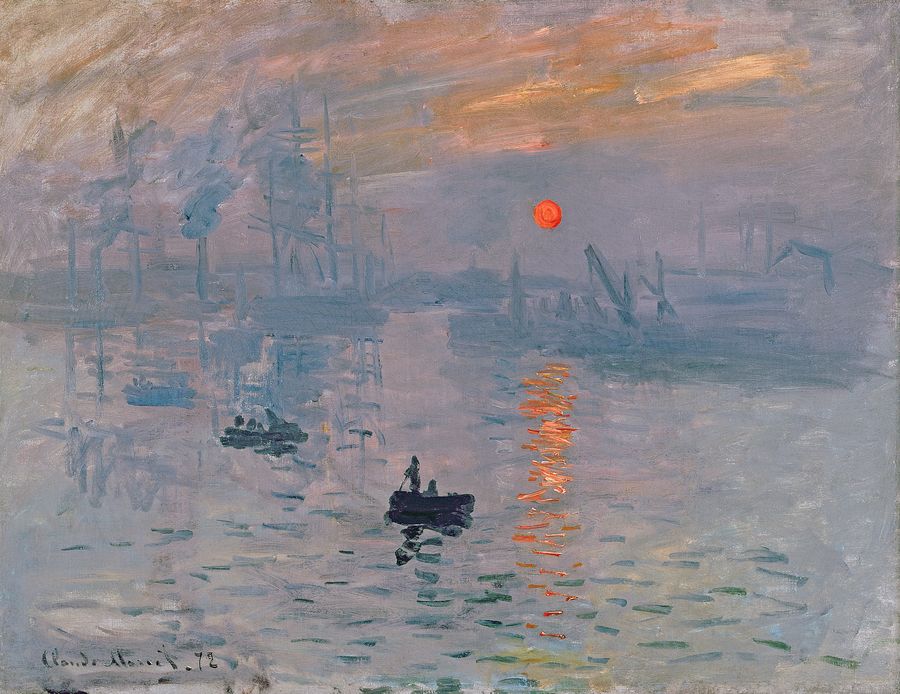
A group of these rebellious artists formed themselves into a cooperative named the Anonymous Society of Painters, Sculptors, Engravers, etc. In 1874 they held an exhibit of their work. Critics condemned the paintings for their unfinished appearance, lack of clear forms, unconventional use of color, and mundane subjects. The artists were called lunatics for portraying on canvass scenes painted in a way that bore no relationship to reality.
Particularly condemned was the painting pictured here, Impression, Sunrise by Claude Monet. Breaking from the highly finished, realistic style demanded by the official art establishment, Monet used quick, visible brushstrokes, which barely suggested the forms of boats, cranes and wharfs. Rather than presenting an homage to that which is eternal and permanent, it is an exploration of a fleeting moment in time. Impression, Sunrise is not a painting of a scene. It is a painting of a new way of seeing.
Critic Louis Leroy condemned its lack of detail and its unrefined brushwork. Referring to the title, he mocked the painting as a mere “impression.” Monet and his colleagues embraced the description with pride. Thus was born the Impressionists.
In Search of Lost Time is the extraordinary novel by Marcel Proust in which he explores the nature of memory. In it the fictional Impressionist artist Elstir presents a painting of his, which Proust may have based on Impression, Sunrise. The setting is a beautiful ocean view where the sea is indistinguishable from the sky. Forms dissolve. Elstir argues that he is presenting “what we actually see rather than what information tells us that we see.” For Proust, this subjective way of seeing informs the work of memory, what we recall of what we have seen…of what we have learned. “We do not receive wisdom,” Elstir remarks. “We must discover it for ourselves, after a journey through the wilderness which no one else can make for us.”
In Parshat Ki Teitzei (“when you go out”) the Israelites are about to go out from the wilderness and enter into the land of promise. The beginning chapters are packed full with laws the Israelites will need to observe. In fact, there are more laws in this portion than in any other in the Torah. With all of the other preparations necessary for crossing over, this last moment recitation of orders, instructions and protocols adds both weight to what they must carry and a stress to the forty-years of responsibilities they have already had to assimilate. So much to remember.
The last verse in Ki Teitzei is an instruction not about remembering, but about forgetting: “You shall blot out the memory of Amalek.” Amalek was a nation that had attacked the Israelites on their exit from Egypt. They were considered particularly cruel, having preyed on the weak and weary at the rear of the Israelite column. The portion’s concluding admonition brings into tension two values: remembering and forgetting.
Rebbe Nachman of Breslov, great-grandson of the founder of the Hasidism, drew upon Jewish wisdom as a source for spiritual, psychic and emotional healing. He viewed forgetting as a healthy aspect of having a good memory. He wrote, “Most people see forgetting as a problem, but I see it as a great benefit.” For Nachman, some experiences and our interpretations of them become burdens in our journey forward to wholeness and fulfillment. Letting go of those, forgetting them, promotes our wellbeing.
There is also a forgetting which is detrimental to our spiritual and emotional health: forgetting the purpose of our sacred journey. “You must be very careful to cultivate a good memory,” he wrote, “and not fall into forgetfulness. What is a good memory? It means keeping the world to come constantly in the forefront of your mind, never forgetting it.”
For Rebbe Nachman, the world to come does not mean life after death. It is a spiritual state in the present, one which we can attain by being aware of the intrinsic value of this world and everyone in it…including oneself. A good memory is not one capable of recalling every event in one’s life. It is an awareness of that which keeps us on the path to the fulfillment of the divine promise of wholeness, purpose and peace…shalom.
Nachman expressed his sense of good memory in poetic form: Teach me, dear God, to make a fresh start; to break yesterday’s patterns/to stop telling myself “I can’t,” when I can/ “I’m not,” when I am/”I’m stuck,” when I’m eminently free.
The journey from Egypt to promised land is known as Yetziat Mitzrayim, “the going out from Egypt.” The word yetziat is built from the same verb as the word in the name of our portion, Ki Teitzei. It is a word we encountered at the very beginning of the journey: “You shall tell your children, ‘It is because of what God did for me in my going out from Egypt (b’zeiti mimitzrayim).’” This is not just a national journey. It is also a personal one, “which no one else can make for us.”
To leave Egypt is to rise above all that inhibits the expression of our best self, our soul, whether imposed by an outside force or by the physical, psychological or spiritual limitations imposed by habit and nature. The fulfillment of that “going out” requires a good memory. One that we have the power to construct, through what we remember and what we forget.
Join here at 7:00 p.m. (PT) on Wednesday September 3 us as we explore after a journey through the wilderness.
Impression, Sunrise by Claude Monet