
Sacred restraint of our most aggressive impulses to possess and control does not diminish our personal sovereignty. It expands and ennobles it.
View the study sheet here. Recording coming here.
In the spring of 1984 Tom Brokaw traveled to Normandy to prepare a documentary for NBC on the fortieth anniversary of D-Day. He had looked forward to a week of stirring stories, fine food and French brandy. Instead, from the moment he stepped onto Omaha Beach with two veterans of the U.S. Army’s 1st Infantry Division, Geno Merli and Harry Garton, he had what he described as a life-altering experience. Merli and Garton and other veterans shared with him in matter-of-fact and soft-spoken measure the horrors they had witnessed and the job they had performed: to secure a beachhead to free the world from a monstrous evil.
Over the course of the next ten years, Brokaw embraced as a mission to tell the story of a generation of men and women, born between 1901 and 1927, who had lived through the First World War, endured the Great Depression and responded to a national call of sacrifice and duty. Brokaw identified that particular generation as motivated by honor, courage, responsibility, and service to community and nation. “It is, I believe,” he wrote in his 1998 book The Greatest Generation, “the greatest generation any society has ever produced.”
Half a century before Brokaw published his book, Time magazine had analyzed another generation, one that was the immediate successor to the Greatest Generation. On the cover of its November 5, 1951 edition was Winston Churchill. Two weeks before, Churchill’s Conservative Party had defeated incumbent Prime Minister Clement Attlee’s Labour Party, returning Churchill to the position of Prime Minister. He had served in that capacity from 1940 to 1945 and had been the face and spirit of British resilience and determination during Nazi Germany’s relentless assault.
That issue of Time included, in addition to coverage of the British election, articles about the Korean conflict, the movement of British troops into the Suez Canal Zone, and the explosive growth of the U.S. steel industry. On page 40 was an essay titled “The Younger Generation.”
Time observed that those born between 1928 and 1945 had grown up not as active participants in World War II but as passive recipients of its trauma. The post-WW II political and cultural environment was shaped less by the call to noble service than by the fear promoted by the McCarthy era. Time characterized the generation as conformist, cautious and reserved. “The most startling fact about the younger generation,” Time wrote, “is its silence.” It dubbed it the Silent Generation.
Edward Hopper was a mid-twentieth century artist known especially for his scenes of urban life, which convey a sense of human isolation, disconnection and alienation. His images are restrained, still. Silent.
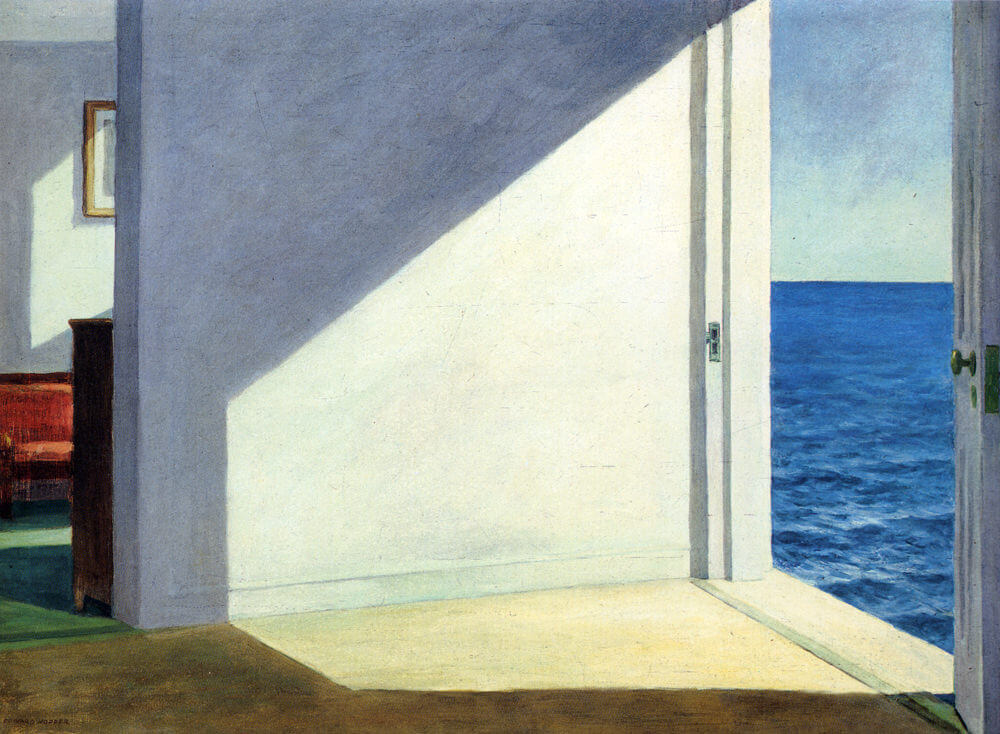
The same year that Time published its piece on the Silent Generation, Hopper painted the piece pictured here: Rooms by the Sea. The scene is based on an actual place, Hopper’s summer home and studio in South Truro, on Cape Cod Massachusetts. The settled reality of the location, however, is subverted by unsettling elements in the image. Where is the land? The door of the studio opens directly to the water. Unlike in many of his paintings, there is no wall beyond the door that closes in upon a human figure on the canvass…or on the gaze of the viewer. There is only the infinite expanse beyond. In contrast is the sliver of adjoining room on the left side of the canvass. It is furnished and appears small, insignificant compared to the large, open and more light-filled studio.
In his notebook, Hopper had titled the painting The Jumping Off Place. There is a liminal dimension to the scene. We are between two spaces: living room and studio. Or perhaps between those and a third: the endless, landless sea. Each represents a different environment and possibility.
Hopper was 69 years old when he painted Rooms by the Sea. Though silence pervades his paintings, he was far removed from the Silent Generation. The individuals who appear in his paintings show up. They are stoic figures ready to serve coffee, pump gas and do the mundane things that must be done to make one day become the next.
Instead of acceptance and resignation, it is possible to see in Hopper’s paintings duty, determination and a readiness to be part of a different scene. Perhaps there were figures in Rooms by the Sea who have jumped off from that place and broken the cycle of isolation and who, even now, are painting a different world for themselves.
Parshat Shoftim (“judges”) initially appears to focus on the design of an enormous administrative infrastructure for implementation in the promised land: the appointment of magistrates and tribal officials; judges to rule on cases; a king to rule the whole nation; and an army to secure Jewish sovereignty.
But on closer inspection we see how much the portion is about limitations on all of this. It is a portion full of restraints. The king may not own many horses, have many wives or amass an excessive amount of gold or silver. While honor killing was a common practice among the cultures in the region, Torah orders that cities of refuge be established as a way to restrain vengeful acts committed in the heat of the moment. Limits are placed on how armies may lay siege to a city. An unsolved murder that occurred between two cities must still be atoned for; the mere absence of established criminal liability does not relieve a community of moral responsibility for the victim. Sacred restraint does not diminish one’s sovereignty. It expands and ennobles it.
These lessons in restraint resurface in the prophetic reading the rabbis assigned to supplement and elucidate Parshat Shoftim. A prophet whose name is unknown to us but whose voice is preserved in the later chapters of the book of Isaiah arose during a moment of transition in Jewish history. He spoke in a way that enabled a nation in crisis to see a future that was very different from their chaotic present.
In the 6th century BCE, Babylon, which held the people of Israel captive in exile, was challenged by the ascendant Persian empire. Isaiah elevated the moment above the historical, above the geopolitical dimension. The prophet spoke to the exiled Israelites not in the language of chastisement or lecture but in that of love and humble service and mystery, declaring: “I have put My words in your mouth and covered you with the shadow of My hand, to plant heavens and establish earth.”
Neither the power of swords, nor unleashed revenge for decades of captivity, nor unrestrained violence would restore lost sovereignty. It is language, divine utterances, the most powerful force in the universe, that will rebuild a nation…and those who are part of it. The Zohar expands on Isaiah’s verse, explaining that it is not mere repetition but creative innovation of Torah’s words that creates new heavens which in turn transform into a new earth. Imagination kindles hope which produces a new reality.
The prophet mixes tears and joy, mystery and intimacy to produce a powerful elixir of comfort and renewal. Like their ancestors in Parshat Shoftim, the captives in Babylon stand at a liminal moment between wilderness and home. After decades of loss and exile, amid a clash of empires, the people taste words that “clear a way for understanding the future in spite of the present” (Abraham Joshua Heschel).
This “clearing of the way for understanding the future in spite of the present” reveals itself in the paintings of Edward Hopper. We encounter there in silent and restrained visual language our longing for human connection. And then we realize, Hopper’s restrained imagery serves not to provide answers about how the world is but provocations about how it could be. To respond to that call to paint anew makes a generation a great one.
Join us here at 7:00 p.m. (PT) on Thursday August 28 as we explore to understand the future in spite of the present.
Rooms by the Sea by Edward Hopper