
To see the one before us as a unique universe of hopes, imperfections and strengths is the beginning of sacred attachment, one based not on domination and possession but on a sense of wonder and mystery and gratitude.
View the study sheet here. Recording coming here.
Located in the Loire Valley is the city of Bourges. During the Middle Ages it flourished as both a cultural and political center. Briefly during the Hundred Years’ War it served as the capital of France under Charles VII. Joan of Arc visited Bourges in 1429 in the course of her mission to defend France from English occupation. By the nineteen century, Bourges had become a hub of economic industry and artistic creativity.
The term “bourgeois” is rooted in the Old French word “burgeis” (“town dweller”). In the Middle Ages it referred to those who inhabited fortified towns, in contrast to those who lived in the countryside. It evolved as a term identifying a distinct class that was intermediate between nobility and peasantry: merchants and tradespeople, those capable of developing wealth.
Berthe Morisot was born into a successful bourgeois family in Bourges in 1841. Her father was a senior administrator for the local government. Her mother was related to one of the most prolific eighteenth-century painters, Jean Honore Fragonard. In 1852 the family moved to Paris.
As the daughter of a bourgeois family, it was expected that Berthe, along with her two sisters, would receive an artistic education. The initial goal of such training was to enable them to make drawings for those within the household, first that of their parents and later ones they would each create with their future husbands.
Seeing their particular talents, their tutor, the painter Joseph Guichard, took Berthe and her sister Edma to the Louvre, where he would have them copy the great paintings on its walls. Guichard warned the girls’ parents that continuing their artistic education could be problematic: “Given your daughters’ natural gifts, it will not be petty drawing-room talents that my instruction will achieve; they will become painters. Are you fully aware of what that means? It will be revolutionary – I would almost say catastrophic – in your high bourgeoisie milieu.”
Despite the warning, Berthe became a painter. In 1864, when Morisot was only 23, the Paris Salon accepted two of her landscape paintings. As a young woman, this was an almost-unheard-of achievement. One critic responded by saying, “You see, ladies, one may be an artist and take part in public exhibitions of painting and remain, as before, a very respectable and very charming person.” She continued to show at the Salon for several years, where her work was well-received.
In 1868 Morisot met the leader of avant-garde painting in Paris, Édouard Manet. Through him she met a circle of artists who were rebelling against the establishment. They were the core group of those who would eventually become known as the Impressionists. She joined them in their independence movement and showed her work at seven of the eight Impressionist exhibitions held between 1874 and 1886. Morisot outsold many of her fellow Impressionists during these exhibitions, including Edgar Degas, Claude Monet and Alfred Sisley.
While her male Impressionist colleagues initially endured harsh criticism for their unnatural use of color and their quick, unfinished brush stroke style, Morisot received praise for the very same qualities. Critics viewed the Impressionist style as perfectly appropriate for women painters: one which, in their view, required less rigorous training in classical technique. The unfinished appearance of Impressionist works, while condemned when produced by male artists, was viewed positively when produced by Morisot. It was seen as reflective of female timidity and indecision.
Though she achieved a high level of financial and critical success with her paintings, Morisot chafed at the constraints imposed upon her as a female artist. Unlike Monet and Pissarro and other male Impressionists, Morisot could not tour the countryside and paint outdoors without a chaperone. There were settings totally barred to her: cabarets, cafes, bars, and brothels.
Faced with these constraints, Morisot focused on the realm most permitted to her: the domestic. Her paintings of life in nurseries and living rooms, of mothers and daughters stun with their inventiveness, their intimacy and their caring.
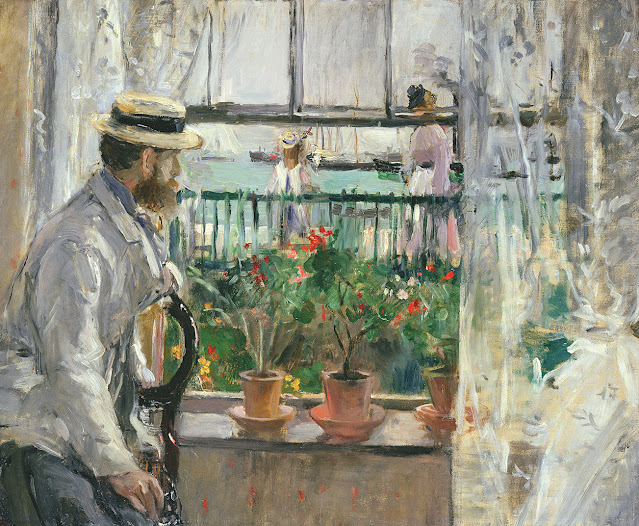
Pictured here is her painting In England (Eugène Manet on the Isle of Wight). It is a work of seeing.
In the foreground is her husband, Eugène Manet, Édouard’s brother. He is gazing out of their hotel window. In his right hand is a pair of binoculars. Through them he had been looking at something, perhaps the boats in the distance. Now he is looking at something else. Perhaps the woman just beyond the garden fence. The woman’s face is blocked by the window frame. We cannot tell where her gaze is directed. Maybe at the child leaning back against the fence. That young girl seems oblivious of the woman, who is perhaps her governess. Carefree, she scans the distant, endless horizon. In her innocence, that boundaryless expanse is hers, bordered only by her imagination.
Where is the color? Not in the sky. Not in the water. Not in the boats. Not in the clothing of woman and child. It is all compressed in the foreground. In the garden flowers and in the plants on the window sill. Morisot has painted the flowers of the potted plants so as to make it hard to tell which are in the garden and which are in the room. Garden and room share the color. The close, the interior realm and its private extension, share the image of vibrancy.
But this is more than a painting about a man, a woman and a young girl seeing. It is a painting of a woman’s perception of a man, a woman and a young girl seeing. It is a painting that reveals Berthe Morisot. There is a man who holds an instrument for seeing beyond. A young girl marveling at an endless horizon. An adult woman whose gaze has been cut off. There are lines of barriers: shelf, window frame, fence, and boats. And there is color! I see not only the creator’s hand in her work. I see the creator…her compartmentalized world and her irrepressible radiance.
This week’s Torah portion is titled Re’eh. It means “see!” My Jewish Publication Society edition translates the portion’s opening verse as: “See, this day I (anochi) set before you blessing and curse.” But since Torah has no punctuation, I can also see the verse beginning as “See anochi…” Anochi is the first personal singular pronoun associated with God speaking. It is how the Ten Commandments begin: “Anochi am the Source of all life who brought you out of the land of Egypt…”
Rebbe Yosef Yitzhak, the sixth Rebbe of the Lubavitch Hasidic community, suggested that all of Torah is compressed in that one word, Anochi. If you know that, you will see everything. Rabbi Yohanan, a 3rd century sage, said that the word Anochi that begins the Ten Commandments is an abbreviation for ana nafshi ketivat yehavit. A simple translation of that phrase would be, “I Myself wrote [these words and] gave [them to you].” A more literal rendering would be, “I wrote down My very soul and gave it to you.” Or, “My soul is inscribed in these words that I gave you.”
At the moment of imminent transition from wilderness to settlement, the Torah brings forward the lesson: As you leave behind the wilderness with its intervening divine wonders and miracles and enter into the realm of human initiative, don’t fill the apparent absence of God’s presence with self-importance and the search for control. That is the very foundation of idolatry. Instead, “See My very soul revealed in what I have crafted.” It will save you from the desperate loneliness born of human conceit.
We artists of everyday life can also etch into our exchanges with others the very soul of who we are. By providing generous offerings instead of aggressive demands. With each encounter with another we can reveal what has always been within us: a desire to attach, not through possession but through a sense of wonder and mystery of the one before us. There is so much to see. An infinite much.
Join us here at 7:00 p.m. (PT) on Thursday August 21 as we explore what do you see.