
A journey lived through ambiguity more than clarity, possibilites more than certainties is the pathway to fulfillment.
View the study sheet here. Recording here.
I know. The correct Torah portion for this week is Vaetchanan. But I have just returned from a month’s vacation. I am still experiencing jet lag. And I have been finding it difficult to proceed through the phantasm that is Parshat Devarim. There are so many anomalies in this portion. They create a thick medium of distortions that slow my advance to the next portion. For the moment I am stuck.
The book of Deuteronomy is a 37-day long speech by Moses. In the course of his oration, he recounts events of the Israelite journey from Egypt and the teachings received from God along the way. Rabbinic tradition refers to Deuteronomy as “Mishneh Torah” (Repetition of Torah), a phrase that appears in verse 17:14 of the book. But the opening portion reveals a recounting that is no repetition.
In Parshat Devarim there are ten instances in which Moses’ descriptions of past events vary from the original accounts: the identification of the mountain of God; origin of the system of adjudication; impetus to send scouts into the land of Canaan; the nature of Israelite panic upon hearing the scouts’ report; which scout remained faithful to God’s promise; the reason that Moses was prevented from entering the promised land; Edom’s relationship with the Israelites; the basis for conflict between the Israelites and King Sihon; interaction between the Israelites and Moab; and the nature of the deal between Moses and the tribes of Reuven and Gad in preparation for crossing the Jordan.
Rather than those national narratives being replicated, they have been vacated. Emptied of their established record and replaced with new versions. Those contradictory perspectives serve as prologue to the announcement in Deuteronomy 4:44, “This is the Torah that Moses set before the Israelites.” It is a verse that is recited when the Torah scroll is lifted up in synagogue services. At that moment are we celebrating those elisions, reconstructed narratives and contradictions as well?
The United States emerged from World War II as the world’s Superpower. It was the center of industrial strength, financial markets and military might. And, for the first time, it was the center of the art world, having displaced Paris, which had held that position for centuries.
The dominant art movement in the United States at that time reflected the contemporary sense of American exceptionalism and swagger. Abstract Expressionism broke from the European tradition of representational painting. It was a muscular aesthetic, expressed in vigorous gestural strokes extolling the individual will of the artist. The presence and personality of the artist was central to the work.
Robert Rauschenberg, born in 1925 in Port Arthur, Texas to very thrifty and religiously conservative parents, saw oil paintings in person for the first time at the Huntington Art Gallery in California while on leave from the Navy during World War II. Upon his discharge from military service, he used the G.I. Bill to pay for art classes at the Kansas City Art Institute. He then studied in Paris and beginning in the late 1940s at Black Mountain College in North Carolina.
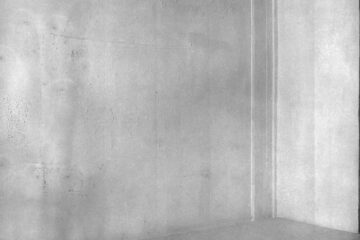
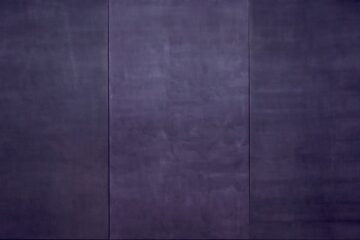
While at Black Mountain, Rauschenberg produced a series of “White Paintings.” The pieces in that series are muti-paneled canvasses rolled with white paint. He intentionally left them free of any mark of the artist’s hand. He even asked fellow artists to paint a few of the pieces, further questioning the very idea of authorship and the role of the artist in determining the meaning of a work of art.
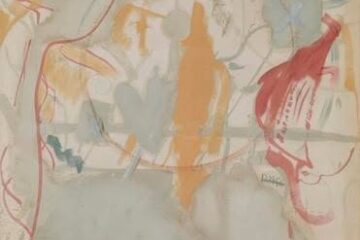
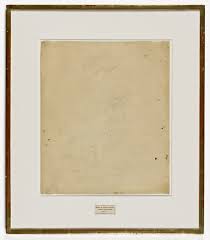
In 1953 Rauschenberg bought a bottle of Jack Daniels and knocked on the door of Willem de Kooning, twenty-one years his elder and the reigning master of Abstract Expressionism. Rauschenberg asked de Kooning for one of his drawings. Not to keep, but to erase. He wanted to discover if erasure of a mark constituted a work of art. De Kooning was appalled and initially rejected the request. But as the evening wore on, de Kooning eventually agreed to give him one of his pieces. To make Rauschenberg’s work more challenging, de Kooning gave him a complicated piece, one heavily marked with grease pencil, ink, charcoal, and graphite.
It took Rauschenberg two months, and dozens of erasers, to finish the task of erasing de Kooning’s drawing. Even after he had finished, there were still traces of de Kooning’s work present. That piece, Erased de Kooning Drawing, first exhibited at a group drawing show in 1955 at the Elinor Poindexter Gallery in New York, is pictured here. By choosing a work by de Kooning as the focus of his piece, Rauschenberg both acknowledged his high regard for his predecessor and signaled a creative re-description of what constitutes art.
In response to criticisms that Erased de Kooning was an act of destruction, a dishonoring of past work, Rauschenberg replied: “It was not destructive. I was trying to purge myself of my teaching. I was doing a monochrome no image. It’s not a negation; it’s a celebration. It’s poetry.”
The word “Deuteronomy” is from the Greek translation of Torah. It is a combination of two words: “second” and “law.” The English rendering of the name of the fifth book of Torah predisposes us to think that what we are about to read will be a replication of past events, recollections and teachings.
The Hebrew name for the book, Devarim (“words”), shatters that expectation. It recalls the very opening of Torah. God spoke, and existence came into being. Words have a procreative force. At the same time, the very first word in Torah, b’reishit, is a grammatically confounding term, almost a non-sense. The medieval commentator Rashi cries out, “This verse says nothing but ‘Expound me!’” Creation begins with a word that invites our participation in creating meaning.
As Torah began, so does it end. With a lesson that there is no meaning given apart from our active participation in its creation. Rauschenberg, with whisky, erasers and rollers of white paint in hand, sought to relieve tradition of any oppressive weight on human creativity. The vacation of filled space, of filled time, is not a negation of tradition; it is a celebration of it. “It is the empty space in the room that gives its function,” wrote Lao Tzu in the Tao Te Ching.
What a gift Torah gives us as we begin its final book. It reminds us of the creative fruit that is contradiction, ambiguity and conflicting perspectives. We lift up the scroll and sing, “This is the Torah that Moses set before the Israelites!”
Join us here at 7:00 p.m. (PT) on Wednesday August 6 as we explore the power of vacation.
Erased de Kooning by Robert Rauschenberg