
How much more of the divine promise we can fulfill in the external world if we but also explore the world within!
View the study sheet here. Recording here.
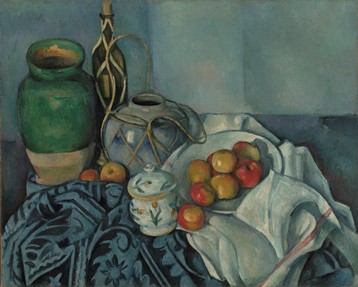
Paul Cézanne was both the mother and father of modern art. At least so say two of the greatest early proponents of that movement. Henri Matisse called Cezanne “the father of us all.” Pablo Picasso said that Cezanne was like a “mother hovering over.” This integration of dimensions can be seen in much of Cezanne’s work.
Upon moving to Paris from Southern France at the age of twenty-two, Cezanne became friends with many of the early Impressionists. He developed an especially close friendship and working relationship with Camille Pissarro, nine years his elder. Pissarro influenced Cezanne to lighten his palette, change his naturalistic style for a softer one and develop a lighter brushstroke.
By the time he was forty, Cezanne began to break from the Impressionists. Instead of depicting the transiency of any moment as the Impressionists did, Cezanne wanted to portray the enduring, substantial qualities of what he encountered. These he found in the underlying geometry of his subjects. Disregarding the standards of classical perspective, Cezanne explored each object’s independent structure and its own plane of existence within the space of the canvass.
Pictured here is his work Still Life with Apples. There are no chairs or windows or wall hangings to confirm our assumption that we are in a room. Still, it is an interior scene…Isn’t it? That is a wall in the background, not the sky. Right? And the apples and jars are sitting on a table, not water. Yes?
When the poet Rainer Maria Rilke viewed this painting, he wrote to his wife Clara about it with a vocabulary describing open air, the earth and water. He saw the outdoors and organic movement.
Cezanne has imbued what might otherwise be a staged and stagnant scene into an open and unpredictable experience. The apples threaten to roll off the plate, perhaps even off the canvass. The sugar jar seems to float in air. The dark tablecloth undulates with an ocean’s tidal power. The folds of the white cloth become land forms. A cavern at ocean’s edge appears at the cloth’s lower right corner. The dynamic and expanse of the exterior world has somehow permeated the static and constrained environment of a mere room.
This conflation of interior and exterior, of inorganic and organic, transforms both dimensions. The mundane and familiar is now profound, eternal and infinite. The wild, expansive exterior world becomes domestic, a site of intimacy. The artist’s hand has laid it out for us. Two worlds we thought distinct merge into something we had not imagined before. And now we can.
We emerged from the book of Leviticus last week. It was seemingly a stagnant text, lacking any narrative. The Israelites stopped their journey to gather around a house, the Tent of Meeting. Much of the book is about how to take care of that house and the house that is the human body. These are domestic matters.
With the beginning of the book of Numbers there is a stirring of activity. Tents are packed up, lines of march are arranged, all of the elements of the Tent of Meeting are disassembled and assigned to various Levite families for transportation. We are back in the external world of action.
And then we remember. The last portion of Leviticus reiterated the book’s opening message: we can overcome the beast in us and magnify the presence of the Divine in this world. The final lesson of Leviticus was about how to walk in the world in harmony and beauty, to walk with the Source of it all. This apparently most stagnant and domestic of all the books is infused with language about how to journey across the expanse and how to make the finite a portal for the Infinite.
We open this week’s portion, Bamidbar (“in the wilderness”), and learn that each of us will be covered in distinction by our own flag (diglo). An artist hand, in the form of a midrash, paints this scene of work life outside the home, the packing and transporting and marching and arming, by identifying the flag in the portion with the flag in Song of Songs: “He brought me into the house of wine, and his flag (diglo) of love is over me.” The text about the busyness of work outside the home is infused with language from the greatest Biblical book about intimacy, sensuousness and love.
To reenforce the image, the rabbis chose as the haftarah for this week’s Torah portion verses from the prophet Hosea, which include these: I will betroth you to Me forever; I will betroth you to Me in righteousness and justice, in steadfast love and compassion. I will betroth you to Me in faithfulness, and you shall know God.
In the pivot point that is the transition from Leviticus to Numbers, we have experienced the confined and domestic permeated with the dynamic and the infinite. And work in the broad expanse of the external world imbued with intimacy and love. We move in and out of both worlds on a daily basis. The way we journey through them can transform us and the world around us, especially if we remember that we are always covered in distinction with banners of love.
Join us here at 7:00 p.m. (PT) on Thursday May 29 as we explore banners of love.
Oil on canvass Still Life with Apples by Paul Cézanne