
Abiding faith finds its place in a world constructed not of final answers but by the sanctifying power of human curiosity and the grace of compassion.
View the study sheet here. Recording here.
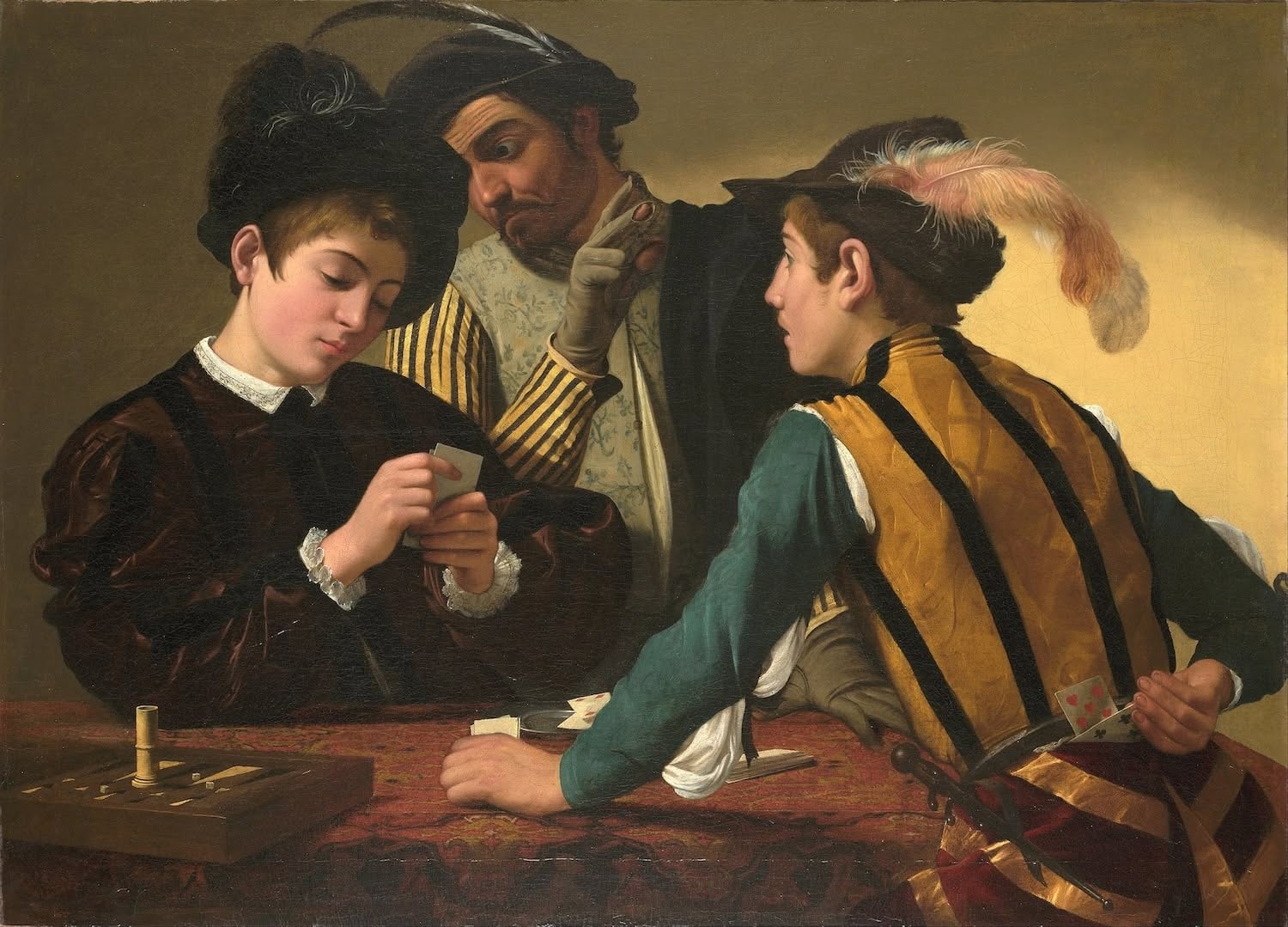
The Cardsharps by Caravaggio
Underneath all the current arguments over immigration, economic policies, and foreign affairs simmers a far more explosive fundamental question: What defines a nation?
Ancient civilizations defined a nation not by geographical borders but by shared kinship, common language, folklore, and ancestry. Peoples conquered by expanding empires such as the Persian, Greek and Roman were considered subjects but not part of the nation. Roman Emperor Caracalla’s edict in 212 C.E. to grant free inhabitants full Roman citizenship was unique throughout the history of empires.
The question “what defines a nation?” emerges in the 18th and 19th centuries with the collapse of empires and the rise of European nationalism. Two distinct answers developed.
The first, promoted especially by German philosophers, argued that a nation is defined by certain objective, organic traits, such as a shared language, culture and ancestry. A second view was articulated by French and English thinkers, who viewed a nation as a political contract.
The United States was born with both views embedded within it. The Mayflower Compact was a social contract establishing self-government in the first permanent English settlement in New England. The Declaration of Independence amplified the view that a nation is constituted by a shared dedication to a philosophical view on equality, liberty and the individual’s pursuit of a meaningful life.
On the ground, however, the newly born United States was a collection of independent states with differing economies, religious groups, social structures, and legal traditions. Those differences erupted into a four-year civil war in 1861.
In May 1863 the Confederate Army defeated a Union Army that was twice its size at the Battle of Chancellorsville in northern Virginia. Emboldened, the Confederate Army invaded the North, crossing over into Pennsylvania. There, in the small town of Gettysburg, the two armies clashed on July 1, 1863. After three days of fierce fighting, the Confederate Army was repulsed. It retreated, never to invade the North again. Total casualties from both sides amounted to over 50,000.
Seven months later, the North established a Soldiers’ National Cemetery in Gettysburg as a burial site for Union soldiers. The primary speaker at the cemetery’s dedication was renown orator Edward Everett. He spoke for two hours. The second speaker was President Abraham Lincoln. He spoke for two minutes.
During his two-minute speech, Lincoln sharpened a philosophical difference between the North and the South. The South, according to its leaders such as John C. Calhoun, viewed national identity as rooted in a specific ancestral heritage and shared cultural customs.
Lincoln, gazing across the bloodied battlefield, spoke about the country’s founders, who had “brought forth on this continent, a new nation, conceived in Liberty, and dedicated to the proposition that all men are created equal.”
With those words Lincoln rejected a definition of national identity based on shared bloodlines or geographic rootedness. Instead, he proclaimed the American nation as one that is defined by a set of core ideas, a model of identity that is open to anyone who embraces them, regardless of ancestral origin or history.
In his speech Lincoln remarked that people would likely not remember what he said that day but that they would never forget the sacrifice made on that ground in the cause of freedom and equality. How wrong he was about the power of his words.
Lincoln encouraged people to look beyond fixed traits of ethnicity and ancestry. He directed their attention instead to a story, the founding of a new nation, a story that he said was a continuing, unfolding one. It is a story of “unfinished work,” he said. It is a story of liberation. To tell it as yours is to be part of the American nation.
In Parshat Ki Tavo (“when you come”) the Israelites are on the precipice of becoming a nation. It opens with the instruction to bring first fruits to Jerusalem and to recite:
“I declare (hegad’ti) that I have entered the land that God swore to our ancestors…My father was a wandering Aramean, and he went down into Egypt with a few people and lived there and became a great nation, powerful and numerous . . . God brought us out of Egypt with a mighty hand…He brought us to this place and gave us this land, a land flowing with milk and honey…”
The Hebrew word hegad’ti is from the verb “to tell.” It hints not at a rote declaration of laws but at the telling of a story. The noun maggid, based on the same verb, means storyteller.
The words to be recited as part of the first-fruit ritual became incorporated into the Passover Haggadah (“the story”). They launch the evening’s telling and discussion of the story of a nation and its journey to freedom and to sacred purpose.
To recite that story is to make the national project of liberation, moral accountability and responsibility a part of one’s personal memory and identity. It is a statement of ongoing covenant, a commitment to a group’s aspirational goals.
Rabbi Jonathan Sacks was a British Orthodox rabbi who was enamored with the covenantal dimension of American civic life. He observed that covenant societies do not worship tradition for tradition’s sake. “They value the past,” he wrote, “to remind themselves of the collective determination that moved people to create their society in the first place. They make room for outsiders, who become part of the society by taking its story and making it their own, as Ruth did. Covenant societies exist to honor a pledge, a moral bond, an ethical undertaking. That is why telling the story is essential to a covenant society. It reminds all citizens why they are there.”
At the very beginning of the liberation from Egypt, God’s voice proclaims, “You shall tell the story (hegad’ta) to your children: ‘It is because of what God did for me in my going out from Egypt.’” To tell the story to the next generation is a prime directive for those who have joined in the march of freedom. It enlists listeners into the adventure.
Caravaggio was a late 16th and early 17th century artist who transformed religious art. He rejected the rigid morality lessons of High Renaissance painting. Instead of perfected virtue and deformed sin, he captured the psychological ambiguity, tension and physicality of human existence.
To gaze upon a Caravaggio painting is to forego comfort, clarity and passivity. We are not parishioners dutifully attending a sermon or students at a lecture listening for answers needed for a good grade. We are on the edge of our seats in the theater of Caravaggio. He draws us closer through his foregrounding of subjects and the extension of objects and human limbs so they almost seem to touch us. And soon we discover that we are no longer in our seats but on the stage. He weaves for us a human drama, the outcome of which seems to involve us!
In his paintings Caravaggio describes not resolution but tension. He captures the split second before change. He takes us into the moment where everything is about to shift. And he invites us into the story, to imagine what happened just before and what will happen next.
Pictured here is his painting The Cardsharps. It is one of several that he did of the world of gamblers, tricksters and thieves. He knew that world well, himself a gambler and street brawler.
Suspense fills the canvas and draws us in. A naïve young man is absorbed in his cards, unaware of a trap closing in upon him. Across from him is a cardsharp. Having played his hand, he leans forward, on edge for what will happen next. His right hand is behind his back. Is he reaching for the card he has hidden there, or for his knife? In between the two is an older man. He’s part of the plot! Look, the tips of his gloves are cut off, making it easier for him to feel marked cards. He is signaling card numbers to his younger partner in crime. What will happen? A successful scam? Violence? Will justice intervene?
Caravaggio offers no resolution, no lecture on sin, no homily on virtue. Instead of moral judgment, Caravaggio paints in hues of empathy. He invites us into the lives of both victim and perpetrator. Real life is complex, shifting, chaotic. Real human beings are not consistently noble or eternally beautiful. They are flawed and aging. Caravaggio’s portrayed life as dynamic and unresolved was one that common people could find a place in. And it is there that an honest faith might feel at home.
Closed systems, whether those of national identity or spiritual transcendence, cannot long sustain human aspirations for worth, connection and meaning. No fixed and final answers can ever satisfy the sanctifying power of human curiosity. It is not the fruit from Eden’s tree that will nourish the human soul. It is that which is grown by one’s own labor and which is offered up in thanks and with a story about the journey behind it all.
Join us here at 7:00 p.m. on Thursday, August 27 as we explore the fruitfulness of storytelling.
The Cardsharps by Caravaggio