
Living in creative tension with that which is different is liberating and empowering. View the study sheet here. Recording here.
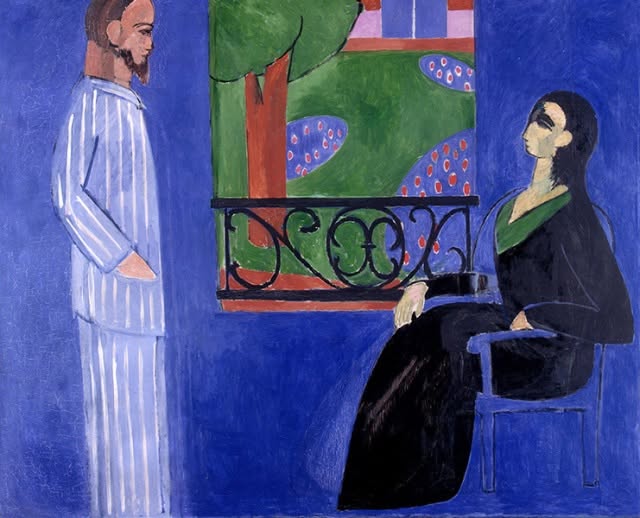
The Conversation by Henri Matisse
We are approaching the midterm elections, an opportunity to choose who will represent us in the governance of our communities and our nation. While character, personality and communicative performance are factors in any political race, candidates will also present us with different choices about our civic life. Who should be allowed into our country, under what circumstances and how? Are the costs, financial and environmental, of hyperscale data centers worth the benefits of AI? Should we continue to project American power abroad or pull back from foreign engagements? How can we best promote prosperity and lower the cost of living?
These are all questions about the shape of our external, communal life.
This week we enter the midterm of the Jewish calendar. Elul, the sixth month, begins at sundown on Thursday, August 13. It marks the beginning of a forty-day period of deep self-reflection, during which we examine our shortcomings and resolve to renew ourselves in the grace and mercy that is always available to those who sincerely seek it. Yom Kippur, the conclusion to that forty-day period, is a celebration of that renewal.
The matters that we reflect on during Elul concern the shape of our internal, spiritual and ethical life.
Civic life and spiritual life. Two dimensions of human existence, which the modern world prefers to distinguish and separate out from each other. Ancient societies, however, saw more of a fusion between the two. Violations of spiritual norms had civic, as well as personal, consequences. In Jewish texts, that was always the message of the prophets and early rabbis: a nation’s spiritual and moral collapse is a greater cause of its defeat than is the military power of its enemy.
Parshat Shoftim (“judges”) is ostensibly a portion about the elements of a governing structure for the nation of Israel. What it promotes are three institutions, each with its own charter of responsibility and all serving as a level of restraint on the other. King. Priest. Prophet.
The king oversees civic affairs: organizes an army, levies taxes, maintains social order. The priest manages the ongoing relationship between the people and God by administering the daily offerings at the Sanctuary and ensuring that the holy is at the heart of national life. The prophet awakens people to divine pathos: God’s care for the weak and vulnerable, grief over human suffering and anger over injustice.
The three roles were designed to be quite different, each with a unique function and a distinct voice. The priest speaks of separation and order, purity and impurity, the holy and the secular. The king is to be the voice of wisdom. He is charged with personally writing a copy of the Torah, which he is to read every day. The prophet speaks in the language of relationships, beyond either the matters of statecraft or the rigid rites of the Sanctuary. He directly addresses the people about their treatment of each other, the urgency for justice, righteousness, compassion and mercy. Three roles, designed both to function independently and to serve as a check and balance on the others.
King. Priest. Prophet. In Jewish spiritual and ethical tradition these roles also describe a blueprint for the human psyche and internal dimensions of the self. Each is endowed with a specific charter helping to govern the human self.
The king represents ego, discipline and execution of action. A healthy internal king maintains order within one’s life and is the vehicle for personal agency. A non-healthy king function can overwhelm other aspects of one’s character and can become a tyrant toward others.
The internal priest functions in cyclical time – maintaining unchanging rituals which anchor the sacred within the daily. An unbalanced priest function can lead to empty, mechanical behavior and an inability to adapt.
The internal prophet governs a person’s values, intuition and creatively disruptive capacity. In contrast to the priest’s immersion in the cyclical time of nature and its seasons, the prophet locates the divine in linear, history-making time. An unhealthy prophet function can lead to reckless enterprises and emotional chaos.
King. Priest. Prophet. Three roles that describe both a system for civic governance and a blueprint for governance of self. Three roles/functions designed to work in creative tension with one another.
Pictured here is a painting by Henri Matisse, The Conversation. It shows an intimate scene from the life of Henri and Amélie Matisse. Henri is wearing pajamas. Amélie is more formally dressed. He is standing. She is sitting. Henri’s verticality is mirrored by the tree outside the window. Amélie’s curves find resonance in the garden.
Some critics have suggested that the garden in the picture is meant to evoke the Garden of Eden. If so, perhaps Henri and Amélie dwell in a post-Eden world. By the time of the painting, they have been married for over a decade. The romantic youthful innocence they explored with each other in their 20’s has evolved into something else.
As with most of Matisse’s work, the primary subject of the painting is color. Here it is a deep blue. It fills their life, creates the space in which they float. It seeps into Henri’s clothing as a paler version. Amélie is suspended in it. Her chair has absorbed the blue. What emotion does it convey? Coolness? Serenity? Isolation? Trust?
A river of blue continues outside. It flows toward a background where another framing of blue is either the source of color or its destination. “A river issues from Eden to water the garden and becomes four branches….God stationed cherubim there with a fiery ever-turning sword to guard the way to the tree of life” (Genesis 2:10, 3:24).
Are Henri and Amélie now in exile…from each other? Or have they each found meaning through the differences they bring to one another. God created a helper, someone who was an opposite, for the first human. Is that what they see now across the room…a helper in this fractured and toilsome world?
We don’t know what Henri and Amélie were talking about that morning. But we do know this: They are present to one another, in all of their differences. Paradise is part of their past. The present is made meaningful and worthy of engagement because of what differentiates them. They live with that tension; and, at least in this moment, they remain attentively committed. Across the space that defines them they are in conversation.
Join us here at 7:00 p.m. on Thursday, August 13 as we explore creative tension.
The Conversation by Henri Matisse