
View the study sheet here. Recording here.

I am reading Amor Towles’ novel A Gentleman in Moscow. It is the story of a Russian Count who is judged by a Bolshevik tribunal in 1922 to be an unreconstructed and unrepentant aristocrat. He is sentenced to house arrest in the Metropol, a grand hotel across the street from the Kremlin and just steps away from the Bolshoi Theatre. There he dwells: between the new world of unsentimental brutality and the passing world of elegance and grace.
The Count is a skilled practitioner of those arts essential to the formation of authentic human relationships: curiosity, humility, loyalty, and, above all, conversation designed to share time and expand imagined space with another.
Towels’ writing is a linguistic incarnation of his protagonist’s character. It is languid and regal. There is no rush to move on, no frantic pace. “Please, sit down and join me for an aperitif and let’s chat. Did you enjoy your walk today? Such a lovely poem I just read. Let me share it with you…” Though one’s physical boundaries may have become restricted, that’s no reason to cease extending graciousness, hospitality or engaging wit.
The Count understands that things do go out of fashion. But that takes years, generations even; doesn’t it? And then Towels writes this bit of realization of the Count’s:
But under certain circumstances, the Count finally acknowledged, this process can occur in the comparative blink of an eye. Popular upheaval, political turmoil, industrial progress – any combination of these can cause the evolution of a society to leapfrog generations, sweeping aside aspects of the past that might otherwise have lingered for decades. And this must be especially so when those with newfound power are men who distrust any form of hesitation or nuance, and who prize self-assurance above all.
“…men who distrust any form of hesitation or nuance, and who prize self-assurance above all.” The phrasing haunts me. For the Count, those men are the newly empowered Bolsheviks, for whom art must serve the state not honor the imagination. Dostoevsky, banned. Ivan Bunin, the first Russian writer to win the Nobel Prize for Literature, forced to flee to France. Production reports, 5-year plans, and proclamations of ideological posture displaced poetry’s call to the heart.
The “distrust of nuance” insinuates itself into the Count’s circumscribed world with a political edict about wine. No longer can one speak of a Sauterne or a Chardonnay. There is to be no differentiation by chateau, no distinction by vintage. Despite the thousands of bottles richly varied by unique vineyard, cru and year lying in the hotel’s cellar, at dinner one can choose only “red” or “white.”
Such censure of variation, such absolutist thinking, is born, as the Count observes, during times of “popular upheaval, political turmoil, [or] industrial progress.” We saw that in our reading of Torah last week. There Korach and others revolted against Moses and Aaron, not with argument and debate but with proclaimed ideology followed by a refusal to discuss it further.
We see it in our times. Authentic human discourse is displaced by social media ecosystems, which reward sensationalism, outrage, and emotionally charged content over measured debate. Self-assured opposition appears as strength. Exploration of alternative viewpoints and collaboration appear as weakness. The universe of discourse shrinks. Language itself becomes coarser. Vulgarity populates civic speech. It signals contempt for one’s opponents and alignment with one’s angry, frightened and frustrated supporters.
During such times are any of us immune from such desecration of language?
In Parshat Chukat-Balak (“laws”-“Balak”), the Israelites arrive at Kadesh. Miriam, associated by tradition as a source of water for the people during their trek across the wilderness, dies there. God calls upon Moses to provide water to a thirsty people. He is to “speak to the rock before the eyes of the people.” That will bring forth water from the rock, God says.
Instead, Moses, himself angry and frustrated with the people, calls them rebels and hits the rock with his staff. As a result of his coarse speech and his failure to use language as the instrument of salvation, Moses is told by God that he will not lead the people into the land of promise.
The divine instruction to speak “before the eyes of the people” rather than “into their ears” indicates that the moment before the rock was to be more a visual than an aural project. God wanted Moses to engage in a speaking that would open the eyes of the people to something extraordinary. It had happened once before.
At the rock called Mount Sinai the divine Presence had cascaded forth, bearing the spiritual hydration of empowerment for a meaningful life. That inundation resulted in “all the people seeing voices” (Exodus 20:15). The flood triggered a massive sensory experience, a recalibration of ethical and psychological patterns: an awakening to the enormity of what it means to be a slave self no longer, to be on the way to becoming a sovereign self.
The moment at Kadesh was meant to be a re-experiencing of that Mount Sinai experience, to “see” as the people had seen at Mount Sinai. Midrash describes that upon recovering from the initial shock of Sinai’s divine tremors, the people realized that they had each seen/heard something slightly different. Their exchange of interpretations is central to the development of a sovereign self and to the nation that they will build together. The drive to live that way is a matter of faith.
The Hebrew word for faith is emunah. It is constructed from the verb aman, which means to confirm, support, nourish. It gives us the word amen, “I believe.” The same root also produces Amanah, which, in Second Kings, is a river that flows through Damascus. And it also is the foundation for the word aman, a master-worker. An artist. Faith is a work of art. It is shaped by a master-worker, one attentive to the flow of life. In response to Moses’ failure to use speech as a means of salvation at Kadesh, God says, “You did not express emunah…”
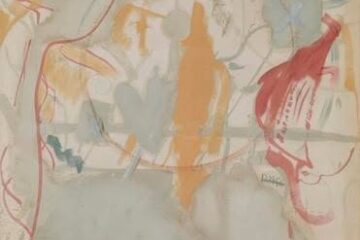
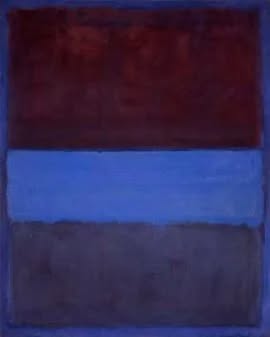
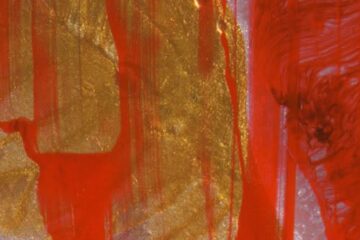
The Abstract Expressionist Mark Rothko remarked, “A good painting whispers. A great one basks in silence.” Rothko’s artistic project was access to the sublime, achieved by a journey through emotion ignited by fields of color and blocks of vibrancy often frayed at the edges and seemingly floating. His paintings do not shout. They do not insist or intrude upon your presence. They graciously wait for you, and upon your stopping invite you in.
Rothko informed viewers that his paintings were best viewed at the intimate distance of 18 inches. To become an immersed part of the colors. No longer a detached judge but a participating artist in the sublime project. He made no prescriptions about what you must discover. His only hope is that you would enter into a state of being that would set you free.
Late in his career, Rothko was invited by Jean and Dominique de Menil, devout Catholics inspired by the inclusive principles of Vatican II, to create a sanctuary where art would facilitate a spiritual experience of human cohesion, integrity and peace. They wanted a space devoid of dogmatic certitude. A place that would hold in embrace those seeking relief from the noise, confusion and injuries of modern life.
For this project, Rothko created fourteen immense panels in the palette of plums, burgundies and black. Pictured here is one of them. The panels are an integrated part of the entire chapel experience: silent, contemplative, enfolding. Rothko’s paintings enlist us to become artists in realizing the sublime. To become faith makers. The Rothko chapel creates an entire environment conducive to opening a portal to the sublime, which we discover to be within us.
Speaking about the panels at the inauguration of the chapel, Dominique de Menil said: “They are intimate and timeless. They embrace us without enclosing us. Their dark surfaces do not stop the gaze. . . . We can gaze right through these purplish browns, gaze into the infinite.”
To “…gaze into the infinite.” At Mount Sinai the Israelites “saw” the infinite. There it was through act of the external divine. At Kadesh the divine intent was to transfer that capacity to cause “seeing” to the human. Moses frustrated that intent. But something extraordinary does happen.
Immediately after the incident at Kadesh, Moses sends a message to the king of Edom, seeking permission to cross his land. The king denies it. Sometime later God instructs Moses to once again assemble the people so that their thirst may be quenched. This time the people take the initiative. They sing out, “Spring up, O well!”
Three verses later the people themselves send emissaries to the king of the Amorites, seeking permission to cross his land. The king denies it. But this time the people march forward, sweeping aside all those who would prevent them from reaching the divine promise.
By the end of the Torah portion, the Israelites are camped on the steppes of Moab, just across the Jordan River from Jericho, portal to the promise. They are learning to be artists of faith.
Join us here at 7:00 p.m. on Thursday, June 25 as we explore faith, a work of art.
Untitled Triptych from the Rothko Chapel by Mark Rothko