
View the study sheet here. Recording here.
Shifting alliances. Declining economies. Emergent new ones. Large scale global population movements. The threat of AI. The hope of AI. Climate change. The world no longer appears as we remember it, or as we expected it to remain as we made plans for our future lives.
During moments of upheaval, we tend to search for explanations so that we might reclaim some order in the face of uncertainty. Established answers no longer satisfy. Politically, compromise and moderation are suspect. Parties and movements that project unyielding certainty about their ideologies and insist on total loyalty to their causes are ascendent. Discussion across the aisle is seen as weakness, if not traitorous.
In 1972 psychologist Jerome Kagan proposed that the drive to resolve ambiguity and achieve certainty is hard-wired within the human personality. We seek to eliminate the distress of the unknown. Social psychologist Arie Kruglanski in 1994 identified this drive for certainty as a desire for “cognitive closure:” a preference for order, predictability and decisiveness.
One of the casualties during a time of extreme social crisis is language. Refined, skillful, invitational speech is displaced by that which is threatening, coarse and domineering. Or speech may deteriorate so drastically until there is only its absence.
Parshat Korach describes a rebellion against the leadership of Moses and Aaron. The leader of the revolt is not a political outsider or one of the unprivileged. Korach is Moses and Aaron’s cousin, a member of the community’s most honored family. He is a Levite, and as such endowed with special privileges. He holds an elevated status within the community, is exempt from military service and from working the land. As a Levite he would be financially supported by community tithes and given a designated city in which to live.
Yet, his challenge to the leadership of Moses and Aaron is what today we would call populist. “Why should you be in charge? What makes you so special?” he proclaims. “The whole community is holy!”
It is a political platform that allows for no debate. Moses seeks to dissuade Korach from his divisive path. But Korach refuses to speak, wary perhaps that an extended dialogue with Moses might undermine the purity of his oppositional stance.
Rabbi Judah Loew, the 16th century Talmudic scholar, mystic and leader of the Prague Jewish community, characterized the personality type of Korach and those like him as “masters of dissension.” They are those whose discourse is one of total rightness, of uncompromising righteousness. Inflexible, unyielding, they bring ruin upon the world. There is no inclination to engage in argument or discussion. It is the end of language as an instrument of exchange or exploration…of relationship. The only use for speech is to proclaim or incite.
In that sense, Korach represents a desecration of the divine enterprise: the use of language to give shape to differences for the sake of life. God’s speaking gave shape and form to distinct life forms. God modeled that speech is procreative. The great Jewish mystical text the Zohar puts its succinctly: “Korach repudiated the creation of the world.”
In contrast to Korach’s absolutist view of reality is the multiperspectival approach which runs throughout Jewish text and its study. Psalm 12 describes the corrosive effect of false and arrogant speech that claims to speak the only truth: “Men speak lies to one another/their speech is smooth/they talk with duplicity/May God cut off all flattering lips/every tongue that speaks arrogance/They say, ‘By our tongues we shall prevail; with lips such as ours, who can be our master?’”
The 3rd century sage Rabbi Yannai, commenting on the psalm, offered a striking interpretation of divine intention. He taught that when God gave the Torah at Mount Sinai, God presented 49 reasons to interpret the law one way and 49 reasons to interpret it the opposite way. When Moses turns to God in exasperation and cries out, “Master of the Universe, when will we get clarity about the matter?!” God replies, “gather together, probe, question, discuss, share your wisdoms and then follow the majority.”
Rabbi Yannai’s commentary highlights that the intentional ambiguity in Torah was specifically designed to draw us into a deeper connection with the text and with one another through the shared process of interpretation.
That intentional ambiguity begins with the very first word of Torah, b’reishit. It is a puzzling word grammatically. In its form it should be followed in Hebrew by a noun not a verb. And its traditional vocalization renders the translation “in a beginning” not “in the beginning.” What is going on here? Was there another beginning?
The journey through Torah as a way of life starts not with certainty but with ambiguity. This is language that creates a void, language that is incomplete inviting human exploration and interpretation.
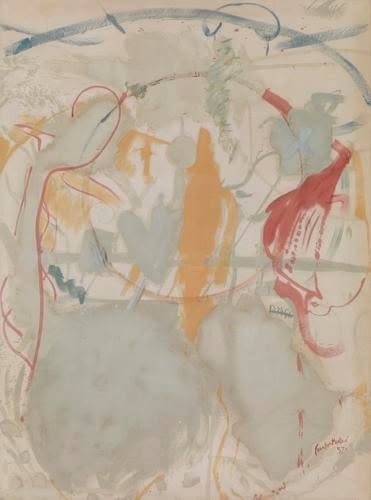
By the age of twenty artist Helen Frankenthaler was already immersed in the center of Abstract Expressionism. The art critic Clement Greenberg was her guide into a world that included Jackson Pollock, Willem de Kooning, Lee Krasner, Franz Kline, and Hans Hoffman. By the age of twenty-four she had innovated her own style. Rather than cover a canvas with thick paint, she thinned her oils with turpentine and used window wipers and sponges to move the pools of pigment across the canvas. Her soak-stain technique emphasized color, spontaneity and interaction between paint and canvas.
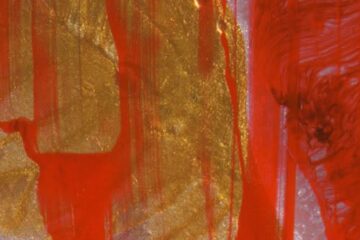
Pictured here is her work Seven Types of Ambiguity. It was inspired by an essay of the same name by literary critic Willliam Empson. Empson emphasized that ambiguity in a literary work is not an obstacle to meaning. It creates a space for the viewer to participate in the artistic endeavor of meaning-making.
Frankenthaler incorporated into her work the notion of “working false space.” She intentionally created areas in her paintings that appear empty at first glance but which function as part of the piece’s depth and meaning.
A painting works best, Frankenthaler wrote, depending on “how much working false space it has in depth…It’s a play of ambiguities.” The viewer’s eye is drawn into the painting through empty areas, which are not truly empty but are part of the layered structure of the piece.
Korach and other “masters of dissension” abhor empty spaces, ambiguities and uncertainties. By contrast, the rabbis of the Talmud thrived on such ambiguities and shaped a form of argument that nurtured and preserved differences of opinion among them.
The Hasidic sage Rabbi Nachman wrote, “Dispute is an aspect of the creation of the world. For had all the Torah scholars been in agreement, there would have been no room for the creation of the world. It was only by way of the dispute between them that there was formed between them an aspect of the empty pace.”
Rabbi Nachman’s description reflects the kabbalistic model for how God created the world. Once, God constituted all reality. Then God withdrew from a portion of that reality, leaving a vacated space. In that vacated space divine speech created distinctions, separations, differentiated objects and life forms. The nature of the discourse shaped by the scholars, their form of argument, was meant to imitate how the divine created new life.
From its very opening through the entirety of the journey it narrates, Torah places us in a world full of ambiguities, of incompleteness…because that is the world in which we live. Torah expresses compassion for us by teaching us how to live well and meaningfully in such a world.
Karl Jaspers, Swiss psychiatrist and philosopher, viewed ambiguity not as a problem to overcome. It was instead the authentic, relational space where freedom, faith, and meaning reside. He wrote, “This is the vision of a great and noble life: to endure ambiguity and to make light shine through it; to stand fast in uncertainty; to prove capable of unlimited love and hope.”
The march through the wilderness, that empty space known in Jewish tradition as the midbar – that place where speech (daber) is to be redeemed – is where we refine ourselves as capable of “unlimited love and hope.”
Join us here at 7:00 p.m. on Thursday June 18 as we explore the vision of a great and noble life.
Seven Types of Ambiguity by Helen Frankenthaler