
View the study sheet here. Recording here.
Located on the east bank of the Tigris River, directly opposite the old city center of Mosul in present day Iraq, is the archaeological mound of Kouyunjik. Kouyunjik was a settlement within the ancient city of Nineveh, the largest city in the world and the final capital of the Assyrian Empire before its fall in 612 BCE.
The Assyrian Empire was during its time the dominant power in the ancient Near East. Its territory stretched from Egypt to the Persian Gulf. To rule this vast empire of conquered states the empire required detailed information about the land, people and wealth under its control.
In 1849-1850 British archaeologist Austen Henry Layard unearthed at the Kouyunjik mound 20 clay tablets providing detailed information about the empire’s provincial capital Harran. The tablets, dated to the 7th century BCE, list land holdings and rural estates in the district, their ownership, irrigation and soil fertility, agricultural output, household structures, professions, ethnic compositions, and labor pools. The tablets became known as the Harran census.
The origin of a census was as a tool for state control by ancient empires, such as Assyria, Babylon and Rome. It provided empires with the efficient means for taxation, military conscription and forced labor for state projects such as building pyramids. Throughout history, various empires, nation-states and countries have periodically used censuses to exercise power over their lands and their people.
The United States became the first nation to constitutionally mandate a regular, periodic population count. Article 1, Section 2, of the United States Constitution requires that an “actual enumeration” of the population must take place every ten years. This is the basis for the federal Decennial Census. The resulting count is used to apportion seats in the U.S. House of Representatives among the states and to draw legislative districts.
The first United States census was conducted in 1790. Under the supervision of Secretary of State Thomas Jefferson, 650 United States Marshals went door-to-door, recording the names of heads of families and the number of people in households.
Unlike prior historical uses, the United States census was not designed to coalesce power in a central state authority. Its purpose was to distribute political representation as the basis for its democracy. The nation’s founders believed that a national census was necessary to prevent the federal government from arbitrarily levying taxes and to keep individual states from inflating their population estimates to get greater representation in the House of Representatives.
The 1850 census marked a massive shift in the amount and detail of information collected. It was the first to list the name, age and birthplace of every free household member – not just the head of household. For the first time, a person, rather than a household, was used as the basic unit of enumeration. Enslaved people were listed on a separate schedule. Data on topics such as schools, crime, wages, and mortality were collected. This census provided a statistical view of each state and territory, including agricultural production, industry and social data.
This inclusion of more information expanded the nation’s understanding of itself and provided a more developed tool for government planning and administration.
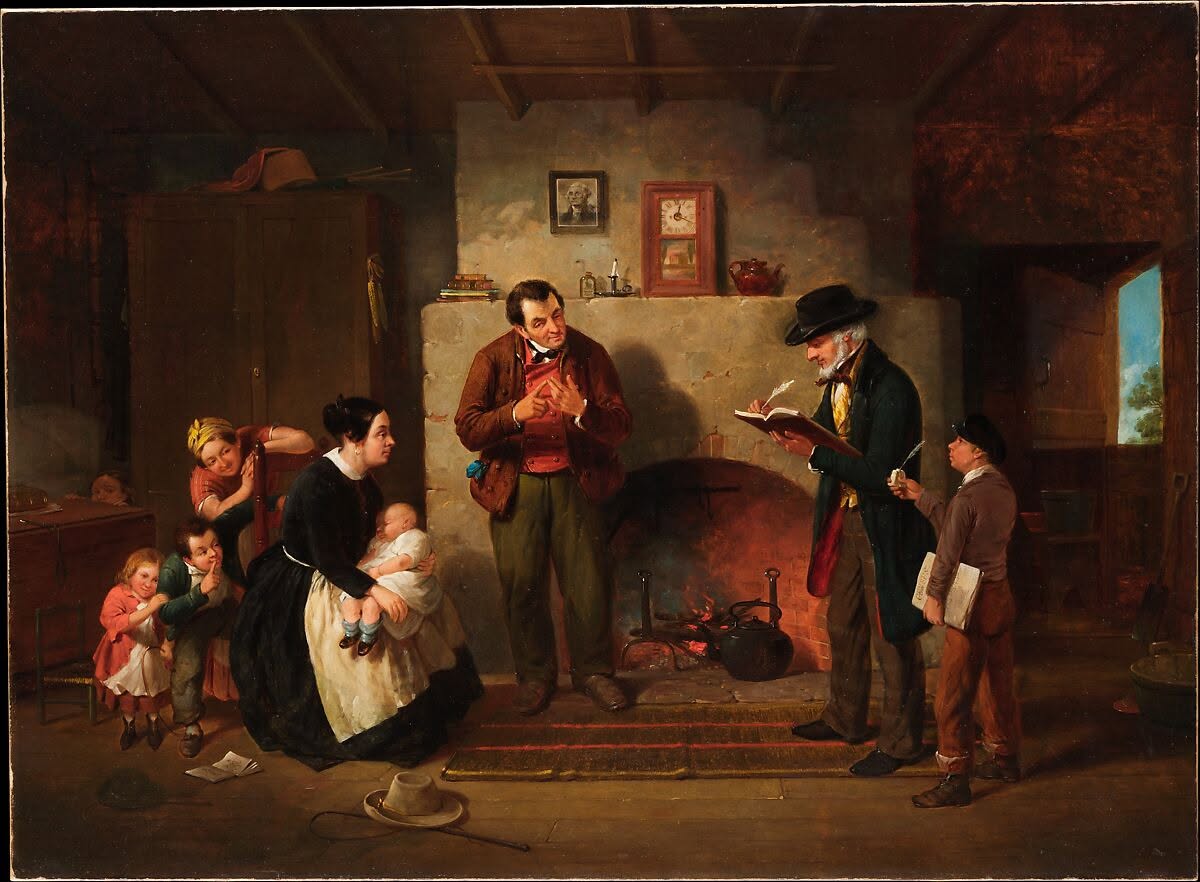
Pictured here is the painting Taking the Census, a scene by Francis William Edmonds of the 1850 census being taken. Edmonds was a banker as well as an artist. Most of his paintings are of everyday life and often contain an element of humor.
In the center of Taking the Census is a father, struggling to answer all the new questions required by the 1850 census. Perhaps he is trying to remember the names of all his household members, several of whom are hiding from sight. Or perhaps he is wondering how all the information the federal government now insisted on was going to promote a more robust, diffused democracy. Above the mantle is a small portrait of George Washington, evocative of both the admonition to never lie and of the genesis of the country’s political system, one based on a dispersion of power.
Parshat Bamidbar (“in the wilderness”) opens with the divine instruction for Moses to take a census of the whole Israelite nation. The specific information to be collected are the names of all males, ages 20 and older, all those capable of bearing arms. They are to be organized by tribe and by paternal lineage.
On initial reading, this census seems to reflect the traditional, ancient focus on organizing a nation’s capacity for promoting power into the world. Rabbinic tradition looked closely at the Hebrew and read the message differently.
The Hebrew for the verse typically translated as “take a census of the whole Israelite community” literally reads “raise up the head of all the community of the children of Israel.” Through that reading the rabbis focus on the elements of elevation and of each person being counted.
The value of each individual member of the community was read into the experience of revelation at Mount Sinai. The 16th century rabbi known as Maharsha commented: “There were 600,000 people who received Torah. The Torah has 600,000 possible interpretations. The reason it was given to an entire people is so that it would reflect all possible holy meanings.” Everyone contributes a unique understanding. The absence of one person is the loss of unique and needed wisdom.
Specifically on the verse directing Moses to count the Israelites, the Hasidic rabbi known as Mei HaShiloach wrote: “The term ‘raise up’ signifies elevation. By means of counting the number of all the tribes, each individual will experience elevation, and a special significance will be seen in each one. The greatness of God is seen in the entire community of Israel as a whole, and if just one member of that community is missing then the mixture will be deficient. Each one of Israel is a portion of God. Each individual possesses one of the attributes of God, and at the time when that individual is counted, then God Godself is present in that attribute.” Each person brings an aspect of the divine into the world.
Unlike the drive of ancient empires to count people in order to amass greater centralized authority, Torah’s instruction is designed to uplift the power and presence of each individual within the community. That diffusion of power and responsibility lies at the heart of the freedom that is the purpose of the ongoing Exodus project for a sacred sovereignty for self and community.
Join us here at 7:00 p.m. on Thursday May 14 as we explore taking account of the people.
Taking the Census by Francis William Edmonds