
View the study sheet here. Recording here.
Expressive of our country’s current divided condition, there are two national organizations sponsoring events to celebrate the 250th anniversary of the signing of the Declaration of Independence. The first is the nonpartisan U.S. Semiquincentennial Commission, established by Congress in 2016. It has organized events under the name America250. The second is Freedom 250, an initiative created by President Trump in early 2025.
America250’s events include: a synchronized America’s Block Party in local communities; Sail250, a maritime celebration; Our American Story, a collection of personal stories from diverse communities; a traveling tech exposition of the country’s greatest innovations; and a national time capsule to be buried in Philadelphia.
Freedom 250’s events include: a parade and fireworks along the National Mall; the creation of a National Garden of American Heroes; and an Ultimate Fighting Championship Bout scheduled for June 14 to coincide with President Trump’s birthday.
There will be plenty of contending narratives about the events of July 4, 1776. It will be understandable if people draw conflicting notions about that historic day and what it means for us as a nation.
One 19th century journalist captured public imagination about the events of July 4, 1776, with a piece he wrote in 1847 for the Philadelphia Saturday Courier. George Lippard was a novelist, journalist, playwright, social activist, and labor organizer. His story in the Courier was a moving account about an aging bellman at the Pennsylvania State House who feared that the Continental Congress would not declare independence. When his grandson rushes in with the news that independence had indeed been declared and shouts, “ring, grandfather!” the bellman rings the bell, eventually known as the Liberty Bell, turning the scene into a patriotic celebration.
Pure fiction. It never happened. The State House steeple was in too poor of a condition at the time. But for years many embraced the myth as reality.
A striking feature of the Liberty Bell is its crack. The bell actually suffered two cracks. The first appeared during its testing in 1752 after its delivery from a foundry in England. Local Philadelphian craftsmen repaired it. The second crack occurred in 1846 after it had been rung in honor of George Washington’s birthday. It has not been rung since.
A second striking feature of the bell is its inscription: “Proclaim LIBERTY Throughout all the Land unto all the Inhabitants Thereof,” selected to mark the 50th anniversary of William Penn’s 1701 Charter of Privileges.
The Charter of Privileges, the governing document of Pennsylvania until the American Revolution, granted religious freedom, separated church and state and asserted the right of self-governance. The Charter was one of several forms of self-government developed by American colonists in the 17th and 18th centuries. Other examples included colonial assemblies, town meetings and direct democracy agreements such as the Mayflower Compact. Each promoted direct engagement in and responsibility for civic affairs by a community’s citizens.
The source for the Liberty Bell’s inscription is Leviticus 25:10, a verse from Parshat Behar-Bechukotai (“on the mountain”-“in My laws”). The context for the verse is a description of the rules governing the Jubilee year, a 50th year in a cycle of counting. In that year slaves are to be freed, debts forgiven, agricultural labor is to cease, and control of lands is to be released and returned to the original Israelite tribes to which they had been initially assigned.
The Jubilee year is a radical version of the 7th year, known as Shemitah, which is also discussed in Parshat Behar-Bechukotai. During that year, all sowing, pruning and harvesting is to stop.
The rules for both Jubilee and shemitah were to take effect only upon the Israelites becoming settled in the promised land. They have no application in the wilderness. They are the price one pays for becoming landed, no longer sojourners but stewards and governors of a place.
And the price is challenging. Torah offers a model of liberty that is difficult. Though they suffered lack of autonomy as slaves and endured daily dispossession as itinerants, the Israelites are not permitted to practice total ownership control over their land, those who work for them or debts owed to them. They must regularly loosen control, release what has been theirs, open their fields to others. The noun shemitah is derived from the Hebrew verb to drop, to loosen.
Yet, in that exercise of restraining human acquisitiveness, avarice and unlimited accumulation, a new culture is being born. The rules for shemitah allow a landowner to eat what exists in his field during the seventh year. It is just that it is to be done with “your slaves and your servants and your hired workers and one who resides with you and your cattle and the beasts in your land” (Leviticus 25:6). As the medieval commentator Rashi observed, although one is forbidden during that year from developing the land to produce more, one may eat what exists… but must treat what is there not as an owner. Rather,” Rashi wrote, “all should be equal” during that year.
Ecclesiastes – attributed as the work of Solomon, the wealthiest Jewish king! – proclaims: “Even the king is subject to the field.” The needs of the domestic house, even the king’s, come second to those of the field and to those of all who rely upon it. Public need must be attended to first. Communal well-being supersedes gratification of ego’s appetite.
Agnes Martin was a mid-20th century artist. She grew up in the wide-open prairies and big skies of Saskatchewan. Having endured a harsh upbringing at the hands of an emotionally severe mother who used silence as a weapon, Martin eventually found her way to New York City and its vibrant art world.
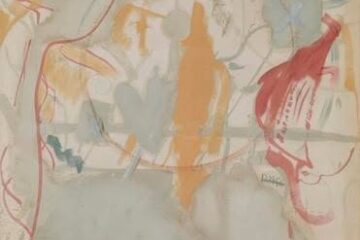
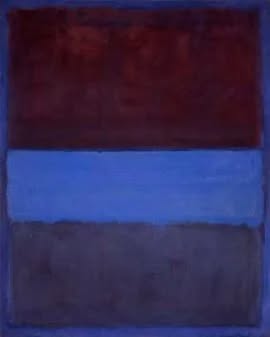
There she encountered the dominant art movement of the time, Abstract Expressionism. It was an approach that celebrated muscularity, bold gestures and thick, broad applications of paint. It called attention not to objects outside of the artist but to stirring, and sometimes turbulent, encounters within the artist.
Distinguishing herself from that boisterous, fast-paced, attention-demanding form of Abstract Expressionism, Martin patiently waited for a glimpse of something slight that said it all.
Meticulously, she drew horizontal and vertical lines on large canvasses to which she added color. These restrained, reserved paintings contributed to the development of a new art movement, Minimalism. This new creative expression emphasized simplicity of form in place of the expressive excess of the earlier Abstract Expressionists. Anonymity of creator rather than triumphal self-proclamation.
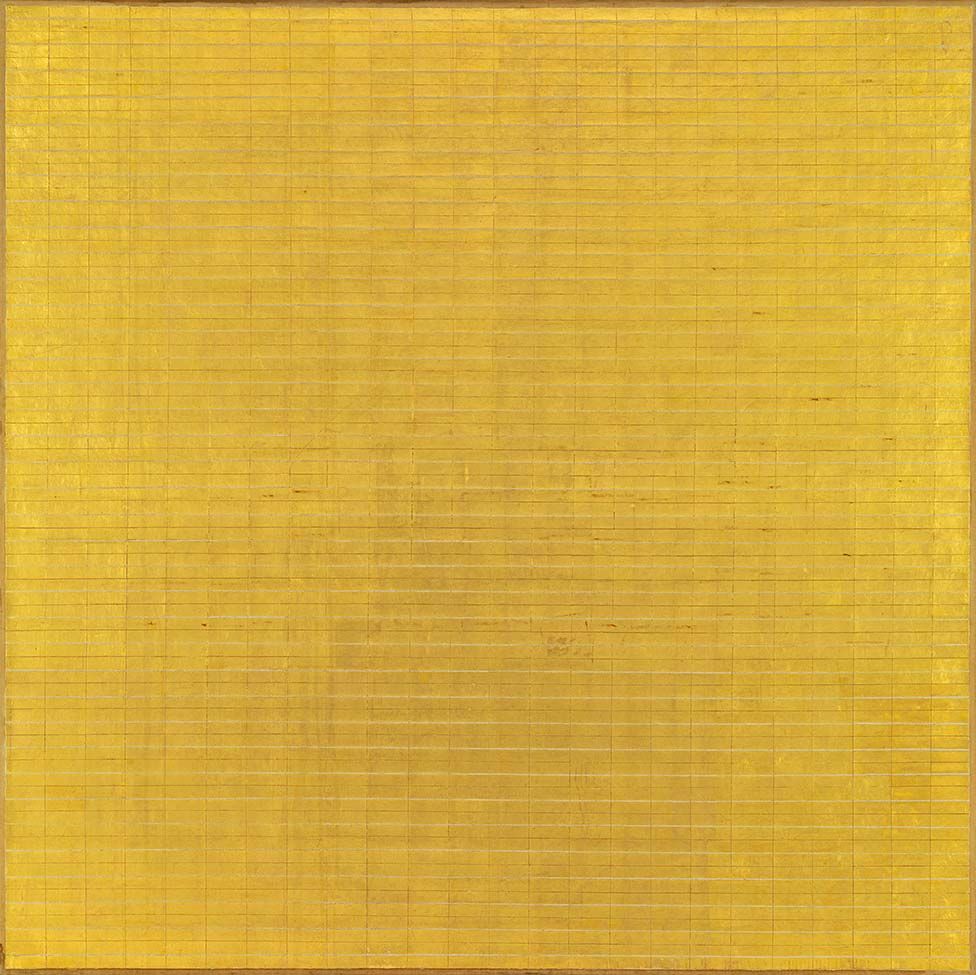
Presented here is Martin’s painting “Friendship.” Displayed are her hallmark vertical and horizontal lines, which this time are covered in gold leaf. This is not the confessional art of Abstract Expressionism. It modestly holds back. It is a meticulous forming of formlessness. Her works were often attacked, vandalized. Martin understood such reactions to be a fear of emptiness. “You know,” she said sadly, “people just can’t stand that those are all empty squares.”
Put art before ego, Martin advised. “I have sometimes, in my mind,” she wrote, “put myself ahead of my work and have suffered in consequence. I thought of me, me and I suffered and the work suffered and for that I suffered more.”
To grasp and hold, to covet and take is to lose everything. To harden one’s heart, to close one’s ears is not to emerge victorious. It is to become an eternal wanderer, quivering in constant anxiety. By contrast, to paint our lives in restraint is to dwell in the promise of an ever-expanding fulfilment that is home.
Torah’s vision of sovereignty is built on the released grip, the open heart and the shared field. The price for sacred control over oneself is a direct challenge to the ego’s drive to amass, possess and exercise exclusive control. It imagines a transcendence of instrumental concerns. As a result, something more sublime is achieved.
Join us here at 7:00 p.m.on Thursay May 7 as we explore a difficult liberty.
Friendship by Agnes Martin