
The journey to a new dimension of self occurs within a framework of fixed responsibilities that supports an imaginative exploration of new possibilities.
View the study sheet here. Recording coming here.
I am typing at my laptop’s keyboard. One letter at a time. With just a few keystrokes I form them into a word. I place a period after several of them and create a sentence. With this next period I now have five sentences. I think I will hit “enter” and, look, I have created a paragraph!
I feel such relief to have finally started filling up my screen with words. That is the purpose of writing, isn’t it? To displace the vacancy of a page with words. That’s where the value is, right? In the black symbols devouring a page’s blankness.
In the 1950’s, artists from various media challenged our focus on what was filling space rather on space itself. In 1951 Robert Rauschenberg produced five works in a series titled White Paintings. The canvasses were all painted completely white. They were designed to appear untouched by human hands, as though they had arrived in the world fully formed and absolutely pure.
A year later his friend John Cage composed 4’33”. The piece is divided into three movements, lasting 30 seconds, 2 minutes and 23 seconds, and 1 minute and 40 seconds respectively. Musicians enter a stage. The score instructs the performers not to play their instruments throughout the three movements.
Samuel Beckett in 1956 wrote Act Without Words I, a short play that is…without words. He followed it up with Act Without Words II shortly afterwards.
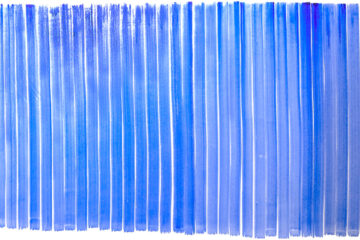
Yves Klein was a French artist best known perhaps for his use of a single color, a rich shade of ultramarine that he made his own: International Klein Blue. In 1958 he staged at Galerie Iris Clert in Paris an exhibition titled Le Vide (The Void). It consisted of nothing but a whitewashed room with a single, empty vitrine. Among the guests at the opening was Albert Camus, who presented Klein with a piece of paper on which he had written “Avec le vide les pleins pouvoirs” (With the void, full powers).
Those works coincided with a developing post-war consumerist culture, one that was particularly surgent in the United States. A boom in spending on goods and services, increased incomes and easy credit reshaped expectations about one’s material life. The exponential increase and reach of aggressive advertising through new media such as television helped to displace values such as thrift and humility with those of constant acquisition and display of one’s latest purchases.
Artists such as Beckett, Cage, Rauschenberg, Klein and others sought to push back against this wave of passive gratification and to incite people to engage more actively in shaping both the social framework and the spiritual design of their lives. Their works created more space, more silence for reflection and participation.
Over a thousand years before that artistic challenge to mid-twentieth century consumerism, the Heart Sutra, one of the most famous texts in Buddhism, proclaimed: “form is emptiness, emptiness is form.” That seeming paradox is a core philosophy of Japanese art, design and culture: absence is as important as presence. This principle is summed up in the Japanese concept “Ma,” which roughly translates as “negative space.” It describes the kind of gap or pause which gives new shape and meaning to the whole. “Ma” is the pregnant void.
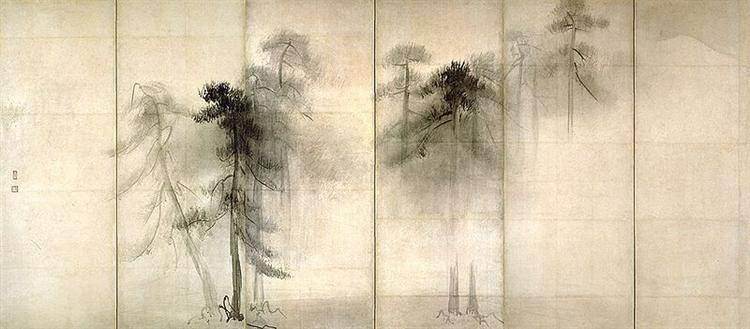
Pictured here is Pine Trees by the late 16th century Japanese artist Hasegawa Tōhaku. The work is monumental in size, about 5 feet high by 11 ½ feet wide, with minimal elements. It shows a grove of trees emerging from/receding into an atmosphere of mist. A mountain top is barely visible in the upper right corner. It is considered one of the classic examples of “Ma” artwork. Rather than explicit detail, it emphasizes suggestion over representation. It relies on voids to convey meaning and invites viewers to fill in the gaps with their imagination. Together, the present, that which is supplied by the artist, and the absent, that which is interpreted by the viewer, fulfills the promise of the art.
Parshat Lech Lecha launches the journey of the founder of the Jewish people: Abraham. Yet, God’s reason for choosing him and Abraham’s thoughts about embarking on this mission are absent from the text. We are left with empty spaces.
This combination of black letter text and the empty spaces they create gives rise to a tradition of Jewish sages describing Torah as constructed of black fire and white fire. “The Torah which the Holy Blessed One gave to Moses was white fire inscribed with black fire; fire mixed with fire, cleaved from fire and given by fire,” observes Rabbi Pinchas in the 4th century CE Jerusalem Talmud.
Black fire refers to the written letters. The limited, the limiting, the fixed. The white fire, the spaces between the letters, is the opening to the limitless, the ever-changing, the ever-growing. That is where we are invited to go and return from to share what we see there. Together, the black fire burning on the page and the white fire entered into by those who accept the invitation to explore and interpret its mysteries create the whole.
In addition to God’s reason for choosing Abraham and Abraham’s thoughts about the mission, the Torah is also initially vague about the destination of the journey. It only says that Abraham is to go “to the land that I will show you.” The 19th century Hasidic rabbi Sefat Emet understands God’s promise is to take Abraham to the point “where I shall make you visible, where your potential being will be realized in multiform and unpredictable ways.” More than to a geographical location, the journey is to a new dimension of self.
The 6th century BCE Chinese philosopher Lao Tzu wrote: “Walls and doors form the house, but the empty space within them is the essence of the house.” In just a few months, Torah will share something similar with its description of the Mishkan project. The amount and weight of materials – wood and cloth and metals – is voluminous; but the Divine Presence will dwell in the empty space, in the “midst” not just of the physical structure but also that of each person: within the human heart.
The word “Ma” is composed of two Japanese characters: that for “door” and that for “sun.” There is a framework shaping a portal through which one can enter into the dimension of light. In Hasegawa Tōhaku’s work the pine trees form the landscape; the empty space is the landscape. So too with Torah. It presents an emptiness full of what could be. Torah’s promise of “a land I will show you” is fulfilled by accepting the call to go beyond the fixed and the determined and to explore the fire of creativity and new possibilities.
Join us here at 7:00 p.m. (PT) on Thursday Ocotber 30 as we explore an emptiness full of possibilities.