
By telling our stories we discover the common threads which we can weave together into a common fabric that is community.
View the study sheet here. Recording coming here.
Ten months from now, on July 4, 2026, Americans will celebrate the 250th anniversary of the Declaration of Independence. Having endured years of tax burdens, interference with colonial legislatures and the unconsented provisioning and quartering of British troops imposed by the British Crown and Parliament, American colonists formally severed their ties with Great Britain.
The Declaration of Independence is an extraordinary document. Along with its detailed list of grievances against the Crown is the aspirational insistence that everyone is endowed by God with the right to life, liberty and the pursuit of happiness. It is an inspiring value statement that continues to motivate our best civic self.
Each of the fifty-six delegates to the Continental Congress signed his name at the bottom of the Declaration, risking torture, execution and confiscation of their property. In doing so, they expressly bound their individual fates to one another: “For the support of this Declaration, with a firm reliance on the protection of divine Providence, we mutually pledge to each other our Lives, our Fortunes and our sacred Honor.”
It seems likely that next year we will see two contending official descriptions of America’s founding heritage. In 2016 the United States Congress established the America250 Commission. It is a nonpartisan Commission, chaired by former Treasurer of the United States Rosie Rios and financially supported by a nonprofit foundation. In January 2025 President Trump issued an executive order creating the Salute to America 250 Task Force. It consists primarily of officials from federal agencies. President Trump is the Task Force Chair, and Vice-President Vance is Vice-Chair. The Task Force is administratively housed under the Department of Defense.
However either of the two groups may describe it, the character of the American polity is one that began to take shape over a hundred years before the Declaration of Independence and which continued coming into focus over the years following it.
In August 1620 the Pilgrims set sail from Southampton, England with a government charter to establish a colony in Northern Virginia. A storm tossed them off course, pushing them north to the coast of Massachusetts. The Pilgrims had no charter, no legal authority to establish a colony there. To prevent a mutiny and cohere social order, they signed a compact by which they agreed to “covenant and combine ourselves into a civil Body Politick.” This initial proclamation of self-governance lies at the very heart of American civic life.
A year after the Declaration of Independence was signed, delegates to the Continental Congress adopted the Articles of Confederation, which provided a governing structure for the new nation. The delegates identified that they had created a “firm league of friendship” among the states, language evocative of a covenantal relationship.
One of the aspects of the Articles of Confederation which caused it to be replaced ten years later by the Constitution was the virtual impossibility of its being amended. The Constitution, written in 1787 and adopted in 1789, embraces the understanding that no final text could anticipate all eventualities: “We the People of the United States, in Order to form a more perfect Union…” This is a document not of perfection but of the pursuit of becoming “more perfect.”
In the movie “With Honors,” the character Simon, a self-described bum played by Joe Pesci, confronts a Harvard professor’s elitist view of the Constitution. The genius of the U.S. Constitution, Simon explains, is that its founders wanted a “government of listeners not lecturers.” That genius was highlighted in an initiative to Encourage Americans to Disagree Better, launched last year by the National Governors Association under the leadership of Spencer Cox, Governor of Utah.
Governor Cox describes the initiative as a counter to toxic partisan absolute certainty: “If perfection is impossible, how about we try being more perfect, to improve, to start, and to continue moving America forward, by listening to others with different ideas…” The fruitfulness of such an initiative would be the blossoming of solutions “that can improve our families, our communities and our nation.”
Fruitfulness is addressed in the opening verses of Parshat Ki Tavo (“when you enter”). Once the Israelites have entered and settled into the land divinely promised to them, they are to offer up some of every first fruit. On the narrative’s surface fruit refers to that which grows in the ground, including grapes, figs and dates. A different notion of fruitfulness is expressed in the story of Creation. To bear fruit was the very first blessing God gave to Adam and Eve: “Be fruitful and multiply…” This fruit is generational expansion beyond self.
Perhaps fruit is expressive of the accomplishment of a purpose that extends beyond one’s immediate self and time. We know that the descendants of Adam and Eve created worlds and encountered crises which those first beings could never have imagined. The Israelites at the initial first fruit offering, in addition to giving thanks for their immediate survival, may well have seen the ritual as one reminding them that change – becoming – lies within the very nature of Israel’s God. One must prepare one’s spiritual self for a constantly changing world.
As part of the first fruit ritual, one is to go the priest and say to him, “I declare that I have entered the land that God swore to our ancestors to give to us.” The Hebrew word used here for “declare” is based on the root nagad (“to tell”). The same root gives us the Hebrew word maggid, a storyteller. One does not merely report about one’s arrival in the place of promise. One tells a story about it.
The word maggid appears just a few times in the Bible. In the book of Isaiah, God appears as a maggid: “I [Adonai] am a maggid from the beginning to the end, and from the origin of things that had not happened.” There is mystery here, and storytelling becomes a power not just for reporting what has happened but for creating new realities.
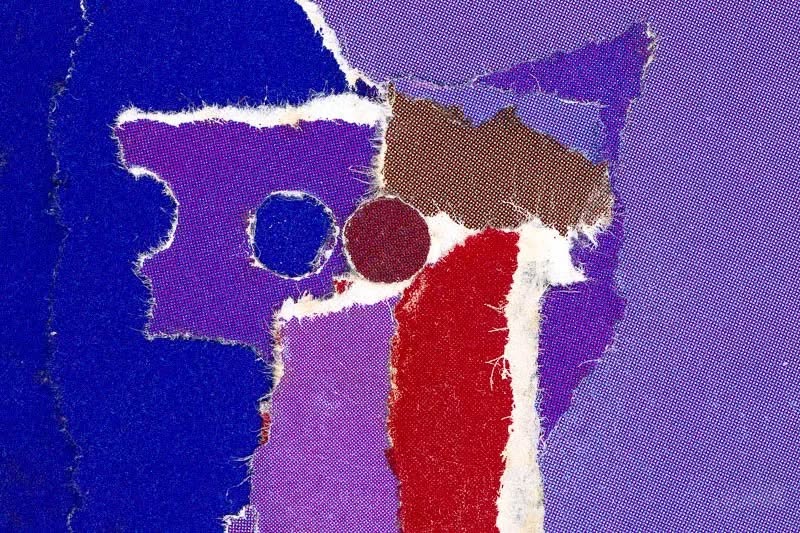
Roberto Pignataro was an Argentine artist, who was particularly engaged in that country’s art movements during the mid-twentieth century. During that time avant-garde visual artists in Argentina used manifestos, public statements and essays to supplement their visual works as expressions of opposition to entrenched centers of political power. Pignataro was skeptical of that approach. He believed that visual art was most impactful when crafted to evoke meaning from the viewer rather than as a vehicle to deliver meaning to them.
Pignataro called his approach abstract storytelling. His works are collections of abstract images without context or supporting narrative. They hint at moods, experiences and behaviors.
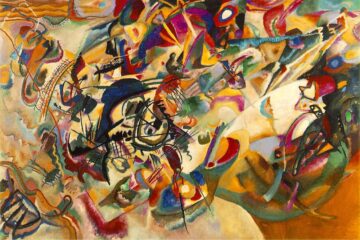
Pictured here is a selection from his second artistic book titled, En Slides Color. The book was a pocket-sized album containing sixteen 35mm slides of projectable abstract collages. Pignataro began by creating a base collage with torn pieces of paper from various magazines, which he arranged into colorful but chaotic compositions. He punched holes into the paper to create negative spaces. He photographed sections of the collage in closeup and created slides of them.
There is a wholeness, an integrity, that underlies each of the small sections that the camera has focused on and turned into a unique piece. A narrative is revealing itself to us as we scan across the album’s slides. But it is one that challenges us to decipher what it is telling us. In the absence of an artist-defined narrative, different viewers will see different meanings. For Pignataro storytelling engenders a covenantal community engaged in a mission of making meaning.
Rabbi Jonathan Sacks was a British Orthodox rabbi who was enamored with the covenantal dimension of American civic life. He observed that covenant societies do not worship tradition for tradition’s sake. “They value the past,” he wrote, “to remind themselves of the collective determination that moved people to create their society in the first place. They make room for outsiders, who become part of the society by taking its story and making it their own, as Ruth did. Covenant societies exist to honor a pledge, a moral bond, an ethical undertaking. That is why telling the story is essential to a covenant society. It reminds all citizens why they are there.” To face an unknown and changing future, not with certainty of outcome but with clarity of purpose and responsibility.
Of all the sacred Jewish texts, there is one that most ingathers the community in engaged and creative discussion: the Passover Haggadah…the story, the telling. Although the Haggadah has a framework, there is no canonized version of it. Every generation, every family reshapes it in response to the issues and questions of the moment. This evolving storytelling is not a disservice to tradition. It honors tradition.
With the destruction of the Temple, the commandment to bring forth first fruits is no longer in effect. However, its spirit lives on. The Passover seder serves as a reenactment of the first fruits (bikkurim) ceremony. Embedded in the Haggadah are verses from the bikkurim ritual in Parshat Ki Tavo, including that referring to an Aramean “who sought to destroy my ancestor.” That verse alone has produced numerous renderings and interpretations over the generations.
Like Pignataro’s slides, the Haggadah has slices of images: food to bless; a history to re-experience; stories of rabbis engaged in mysteries; children erupting with questions; elders hiding symbols, hoping they will be found; doors opened to the unknown. No one of us alone can make sense of it all. And what sense we make together will be different in years to come. But telling the story bears fruit. Freedom becomes ever more precious. And our community more perfect.
Join us here at 7:00 p.m. (PT) on Thursday September 11 as we explore be fruitful, tell a story.
Slide 8 from En Slides Color by Roberto Pignataro