
IN HONOR OF THANKSGIVING, WHICH ENCOURAGES US TO GATHER AROUND A TABLE WITH FAMILY AND FRIENDS, HERE IS A COMMENTARY ON THIS WEEK’S TORAH PORTION PARSHAT VAYETZEI
View the study sheet here. Recording here.
This week many of us will sit around a table of thanksgiving with family and friends. It is an opportunity to reflect on a world that is other than we might wish it to be and to imagine the possibilities nurtured by hope.
Parshat Vayetzei is a tale of Jacob’s journey. Torah presents two reasons for why Jacob is leaving his parents’ home. Each suggests a different state of mind for him. The first is that he is driven by fear, anxious that his brother Esau wants to kill him for tricking their father in to giving Jacob instead of him the ancestral blessing. The second is that Jacob is full of hope as he heads toward a bright future, with the promise of marriage, children and wealth. Which is it: fear or hope?
At the beginning of his journey Jacob has a dream. A ladder with angels going up and down it, and God standing by Jacob. Torah presents two reactions by Jacob to his dream. The first is rapturous awe: “How awesome is this place!” The second is cynical transaction: “If God gives me bread and clothing, then Yud Hei Vav Hei shall be my God.” Which is it: unconditional veneration or selfish dealmaking?
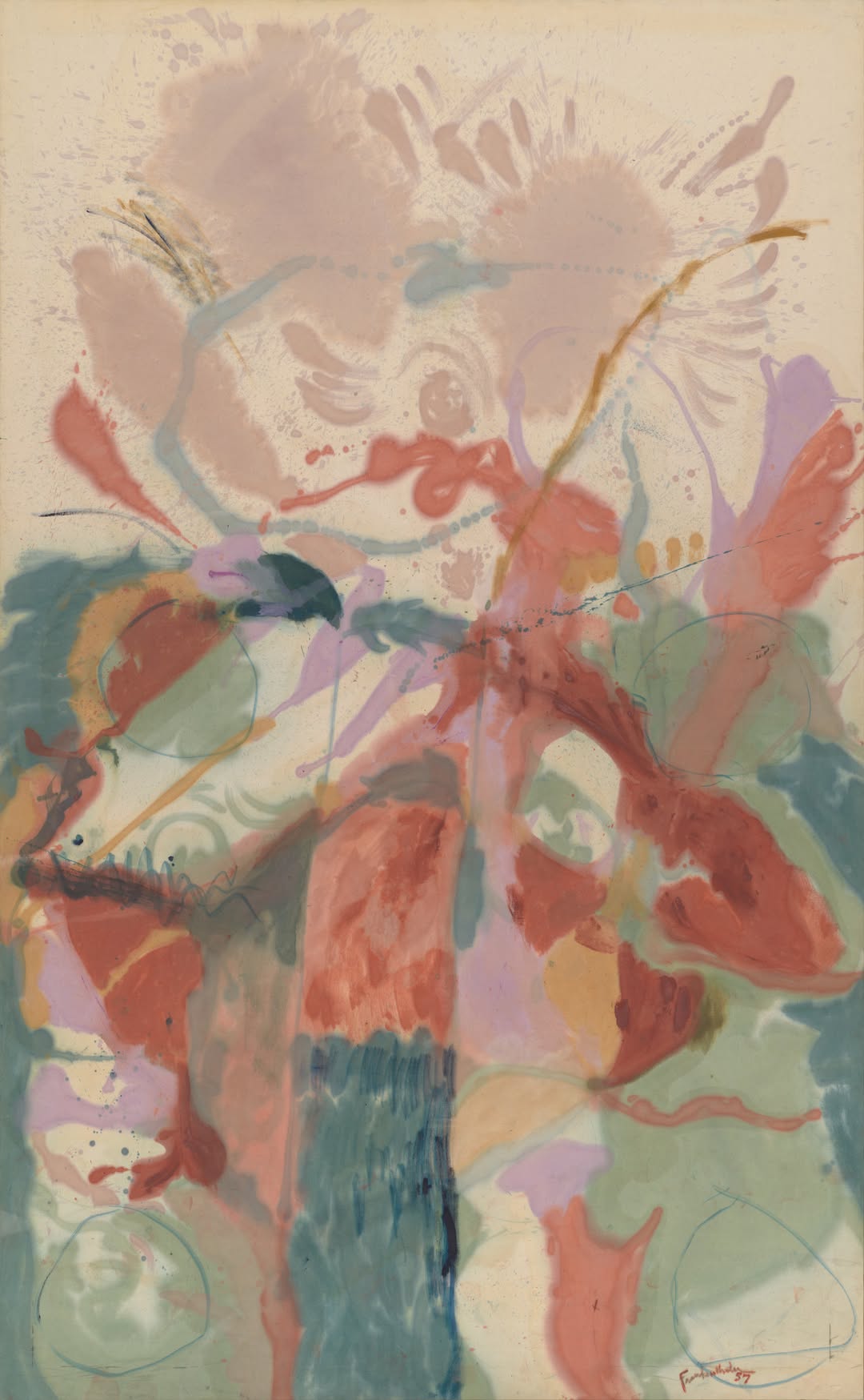
Helen Frankenthaler was one of the great Abstract Expressionists. Pictured here is her work Jacob’s Ladder. Frankenthaler began by placing a blank canvas on the floor and pouring thin oil paint on it. As she continued to work the painting, her eyes moved across its horizontal orientation. When she was done, however, she rotated it and hung it vertically. What began as a visual journey across the width of her floor ends as an exploration up the height of her wall.
The painting’s upward trajectory resolves in pale descriptions of flowers. The ethereal environment of heaven. Deep, commanding colors populate the bottom half. The rich soil of earthly existence. Frankenthaler’s palette allocation captures Torah’s message about the meaning of Jacob’s dream: There may be ascension, separation from the earth, but the power at the canvas’ base reminds us that the trajectory of travel in Jacob’s dream is a return to earth. Where crops grow and herds graze. And people, in all their complexity, live.
With this, Frankenthaler has visually described Torah’s central message: The purpose of a spiritual life is not to separate from the material world in order to live in a divine one; it is to transform this world into one where the divine can dwell.
Like Jacob, we experience both moments of fear and those of hope. How can we turn our anxieties, mistrust and skepticism, into sources of greater love, compassion and connection?
Rabbi Jonathan Sacks wrote in his book Dignity of Difference: “Faith in Judaism means seeing the world exactly as it is and yet not giving up the belief that it could be otherwise, if we are ready to act with others to make it so. Faith is realism that has been touched by hope. And hope has the power to transform the world.”
Where to find hope in this world? One place is in the faces and embrace of those with whom we give thanks this week.
In thanksgiving and gratitude,
Rabbi Steven Moskowitz
Jacob’s Ladder by Helen Frankenthaler