
The way of love has no certainty of a specific outcome. It is a path marked by vulnerability and risk. The promise it offers, though, is beyond measure.
View the study sheet here. Recording here.
Stuart Firestein is the former Chair of the Department of Biological Sciences at Columbia University. His class in cellular and molecular neuroscience required students to read a 1,414-page textbook that weighed 7.7 pounds…more than twice as much as a human brain. One day, lifting and looking at it, he realized that his students must think that most everything in neuroscience is known. He recognized that he had done his students a great disservice. “I had by teaching this course diligently,” he writes, “given the students the idea that science is an accumulation of facts.” He had failed to convey the most critical part of the scientific enterprise: the role of ignorance.
To correct the misapprehension that science is primarily concerned with answers, Firestein wrote Ignorance: How It Drives Science. It is a celebration of a tolerance for uncertainty, the pleasures of mysteries and the cultivation of doubt. “The truth, the correct answer,” Firestein writes, “is narrow. It doesn’t go anywhere. Whereas there are endless ways to screw up, and many of them are quite interesting. They take you down new pathways. Quite often, the screw-ups are really where the data comes out.” The purpose of knowledge is to inspire new questions.
The ability to thrive with uncertainty has become increasingly difficult to develop in our information age. In the mid-1990s researchers at Université Laval in Canada, led by professor of psychology Michel Dugas, explored the relationship between an intolerance of uncertainty and Generalized Anxiety Disorder. They found that those who viewed unknowns as threats rather than as challenges tended to have poorer skills coping with changing circumstances. They were more vulnerable to mental health challenges such as anxiety, eating disorders and depression.
Based on his findings, Dr. Dugas and his team developed therapeutic protocols that helped those with generalized anxiety to reduce their aversion to not knowing by experiencing uncertainty in small and managed doses. An important element of such protocols is creating a culture of uncertainty tolerance, in which open-mindedness, flexibility and curiosity are prized. To see not knowing not as a weakness but as a strength.
Uncertainty is deeply embedded in the artwork of Julie Mehretu. Born in Addis Ababa, Ethiopia, in 1970, to an Ethiopian college professor of geography and a Jewish American Montessori teacher, Mehretu and her family fled the country in 1977 to escape political turmoil. They moved to East Lansing, Michigan, for her father’s teaching position in economic geography at Michigan State University. Her family’s uprootedness, breadth of cultural traditions and her own experiences with global disruptions inform her art.
Her work is primarily abstract, which she views as a visual vocabulary best capable of expressing life in process, reality that is dynamic rather than settled. Her canvases often contain layered fragments of architecture, blurred documentary images and marks of agitation as wells as those of stillness. News events, of global disorder and immigration crises, may find a home there as might more personal encounters. She is open to contradiction, to intuition, to not knowing. In an interview she said, “I’m interested in the space in between, the moment of imagining what is possible and yet not knowing what that is.”
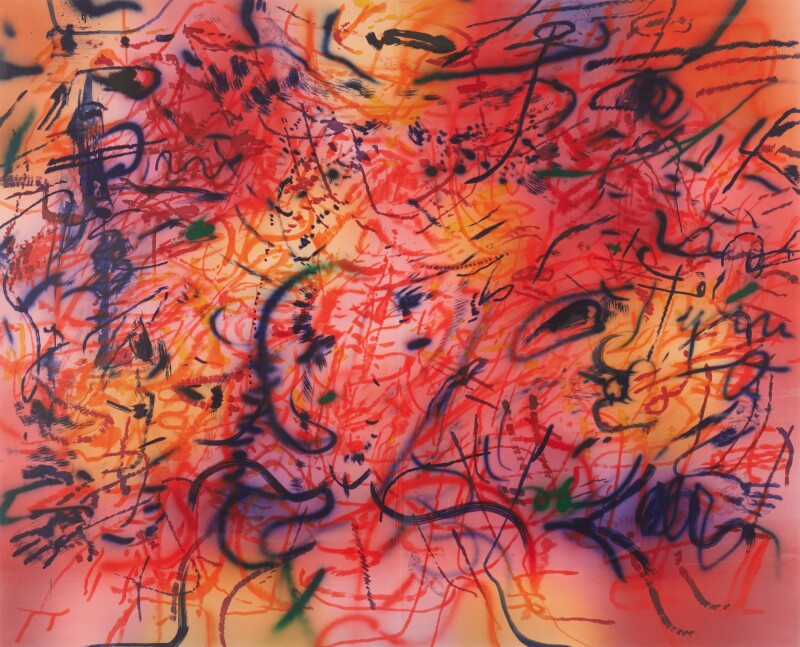
Presented here is her piece Fourth Seal. It is one of four in a series titled Slouching Towards Bethlehem. That title evokes Joan Didion’s 1967 essay Slouching Towards Bethlehem, which in turn calls forth William B. Yeats’ poem The Second Coming. Both of those literary pieces describe a moment of reigning chaos, a moment in time when everything seems to culminate and fall apart. Mehretu’s Fourth Seal, with its turbulence and conflagration in red and yellow, spills forth the unleashing of potential destruction written about in the book of Revelation, as a fourth horse ridden by death storms across the land killing with sword, famine, plague and wild animals.
Painted during 2019-2020, the four pieces of Slouching Towards Bethlehem are not a matter of prophesy by Mehretu. They are expressions of one aspect at work in the world as she is experiencing it. She presents the images to us more as questions than as certainties. “Art’s job,” she writes, “is to complicate as much as possible…That’s where radical possibility exists. Imagining other possibilities is how things change.”
Parshat Vayeshev (“he settled”) presents alternative ways of living in the world. The first was actually offered at the end of last week’s portion, where the text describes Esau as going to “a land.” The use of the indefinite article “a” indicates that Esau is not interested in the family goal of dwelling in the “promised” land, that which is part of the Covenantal enterprise. He just wants some place to settle down and raise his family and his herds.
By contrast, Jacob chooses to embrace the familial Covenantal enterprise, including the divine promise that “your offspring shall be sojourners in a land not theirs.” Esau chooses what is known and immediately available, free of any obligation. Jacob chooses the long way, a way of constant dislocation, challenge and disruption.
The Hasidic sage known as the Ishbitzer, in commenting on Jacob and Esau’s respective choices, acknowledges the human desire for stability and peace. But Esau’s way does not promote human growth and development. It is the way of easy answers. Jacob’s way, as full of agitation and turmoil as it might be, allows human beings to grow beyond who they are today. He writes, “As long as a human being lives in a bodily experience, it is impossible to behave with extreme wariness and fear and humility. God wants human acts, and in this world human beings must act in love, in ways that are not completely clarified.”
The way of love is not the risk-free way. It is the way of vulnerability. There is no guarantee of a specific outcome. It is a journey of shared effort and growth. It is the path of a covenantal relationship. Through it we discover what it truly means to be human, and thereby discover what is divine.
Join us here at 7:00 p.m. (PT) on Thursday December 11 as we explore acts of love.
Fourth Seal by Julie Mehretu