
Appearances are constantly coming into our lives. They have the power to unlock the treasures of love, compassion and justice that are our spiritual inheritance.
View the study sheet here. Recording here.
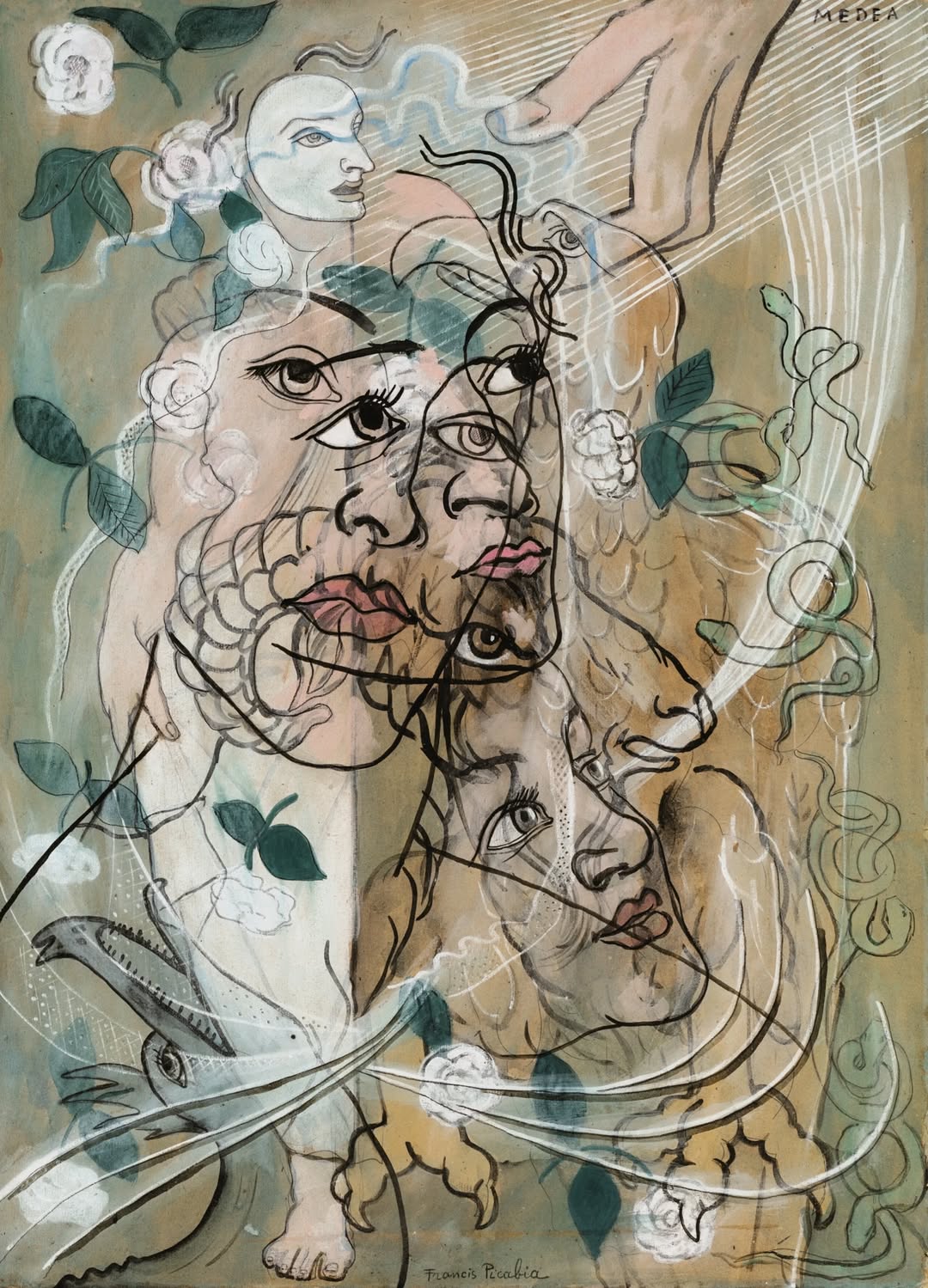
Francis Picabia was one of the principal members of the Dada movement, which consisted of artists driven by a rage against European culture that they believed had led to the carnage of World War I. Picabia, who relished his role as prankster, poked at and mocked conventional notions of morality, religion and law. Sometimes the target of his humor extended even to his own colleagues. He remarked, “Artists, so they say, make fun of the bourgeoisie; me, I make fun of the bourgeoisie and the artists.”
During a five-year period, however, from about 1927 to 1932, Picabia shifted focus. Instead of filling his canvasses with references to modern culture, he reached back centuries. To themes from Greek mythology and to compositional references from the Renaissance. Collectively, these works became known as his Transparencies. In that series, Picabia superimposed multiple translucent images onto a single surface, creating a layered, dreamlike effect.
Despite their name, the paintings from this period are anything but transparent. They resist a single narrative, challenging us with their ambiguity and their confoundment of sources. Pictured here is his transparency Médéa. The subject of the work is the Greek myth of Jason and his search for the Golden Fleece, during which he is aided by Medea and her magical powers.
In the painting appear three female figures, layered upon one another. All three are inspired by paintings by the Renaissance artist Botticelli. Two are from his work Madonna of the Pomegranate. The third is from his painting Venus and Mars. None of those are characters involved in the Greek myth that inspired Picabia’s painting. Emerging in the middle of the painting, among the faces of the three women, is a ram’s head, evoking the object of Jason’s quest. Making an appearance in the bottom left portion is a serpent, a memory of Jason’s final test, which was to get past a watchful dragon.
This blending of stories across centuries and fusion of Renaissance and Dadaist-Surrealist styles creates a miasma of dreamlike associations. The source of it all seems to be less a detached scholarly study of either the myth of Jason, the story of Jesus or the tale about Venus than a psychological exploration of birth, mission, death, and rebirth. So many images struggling to the surface, each seeking a piece of the artist’s attention and a place on his canvass. Picabia’s art dealer, Leonce Rosenberg, described Médéa as “the association of the visible and the invisible.”
Jason and the Golden Fleece was a central part of Joseph Campbell’s exploration of myths and legends. Campbell identified that at the core of these stories from many different cultures was the hero’s journey. The elements of this archetypal story are a hero venturing from the ordinary world into a realm of wonder, facing formidable tests and eventually gaining a power that bestows blessings upon humanity. As noted by Dr. Jessica Koehler in Psychology Today, while describing an external adventure “the hero’s journey mirrors the inner transformative odyssey every individual embarks upon in their lifetime.”
In Parshat Lech Lecha we met Abraham, who was called to uproot himself and journey to another land and become a blessing “to all the families of the earth.” We know that he will confront many challenges along the way, perhaps none greater than those he faces in this week’s portion, Vayera (“appeared”), where he will be told to cast Hagar and Ishmael out from the family camp and, later, to sacrifice Isaac as a burnt offering to God.
The portion begins with an appearance, actually two appearances that seem to superimpose themselves on each other, as in Picabia’s painting. The text opens stating that “God appeared” to Abraham. But when Abraham looks up, he sees “three men standing by him.”
The verb “appear” is itself in an odd construct. It is in the Hebrew niphal form, which typically means a passive or reflexive action. Here, a grammatically nuanced translation might be God “was appeared” or “caused Godself appear.” This is not Abraham having an external siting with his eyes. An appearance from some non-external dimension has made itself known to Abraham. Whatever that awakening was, Abraham responded to it by providing hospitality to three travelers.
The appearance described in the opening verse of Parshat Vayera impels Abraham, once the three men have left, to challenge God over the righteousness of destroying Sodom and Gomorrah. Whatever the source or nature of the opening appearance, it has now become activated within Abraham as ignition both for hospitality towards strangers and for justice even for those one has never met.
Abraham’s greatest trial occurs towards the end of the portion. He is instructed to sacrifice Isaac on Mount Moriah. The text can be read as if Abraham is prepared to slay his son and is only restrained by the intervention of an angel. But an early midrash looks at the verse’s precise wording – “The angel said, ‘Do not lay your hand against the boy’” – and wonders: why does it say “hand” instead of knife? The midrash concludes: Because “Abraham’s eyes were looking into Isaac’s eyes, and tears were flowing and falling from Abraham’s eyes,” and the tears dissolved the knife. Abraham had restrained himself and abandoned the ritual sacrifice prior to any divine intervention.
Immediately upon his resolution of that crisis, Abraham declares that Mount Moriah is to be known as Adonai yireh. The verb yireh means “appear” and is in the same niphal form used in the opening verse of Vayera, only now it is in the future tense. In moments of profound conflict and crisis, God “will cause Godself to appear” and be available to us. Not as an external force, but internally as a capacity to act with love, compassion and justice.
Francis Picabia explored with his transparencies the layers that we carry within us, each with a lesson and a guidance to share. Joseph Campbell identified the archetypal journey we can go through as we transform ourselves into blessed beings. And Torah urges us to awaken to the appearances that are constantly coming, unlocking within us the treasures of love, compassion and justice that are our spiritual inheritance.
Join us here at 7:00 p.m. (PT) on Thursday November 6 as we explore the power of an appearance.
Médéa by Francis Picabia