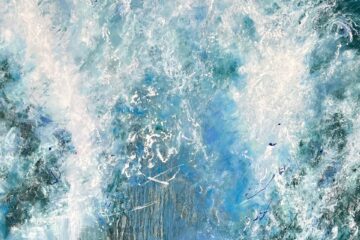

The way to the promise of fulfillment, fruition and peace requires an un-knowing of those certainties that serve only to blunt our capacity for love, compassion and connection.
View the study sheet here. Recording here.

Leonard Bernstein took a sabbatical from the New York Philharmonic during its 1964-1965 season. The preceding year had been an emotionally challenging time for him. Shaken by the assassination of President Kennedy, Bernstein paid tribute to the fallen president two days later, November 24, by leading the Philharmonic in a performance of Mahler’s Symphony No. 2 (Resurrection).
The next evening the United Jewish Appeal of Greater New York held its annual fund raiser for aid on behalf of Israel. That event became a memorial to the slain president. Bernstein stepped up before the assembled crowd and began by quoting Kennedy, “America’s leadership must be guided by learning and reason.” He then remarked: “Learning and reason: the two basic precepts of all Jewish tradition, the twin sources from which every Jewish mind from Abraham and Moses to Freud and Einstein has drawn its living power….We musicians, like everyone else, are numb with sorrow at this murder, and with rage at the senselessness of the crime. But this sorrow and rage will not inflame us to seek retribution; rather they will inflame our art. Our music will never again be quite the same. This will be our reply to violence: to make music more intensely, more beautifully, more devotedly than ever before.”
A year later, Bernstein’s dear friend Marc Blitzstein was murdered. Bernstein’s initial plan for his sabbatical had been to compose a Broadway musical based on Thornton Wilder’s novel The Skin of Our Teeth. The title is from the Book of Job (“My bones stick to my skin and flesh; I escape with the skin of my teeth”). The novel explores human resilience in the face of numerous catastrophes. Bernstein found himself unable to proceed: “I don’t know what I’m writing. I don’t even know what I’m not writing…I can’t get over Kennedy or Marc. Life is a tooth without a skin.”
It was in that state of “not knowing” that Bernstein began his sabbatical. The vacuum created by the failure of the Skin of Our Teeth project ended up being filled by an invitation from the Very Reverend Water Hussey, Dean of the Cathedral of Chichester in Sussex, England, to compose a piece for the Cathedral’s 1965 music festival. Bernstein responded by composing Chichester Psalms, a choral work in three movements constructed around Psalms 2, 23, 100, 108, 131, and 133. Bernstein insisted that all of the text be sung in Hebrew.
The first movement opens triumphantly with text from Psalm 108 (“Awake, O harp and lyre!”) and dances into Psalm 100 (“Make a joyful noise unto the Lord!”). The second movement presents a lyrical setting of Psalm 23, which is interrupted by agitated music to words from Psalm 2 (“Why do the nations rage?”). The final movement uplifts with a visionary plea for reconciliation and unity, concluding with “Amen.”
By combining Jewish liturgical Hebrew text with Christian choral tradition, Bernstein was painting a setting of hope for human elevation and unity and issuing a plea for peace in Israel in particular (“Why do the nations rage and peoples plot vain things; kings of the earth take a stand and regents intrigue against the Lord and His anointed?”).
With his initial plan shattered and in a state of “not knowing,” Bernstein composed during his sabbatical a piece of transcendence and grace.
In an article at the conclusion of his sabbatical, Bernstein wrote that the great benefit of a sabbatical year is that “perceptions, established certainties will begin to crumble, and the other side of any controversy will beckon appealingly…the answer is in the questioning. By experimenting with a problem, by feeling it out, by living with it, we are answered…”
“A work of art,” Bernstein continued, “does not answer questions: it provokes them; and its essential meaning is in the tension between their contradictory answers.” Not knowing becomes a source of wisdom and surprising creativity.
Parshat Toldot (“generations”) opens with Rebecca in the throes of giving birth. She cries out, “Lameh zeh anochi” (“Why is there this ‘I-ness?/Why do I exist?”).
Both “anochi” and “ani” can mean “I.” The 19th century Hasidic rabbi Mei HaShiloach notes that God uses Anochi when directly presenting the Ten Commandments and its wisdom to the Israelites. Anochi is ani with the insertion of the letter caf, which means “like,” allowing Anochi to be nuanced as “like I.” Had Ani been used instead, he writes, it would mean that God had revealed everything in perfect clarity to Israel, which would have given them no incentive to question, ponder and reflect. Anochi indicates not perfection but a “state of non-completeness.” The moment at Sinai is a pro-voking, a calling of the people to abandon old certainties and to embark on a journey of discovery.
The same year that Leonard Bernstein embarked on his sabbatical in a state of “not knowing,” artist Paul Brach and Jewish theologian and novelist Arthur Cohen collaborated on a portfolio of ten textual statements and ten illustrations, The Negative Way. It is a work in the tradition of kabbalah, which resists the human temptation to finalize knowledge generally, and knowledge of God in particular. In their work, Torah is not a book of answers. It is an undermining of final conclusions. To get on the way to wisdom, fulfillment and peace requires emptying oneself of certainty.
Pictured here is Brach’s The Negative Way #10. It accompanies Cohen’s Text #10, which includes these words: “God’s nowhere is a portion of man’s somewhere.” To be divinely present requires finding one’s nowhere-ness.
The Torah is written without punctuation. Immediately following her crying out, Rebecca goes “to inquire of God.” Rebecca’s cry in the process of birthing new life may begin as a question (“Why is there this ‘I-ness?’”), but it can be read as transforming into a statement (“Why, there is this ‘I-ness’”!). Her “not knowing” opens her up to exploration and interrogation. And the result is that “Adonai (Yud-Hei-Vav-Hei/Beingness) answered her.”
Bernstein’s rhapsodic generation of choral celebration of peace and unity resulted not from preconceived certainty. It emerged from tragedy, loss and spiritual dislocation…from experiencing life as “a tooth without a skin.” The restorative answer was “in the questioning.”
By opening ourselves up to our worry, “by feeling it out, by living with it, we are answered”…as was Rebecca. We become the generators of a new self and a new world. The bearers of blessings.
Join us here at 7:00 p.m. (PT) on Thursday November 20 as we explore the blessings of generations.
The Negative Way #10 by Paul Brach