
A resilient life is one that returns again and again after loses and setbacks to the daily tasks of life. In the course of doing so, we expand our connection to that which is everlasting.
View the study sheet here. Recording here.
Last year the Pew Research Center asked 50,000 individuals in three dozen countries: “Do you believe there is life after death?” In most of the nations surveyed, a majority of adults answered either “definitely” or “probably.” In the United States, 70% of adults say there is definitely an afterlife of some kind. According to the study, 83% of Christians in the United States believe in a life after death. Among American Jews, the Pew survey found, 38% believe in life after death.
If the Pew Research Center had been conducting surveys in the Ancient World, it would have found that 100% of those civilizations had a belief in life after death. With one exception. The Israelite nation, at least during its first 1,000 years of existence, had no rituals or sacred writings expressing such a concept. The Jewish Bible views death as absolutely final. Human beings die. They do not live again as individuals in either an embodied or spiritualized manner in another dimension. Their continuing presence in this one, however, is another matter.
Parshat Vayechi (“he lived”) begins and ends with a death. The portion opens with Jacob preparing to die. He convenes his family, directs that he should be buried with his ancestors in Canaan and blesses each son. The portion ends with the death of Joseph. His final words to his family are a reaffirmation of the divine promise of their eventual redemption from the exile that is Egypt.
The portion’s name, vayechi, evokes that of another portion about death, that of Sarah: Chayei Sarah (“the life of Sarah”). Both names are derived from the same Hebrew word, hayah (“to live”). What is curious about Chayei Sarah is that it is very little about Sarah and her death. That occurs in the first two verses. The remaining 103 verses tell about Abraham’s search to find a wife for his son Isaac; his servant’s encounter with Rebecca at a well; her demonstration of character by providing life-saving water not only for Abraham’s servant but also for his camels; Rebecca’s return to marry Isaac; and Abraham’s own remarriage and fathering of more children.
Chayei Sarah does not dwell on her death. It quickly corrects course back on to the path of life and its urgencies: marriage; water; the care and feeding of both humans and animals; hospitality; and more children. The story of Sarah’s death is a narrative about life renewed.
With that association between death and the continuation of life, we can read about the deaths of Jacob and Joseph differently. What we might have otherwise thought to be a tale about the end of life is really about life’s renewal. Not in some ethereal dimension but in the grit and responsibilities of this one.
The artist Dona Nelson was born in the no-nonsense soil of the Midwest. She grew up in Nebraska, Indiana and Ohio. Her mother was a grade school teacher and a Brownie leader…and an artist. When she was in the second grade, Nelson accompanied her mother to art classes in Kokomo, Indiana. At the age of eleven, she took an art class with her mother in their church basement in Columbus, Ohio, where her mother painted scenes of rural and village life. “I always loved my mother’s paintings and pastels,” she said in an interview, “even though they were just tiny little paintings. You might think that they’re basically calendar scenes, but I always found them very moving and really authentic.”
Nelson moved to New York when she was twenty and immersed herself in its dynamic art world, with its jostling among abstract, representational and Pop art painters. She herself has often crossed from one style to another, and then sometimes back again, defying the constraints of any single approach.
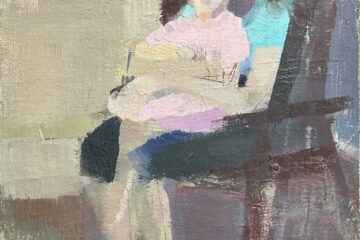
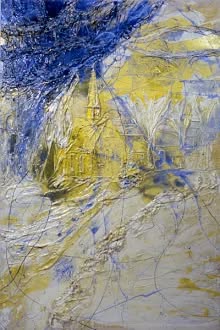
In 2000, she returned home…in a sense. In that church art class some forty years ago, her mother had drawn a small pastel of a village, with a church in its center. Nelson was drawn to the enduring connection that binds one generation to the next. But rather than replicate the image, Nelson explored how to bring her mother forward into her own artistic journey. One of four paintings that she did as part of that honoring of her mother is pictured here, My Home II. Instead of her mother’s pastels, Nelson has brought the past forward with cheesecloth, modeling paste, acrylic, and acrylic mediums. Her mother’s representational image is now merged with Nelson’s abstract presentation.
When her My Home paintings were exhibited in 2018, she was interviewed by BrooklynRail magazine. The interviewer probed Nelson about the extent to which the physical process of painting takes her to a spiritual plane: “Do you think that literal objects in our life…serve as portals into the spiritual plane?” Nelson would have none of it. “No. Reality is the spiritual plane. I don’t like the idea that I have to go someplace. I like the idea that I’m here.”
Absent from the Jewish Bible is any emphasis on transcendence of the material. Elevation takes place on a very earthly plane. Salvation is not that of an individual’s disembodied soul. It is the reunification of a dispersed people and the restoration of national sovereignty.
From the moment of Abraham’s encounter with God, the mission has been adherence to and fulfillment of a covenant with God: that partnership in which human beings would grow ever more responsible for the world’s moral construction. Participation in the covenant is rewarded not by transition into a heavenly dimension. The reward is the drawing down of heaven to earth.
Torah’s approach to life is one that celebrates “the idea that I’m here.” Parshat Vayechi is not only the end of two lives, Jacob’s and Joseph’s. It is also the end of the book of Genesis. What follows is Shemot (“names”), the story of people no longer merely a family but a nation. It tells of the fulfillment of the divine promise “your descendants will be strangers in a land that is not their own.” This is where a nation will be trained in the art of resilience, in the moral quality of compassion and in the ethical call of freedom. All in the service of creating a world where the divine can dwell.
Join us here at 7:00 p.m. (PT) on Thursday January 1 as we explore a resilient life.
My Home II by Dona Nelson