
To breathe unconstricted from fears and pains of the past and anxieties about the future is the breath of redemption.
View the study sheet here. Recording here.

There is a moment in the biblical story of creation when the human being is only a shapened mound of earth. No consciousness. No will. No purpose. And then God blows into the human being’s nose “and the human became a living being.” Immediately thereafter, a garden springs forth, radiant and fruitful trees appear, and knowledge, of both good and evil, becomes one of creation’s most consequential harvests. No longer is the world governed solely by natural cycles. Human choice becomes a factor.
We don’t have to make choices about our breathing, however. It is controlled by the autonomic nervous system, specifically the brainstem’s medulla oblongata, which manages involuntary functions like heart rate, circulation and digestion. The lungs, essential organs of the respiratory system, are a wonder of design. They pack some 480 million gas exchange units, alveoli, into a small area. The tubes of our lungs, if arranged on end, would stretch for about fifteen hundred miles. Each day we take around 20,000 breaths, 7.5 million each year.
Breath animates the human, turning it from a lump of earth into a conscious, purpose-driven being. It engines men and women in Torah’s epic tale of settlement and exile, honor and shame, moral ennoblement and degradation.
The Hebrew word for nose is af. It is derived from the verb anaf, which is usually translated as “to be angry.” The same word rendered as “nose” is also used in the Bible to mean “anger.” There is the hint that the divine gift of breath, once it passes through the human portal, carries into the human system something of both the purity of its source and the moral imperfection of its mortal host. Perhaps breathing requires some kind of choice after all.
In Parshat Vaera (“I appeared”) the Israelites, then slaves in Egypt, are presented with the opportunity of redemption. But when Moses presents to them the divine message of freedom and fulfillment of the promise of a land of their own, they cannot hear that message “because of shortness of breath.” The Hebrew word for “shortness,” kotseir, is from the verb “to be ineffective, powerless.” That same verb is also the root for the noun “impatience.” At the heart of the Israelites’ deafness to the possibility of redemption is an aspect of their being which is subject to conscious development and control. Torah points us to a connection between one’s breathing and one’s openness to making a new life for oneself.
Conscious breathing has been a part of human spiritual and psychological life for millennia. In India, masters of yogic practices developed over a thousand years ago forty-nine different breathing practices designed to cleanse body and mind in order to promote equilibrium and unity as part of their exploration of the self and the cosmos.
Taoist disciplines such as tai chi and qigong incorporated breathing methods to achieve higher levels of wellbeing, attunement with one’s internal state of being, and greater influence over one’s disposition. The Talmud hints that the early rabbis also practiced some forms of breathing practices to attain alternate mental states.
Today there is a rich body of literature within the medical and therapeutic communities about the value of various conscious breathing techniques designed to calm the mind, manage stress and ground oneself in the present moment.
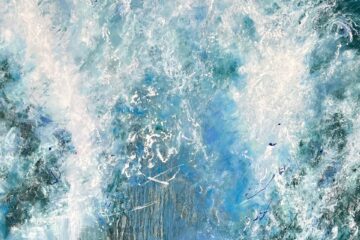
Ten years ago the Danish artist Jeppe Hein suffered an emotional breakdown. To restore himself he began a practice of conscious breathing. He incorporated the technique into his artwork. Initially, he did this through a series of “Breathing Watercolors,” where the lengths and depths of his breathing guided the execution of his brushstrokes. Pictured here is a work from that series. He then began to invite visitors to his exhibitions to do the same, to paint their breath on canvasses set up on the walls.
This act of focusing on and painting their breath was transformative both individually and collectively for the participants. Hein said, “I try to encourage people to focus on their body and mind at the present moment and to enter into an inner dialogue. By painting their own breath onto a medium, they will not only be able to experience their breath, body and mind in the here and now, but also be part of a collectively experienced moment with their environment.”
Hein’s work became a global engagement art project known as Breathe with Me. In partnership with Art 2030, a nonprofit organization that works with art to inspire action for a sustainable future, Breathe with Me was launched at the United Nations’ Youth Climate Summit in 2019. Dignitaries and diplomats painted their own breath on an undulating canvas wall weaving its ways through the lobby of the UN headquarters.
Subsequent to the UN presentation, Hein turned his project into a larger installation in Central Park. The public was invited to paint their breath over six large canvas waves, spanning 600 feet and winding its way through the park. For Hein, the goal was to have the public visualize the invisible, “our breath and the resulting relation between us, reminding us to cooperate if we want to share this world together today and in the future. Ideally, it will encourage people to conspire, as in Latin conspirare means to breathe together.”
In exploring the Israelites’ difficulty in accepting that redemption was possible, the Hasidic master known as Sefat Emet identified its source as “obstructed breathing.” Their spiritual airways had absorbed too much of the culture around them: idolatry, the worship of material wealth, physical power as a measure of sovereignty. A life lived in exile had reshaped the Israelites’ internal being. Their hopes had become shriveled. Their breathing had become short, panting, desperate.
Sefat Emet paints a picture not of an oppressed people ready to join in rebellion against their masters and in the construction of a new world of freedom and responsibility. Getting out of Egypt will be much, much easier than getting Egypt out of themselves. The journey towards divine promise will be a long march through a wilderness not just of deserts, rivers and mountains but, more importantly, of the people’s own fearful, grievant, negative tendencies.
Jeppe Hein did not paint an ideal world for others to behold. Instead, he handed paint brushes to others so that their breaths would become part of a global canvass of aspiration. Torah too has a collective creative project. It is the ongoing telling of the Exodus story, with each generation and each one of us telling it slightly differently. It is our canvass for self-discovery and for the designing of a fuller, imagined life.
Sefat Emet wrote that “in the act of telling about the Exodus, the miracle itself is continually fulfilled and enhanced. That’s what the tale does: it keeps drawing out further potential.”
The story of the Exodus is not about what happened. It is about what is happening. To engage in such an exploration and development of self and community is the breath of redemption.
Join us here at 7:00 p.m. (PT) on Thursday January 15 as we explore the breath of redemption.
Breathing Watercolor by Jeppe Hein