
A home that welcomes the unexpected, the visitor, is one constructed for glory and beauty.
View the study sheet here. Recording here.
Shattered norms. Broken institutions. Disparity in wealth. Cultural divides. Hyper partisanship. Social divisions. Political violence. Sides chosen and not crossed.
In the middle of social upheaval, one can experience a sense of increasing polarization that seems to sharpen differences into absolute dichotomies. Right and wrong. Good and evil. Self-reflection and transformation of self become casualties. Self-defense and defeat of the other become greater priorities.
Someday someone will write a great novel that will become a classic about the times through which we are living. Until then we might turn to Charles Dickens’ masterpiece A Tale of Two Cities.
The unnamed narrator opens with the iconic lines: “It was the best of times, it was the worst of times, it was the age of wisdom, it was the age of foolishness, it was the epoch of belief, it was the epoch of incredulity, it was the season of Light, it was the season of Darkness, it was the spring of hope, it was the winter of despair…”
Stopping there, one might sense that Dickens is describing a society divided between forces of liberation aligned against those of oppression. But the narrator continues:
“…we had everything before us, we had nothing before us, we were all going to Heaven, we were all going to Hell.” The use of the first-person plural hints that all those qualities quoted in the earlier paragraph flow in and among the people of the story. The lines appear more fluid. The characters move not only in march-step or rigid formation. They also move in a flow that describes the complexity of human behavior at the heart of Dickens’ novel.
Dickens’ description in his novel of a dance captures that human complexity. Hundreds of people dance to the revolutionary song, La Carmagnole. They sing of the queen’s treachery, of the king’s buffoonery. Quickly partisan fervor descends into frenzied ecstasy. Blood lust is unleashed. Dickens writes: “No fight could have been half so terrible as this dance….a healthy pastime changed into a means of angering the blood, bewildering the senses, and steeling the heart. Such grace as was visible in it, made it the uglier, showing how warped and perverted all things good by nature were become.”
One of the tragic dynamics of the French Revolution was that some of its most fervent advocates turned into versions of those they toppled. Engaged in a fight against an absolute monarchy, many revolutionaries adopted tyrannical methods: arbitrary arrests, censorship, and widespread executions. During the Reign of Terror, the revolution executed or killed over 40,000 citizens.
It seems that the tyranny that had ruled over them became a source of moral infection within tyranny’s opposition. The culture of power, oppression and intolerance reappeared in mutated form even as the Bastille fell and the guillotine was erected.
In the middle of another era of social upheaval and violence, the poet Wallace Stevens gave a speech in 1942 at Princeton in which he addressed the chaos of the previous decade and the current violent world upheaval that was World War II.
Stevens said, “We are confronting a set of events, not only beyond our power to tranquilize them in the mind…but events that stir the emotions to violence.” Such events are so disruptive of normal patterns of human perception, assessment and response that they narrow what we imagine is possible.
To counteract such human contraction, Stevens summons forth the power of imagination to give voice to a new reality, one based not on abstract ideals or the lure toward violent division. We can, he writes, construct from within ourselves a world of tolerance, compassion and peace.
Stevens titled his speech “Necessary Angel,” after a line from his poem “Angel Surrounded by Paysans.” The poem was inspired by his contemplation of a painting by French artist Pierre Tal-Coat. It is a still-life painting, consisting of a Venetian glass bowl, terrines, bottles, and glasses. As he gazed upon it, he saw an angel around whom gathered peasants. His poem takes the dramatic form of a biblical episode: a peasant opening the door to welcome a visitor, an angel.
The angel announces that he is not one of heaven’s angels. He bears no otherworldly appearance, has no more knowledge than any of the peasants, has no enduring presence. I am the angel of reality/Seen for the moment standing in the door…I am one of you and being one of you/Is being and knowing what I am and know/Yet I am the necessary angel of earth/Since, in my sight, you see the earth again.
Stevens’ “angel of reality” bears the message that the answers to our fears and confusions rest here, with us, with our fleeting presence and our necessarily fluid perceptions of reality. Our power rests not in holding onto things but in embracing impermanence. Meaning is found not in the transcendent but in the mundane.
For hundreds of years the world of art was shaped by the pursuit of idealized notions of truth and beauty. The Northern European Renaissance of the 15th century, with artists such as Van Eyck, Bruegel and Bosch, challenged that approach. They brought art down to earth. They painted scenes of harvesters, peasants, tradespeople, and merchants. Beauty became a matter of everyday life. The moment, not just the transcendent, had value.
The revolution launched by those painters reached a compelling climax with the Impressionists. With their focus on the transiency of time, the fleeting presence of light, the value of everyday life, and the role of artistic subjectivity, they changed not only what and how artists painted but also how art was exhibited and sold.
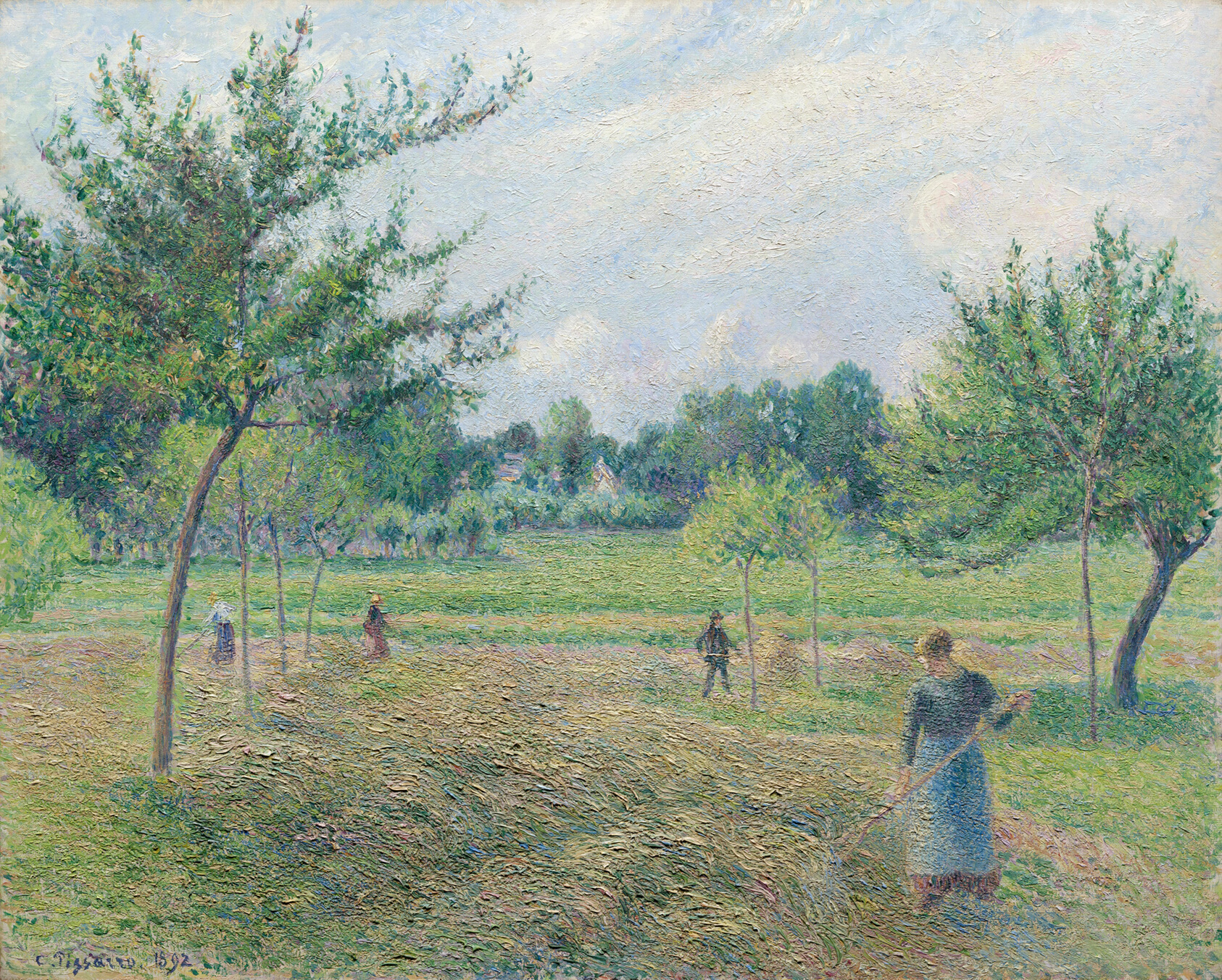
Pictured here is Haymaking in Éragny by Camille Pissarro. In the foreground is a woman raking in the harvest, while others share in the work in the background. Framing the grain field is a small orchard. Two trees in the foreground curve slightly, giving a sense of movement. In the sky are shifting wisps of clouds, whose almost intangibility is countered by thick layers of paint that rise off the canvass.
Haymaking in Éragny is a landscape…but it is a humanized landscape. Pissarro painted very few landscapes without a human figure. The human as a part of natural life was a defining aspect of Pissarro’s work. His canvases give presence to and honor domestic help, rural workers and those selling their wares in village markets.
A member of a diasporic Sephardic Jewish family and born on the island of St. Thomas, far from the center of artistic life, Pissarro had compassion for and elevated the non-privileged, the everyday. With his paintbrush he blessed them as conveyors of beauty. He wrote, “Blessed are they who see beautiful things in humble places where other people see nothing.”
Parshat Tetzaveh (“you shall instruct”) describes the priestly vestments to be worn by Aaron and his sons. They are to be designed as garments of glory (kavod) and beauty (tiferet). The Hebrew word kavod is used everywhere else in Torah only to describe God. Here it is applied to a human being. Some kind of transfer is occurring.
That transfer from heaven to earth occurs during the long journey of the Israelites toward a dimension of sovereignty and responsibility, a placed called “home.” The trek through the wilderness reveals itself to be a poetic description of what is needed in order to reach home. It is not enough to be free from Egypt. One needs to free oneself of Egypt.
How to free ourselves from the grip of Egypt inside of ourselves is hinted at by a remarkable feature of Parshat Tetzaveh. It is the only post-Genesis portion in Torah in which Moses is not mentioned by name. To gain sacred personal sovereignty requires the diminishment of one’s ego. In return, one becomes bigger than one ever imagined.
The second quality of the priestly garments is that they display tiferet (beauty). That word is used only three times in Torah. Twice in Parshat Tetzaveh and once in Deuteronomy, where Moses announces to the people: “God made you for praise, for a name, and for tiferet.”
However troubling, destructively cynical and brutal any time might be, we can rise to the occasion as “necessary angels of the earth.” We are endowed with beauty. And we recognize that the home that we seek is one of our own making. A home ready to welcome visitors to share with us our yearning to “see the earth again.”
Join us here at 7:00 p.m. (PT) on Thursday February 26as we explore an angel of earth.
Haymaking in Éragny by Camille Pissarro