
The path towards peace, fulfillment and responsibility involves shedding absolute certainty and the urge to control other than ourselves.
View the study sheet here. Recording here.
Located on the western edge of Paris is the Bois de Boulogne, a public park that at 2,088 acres is two and a half times the size of New York City’s Central Park. It is a remnant of a royal hunting reserve which was burnt to the ground during the Hundred Years War. King Louis XI replanted the forest in the mid-15th century. In 1852 Napoleon III designed it with large lawns, lakes and ponds, gardens and forests as an escape into nature for Paris’ urban dwellers.
Floating through the middle of the Bois de Boulogne is a 125,000 square foot iceberg that is 150 feet high. Fortunately for the people of Paris, there is no danger of this iceberg melting, despite even the most severe impacts of global warming. This “iceberg” is the building housing the Louis Vuitton Foundation.
Designed by Frank Gehry, the Louis Vuitton Foundation building has an interior core consisting of eleven galleries clad in 19,000 unique panels of white fiber-reinforced concrete. Gehry termed this inner white, block-like structure an “iceberg.” Surrounding it are twelve glass “sails.”
The building’s compositional references to water and wind upend typical architectural principles emphasizing solidity and rigidity. “To reflect our constantly changing world,” Gehry remarked, “we wanted to create a building that would evolve according to the time and the light in order to give the impression of something ephemeral and continually changing.”
Gehry’s iconic works such as the Walt Disney Concert Hall in Los Angeles and the Guggenheim Museum in Bilbao do not stand as much as bend and flow…and dance. They are challenges to the cold, efficient and static nature of 20th century Modernist architecture. Architect Reno Piano describes Gehry’s architecture as “really like an explosion; it’s about energy; it’s about joy.” Gehry said simply, “I was looking for a way to express movement.”
That sense of movement would always begin for Gehry with his touching a pen to a piece of paper and drawing a single, uninterrupted line. That line would sometimes accelerate, sometimes decelerate. But never stop. Often the line would move in circles and spirals. It was a pen in search of something. Not knowing where it might end, the pen was engaged in dream shaping. From that dream shaping came buildings that flow and sail and dance.
Spontaneous free-form exploration rather than rigid, planned design also characterized the work of early 20th century artist Paul Klee. He too celebrated the dynamic power invested in paint transferred from brush to canvas. “A line is just a dot that went for a walk,” he noted. That dot becomes “an active line on a walk, moving freely, without a goal.”
The wandering journey across the canvas of Klee’s line created complex, lyrical patterns revealing unseen dimensions of reality. “Art does not reproduce the visible,” Klee observed. “Rather, it makes visible.”
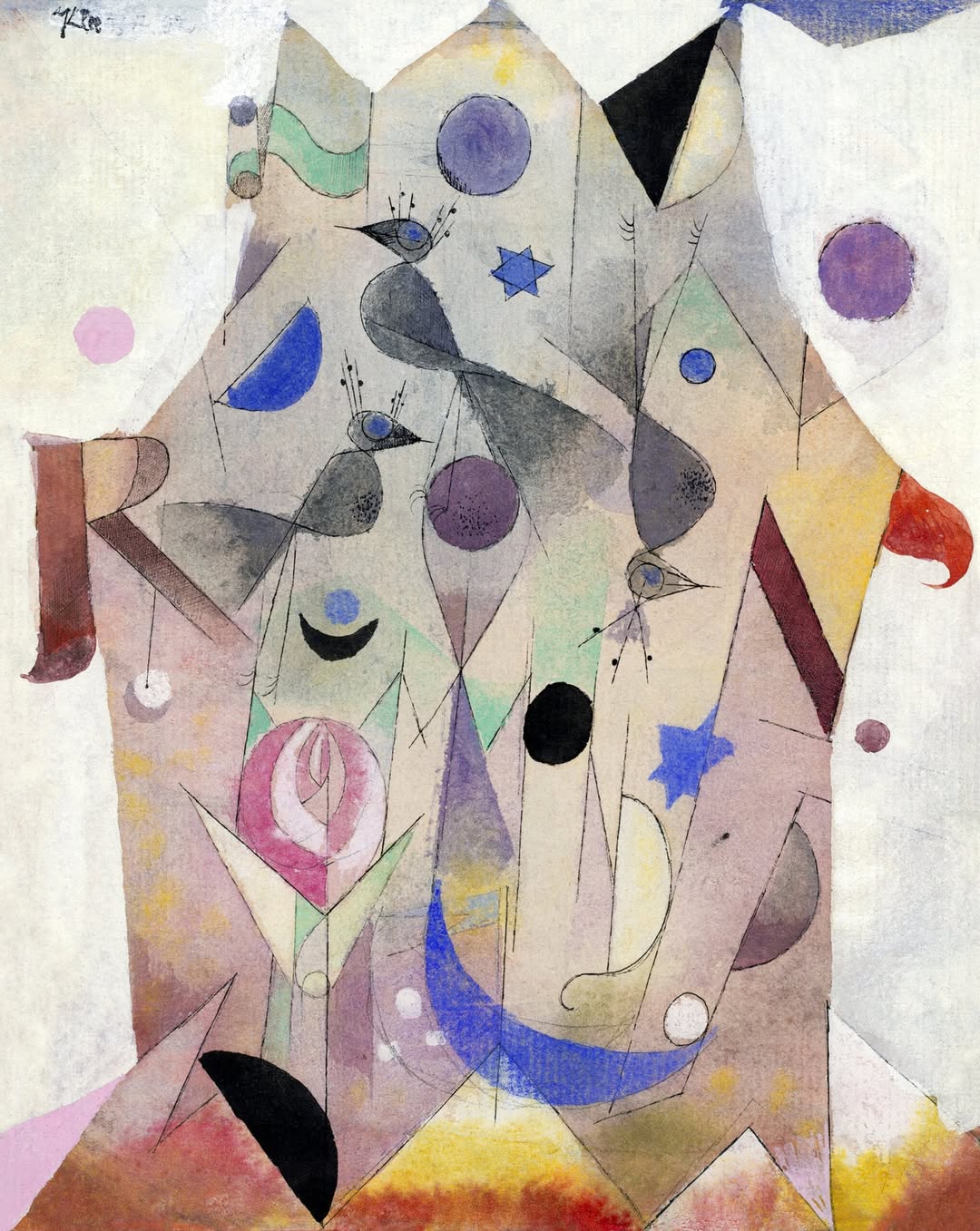
Pictured here is his painting Persian Nightingales. It is a watercolor painted using a wet-on-wet technique, which allows colors to bleed into each other. Forms in the image include birds, circles, stars, and crescent shapes, all under a tent-shaped structure.
The work is inspired by 14th-century Persian poet Hafiz’s poem “The Beloved,” which includes these verses: Mortal never won to view thee/Yet a thousand lovers woo thee/Not a nightingale but knows/In the rose bud sleeps the rose.
Hafiz’s poem expresses a classic Persian dichotomy of earthly yearning and divine glory. The beloved’s presence is hidden but always present in the heart of the seeker.
In the book of Exodus the Israelites are in the early stages of a journey. Rather than guiding them on the most direct route from Egypt to the land of Canaan, divine wisdom has set them on a wandering.
Early on in the story it becomes clear that the physical release from slavery is only the beginning stage of the Israelites becoming free. More profound and more difficult is an inner conflict that threatens their ability to experience themselves as active makers of a new world.
And like Gehry’s line drawing, the Israelite journey will sometimes move in straight directions and sometimes in circles and spirals. Sometimes forwards. And sometimes back over itself. Always in search of something. Often not quite sure what.
In Parshat Terumah (“donation”) God instructs Moses to collect donated materials from the Israelites to be used in building a dwelling place for God, a Mishkan. Two portions ahead we will read about the insult to the divine, a relapse into an idolatry experienced in Egypt…an event known as the making of the Golden Calf. The medieval commentator Rashi disrupts our purely linear reading by declaring, “The incident of the Golden Calf preceded the commandment of the work of the Mishkan by many days.”
Rashi’s reading of Torah’s canvas echoes one shared by early rabbis in a midrash: “The order of the Torah narrative is not necessarily chronological, as it is said in Proverbs 5:6, ‘Her course meanders for lack of knowledge.’ So do the paths of the Torah and its narratives meander.”
What do these sages see in this meandering that escapes our seeing only a straight chronological line? It is about fire and gold. Two materials that are central to the construction of both the Golden Calf and the Mishkan.
Gold is the fundamental material used to make the Golden Calf. Aaron tosses it into fire “and out came this calf!” Aaron exclaims to Moses. The calf is dense, solid and visually comprehensible and certain. Fire has been in the service of the known and tangible.
Gold is also a critical element in the construction of the Mishkan. Most significantly it is used to make the ark and the two cherubim fused into its cover. Here gold is not the object of worship. It frames the focus of sacred presence, which is an empty space.
Fire in the Mishkan is used to burn offerings, to render the material insubstantial, and to create out of spices a fragrant cloud of smoke that will fill the Holy of Holies with mist and sweet odor. Here fire is in the service of the intangible and the mysterious.
For Rashi and the sages the Mishkan serves as a therapeutic project to process a necessary stage in the journey toward human sovereign growth: liberation from reliance on the static, the known, the controllable.
Fire that only produces objects reflective of our fears and anxieties and our desire to control the world around us sheds no meaningful light at all. Fire that illuminates the mysterious and the yet-to-know destabilizes the security of meaning that lies at the heart of idolatry. Torah’s meanderings and ambiguities is a flickering fire that reveals who we need to become.
Torah’s meanderings are ours. Like Klee’s dot that goes for a walk, they paint a picture that “makes visible” the sacred yearnings in our heart for beloved presence that magnifies our own worth and purpose. And like Gehry’s uninterrupted and wandering line, they inspire us to build structures that flow and sail and dance.
Join us here at 7:00 p.m. (PT) on Thursday February 19 as we explore a text that flickers, a dot that wanders.
Persian Nightingales by Paul Klee