
When we make our dreams come true, we discover new ones emerging on the horizon. And so, we continue in our explorations and the transformation of ourselves and our world.
View the study sheet here. Recording here.
The American flag changed the entire trajectory of art in America. Or at least a painting of one did. And it was all the result of one artist making his dream real.
For six hundred years Europe occupied the center of the art world. Italy, especially cities such as Florence and Rome, served as the hub for artistic creativity during the Renaissance and Late Renaissance periods. By the 19th century, the focal point of artistic activity shifted to Paris. Artists flocked there to experiment, innovate and express their visions of beauty. The rise of totalitarian regimes and World War II crushed that fervor.
During the 1920s and 30s, both fascist and communist movements suppressed artistic creativity. They each defined what was acceptable and what was “degenerate;” established state-sponsored art academies; removed from public viewing, and in some case destroyed, works of art; and persecuted artists who did not align with their respective ideologies. Artists who could fled to the one country that provided them with physical safety, freedom of expression, and a haven for their artistic development: the United States.
The United States emerged from World War II a completely transformed nation. Previously, it had played an isolationist, largely observer role in global affairs. Now, it was a world superpower. It had the world’s wealthiest economy, the strongest military and served as the political leader among free nations in reshaping a post-war world. The center of wealth, power and world leadership shifted from Europe to America.
Complementing this emergence of the United States as the new center of global power in the free world was a transition of the center of art.
In New York City during the 1930s and 40s, a new generation of artists sought to develop a distinctly American form of expression. They created works that were monumental in size, muscular in application, and heroic in self-exploration. And, as part of their approach of communicating on a visceral and emotional level, their paintings were free of objective, representational images. This new art, Abstract Expressionism, was the first American movement to gain international influence and establish the United States as the leader in modern art. And then in 1954 a man had a dream, and everything changed.
Jasper Johns was born in Augusta, Georgia in 1930 and was raised in rural South Carolina by his paternal grandparents after his parents divorced. Johns was named after William Jasper, a sergeant in the Second South Carolina Regiment, who hoisted the regimental flag after the mast was destroyed during the battle of Fort Moultrie near Charleston in 1776. Jasper held the flag while under fire from a British warship until the mast could be repaired. Three years later, on October 9, 1779, Jasper charged up the Spring Hill redoubt to plant the same flag in an assault on British defenses during the Siege of Savannah. He was shot and died from his wounds.
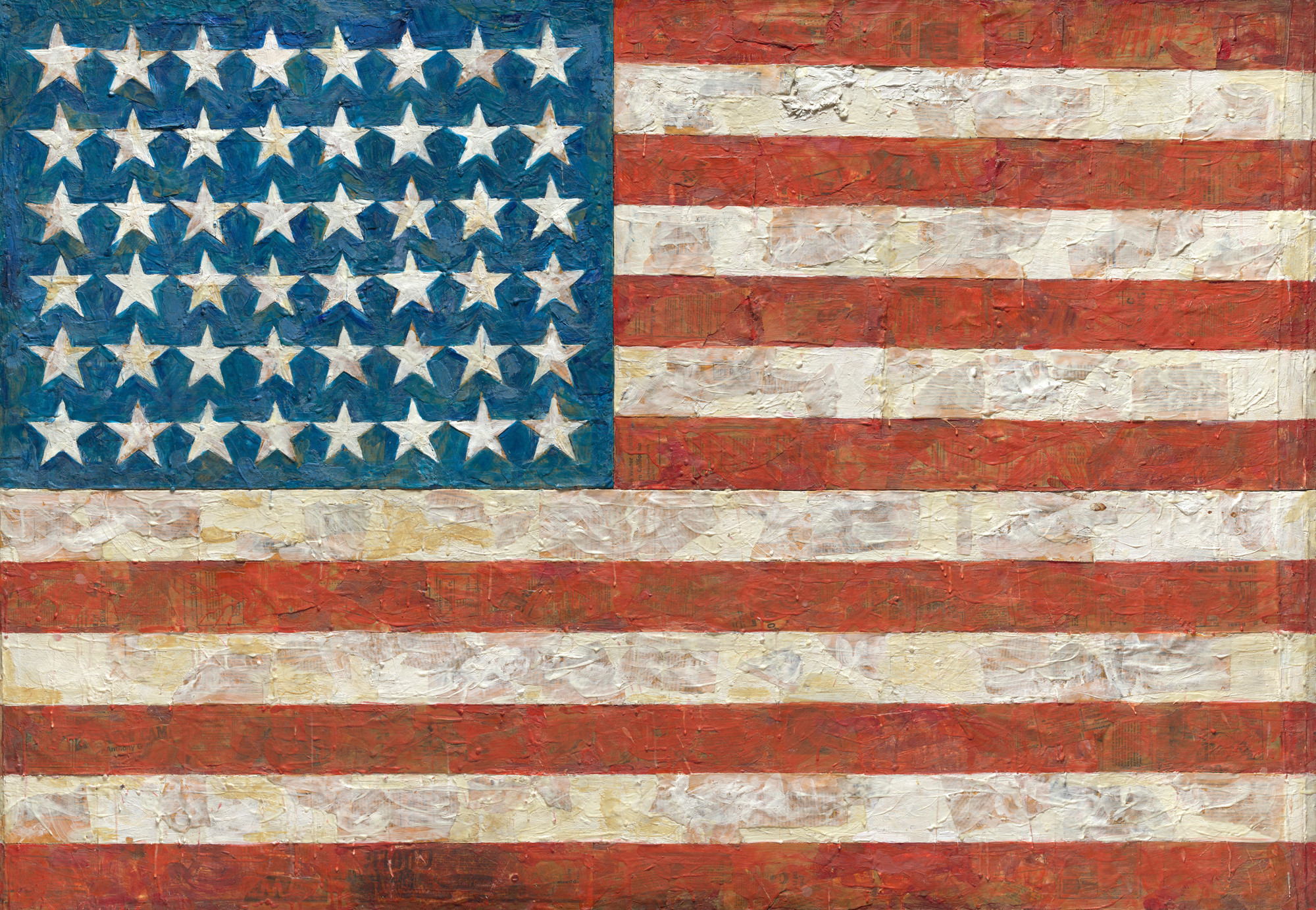
One year after he was discharged from the United States Army in 1953, Jasper Johns had a dream: “One night I dreamed that I painted a large American flag, and the next morning I got up and went out and bought the material to begin it.” Pictured here is the result of Johns’ dream and his realization of it, Flag, painted in 1954.
Johns painted over 40 variations of the American flag. This one is built from a dynamic surface made up of shreds of newspaper dipped in encaustic. Parts of the text remain visible through the wax. The applied paint is captured as drips and smears and brushstrokes.
The image is identifiable and familiar: forty-eight stars on a blue field and thirteen stripes in alternating red and white. A design that had lasted for forty-seven years, from July 4, 1912 to July 3, 1959. Yet the tradition of that design is disrupted by its medium, expressing both frozenness and fluidity. And the underlying news clippings contextualize the flag in a specific moment, one defined by the Cold War, McCarthyism and the beginning of the civil rights movement.
Flag is both a thing (a flag) and its representation (a painting of a flag). When critics asked Johns if the work was a painted flag or a flag painting, he said: “It’s both.” It is also, in its ambiguity, a provocation. Is it a critique of that era’s understanding of patriotism? Is it a tribute to his namesake? A celebration of national pride as an evolving concept?
The Board of Trustees of the Museum of Modern Art denied its director’s request in 1958 that the museum purchase the work. It deemed Flag to be unpatriotic. Instead, the architect Philip Johnson acquired it and donated it to the museum fifteen years later.
In any case, two things are most definitely true about Flag. It is a dream brought to life. And once brought to life, it signaled the end of Abstract Expressionism’s dominance in art. After Flag, artists felt freed to incorporate recognizable images into their works in new and creative ways. Johns’ representation of the standard of American tradition ignited a new generation of dreams.
In Parshat Sh’lach (“send”) scouts are sent ahead to explore the land of Canaan, the promise that has been the Israelites’ goal since leaving Egypt. They return and report that the land is indeed beautiful and fruitful. But they also report that the people who live there are giants, impossible to confront. The people moan and weep; and God declares that they will wander in the wilderness for another thirty-eight years, until the entire adult generation dies and their children are ready to fulfill the journey.
Most commentary describes the Israelite reaction to the scouts’ report as a collapse of will and an expression of lack of faith. Rabbi Menachem Mendel Schneerson says the opposite: The Israelites were not afraid of failure; they were afraid of success. They had experienced their time in the wilderness as one of unmatched closeness to God. They ate manna from heaven. Drank water from a miraculous well. They were surrounded by Clouds of Glory. To enter the land meant creating an economy, farming the land, managing business relationships. Rather than realize the dream, they wanted to remain in exile in it.
That moment becomes a repeating dynamic in Jewish life: Instead of living in the reality of the dream, Jews made the dream the place where they would live. Over time there develops a great, and poetic, investment in the dream of fulfillment rather than in fulfillment itself. Stories are told, poems written, songs sung about the beauty that awaits. There is an intoxication with the dream that is far more appealing than the sobering encounter with what is required to make the dream real.
That intoxication is eventually challenged by Theodore Herzl: “If you will it, it is no dream.” The modern Zionist movement called upon Jews to stop dreaming of a mythic homeland and to start buying land, draining swamps, and building settlements. Desire should be the fuel for constructing reality not for enlarging one’s dreamscape.
Yet, in the very same work, The Old New Land, that contains Herlz’s famous quote above is another insight by him: “Dreams are not so different from Deeds as some may think. All the Deeds of human beings are only Dreams at first. And in the end, their Deeds dissolve into Dreams.”
Dreams inspire deeds which inspire new dreams which…. Jasper Johns had a dream. He went out and acquired the necessary tools and made his dream real. That in turn inspired a new generation of artists to dream and make theirs real.
On June 14, 1777, the Continental Congress adopted the Stars and Stripes design as the official American flag. Woven into its fabric was a fantastic dream that had never been made real before in human history. The conclusion of the American Revolutionary War with the signing of the Treaty of Paris on September 3, 1783, did not end national dreaming. It launched a dynamic of dreaming and doing and dreaming that continues to this very day.
After the majority of scouts had made their report to the Israelites, Joshua, who had also participated in the exploration, stepped forward and said, “If God desires us [to do so], God will bring us into the land.” The Hasidic master Sefat Emet relocates the source of desire, “This should be read as ‘All depends on Israel’s desire.’”
The fulfillment of our most sacred dreams rests with us. And their fulfillment will bless us with even more.
Join us here at 7:00 p.m. (PT) on Thursday June 19 as we explore dreams and deeds.
Flag by Jasper Johns