
The blossoming of different points of view, the richness of creative souls, is not an obstacle to attachment to the unity that is Divine. It is the pathway to it.
View the study sheet here. Recording here.
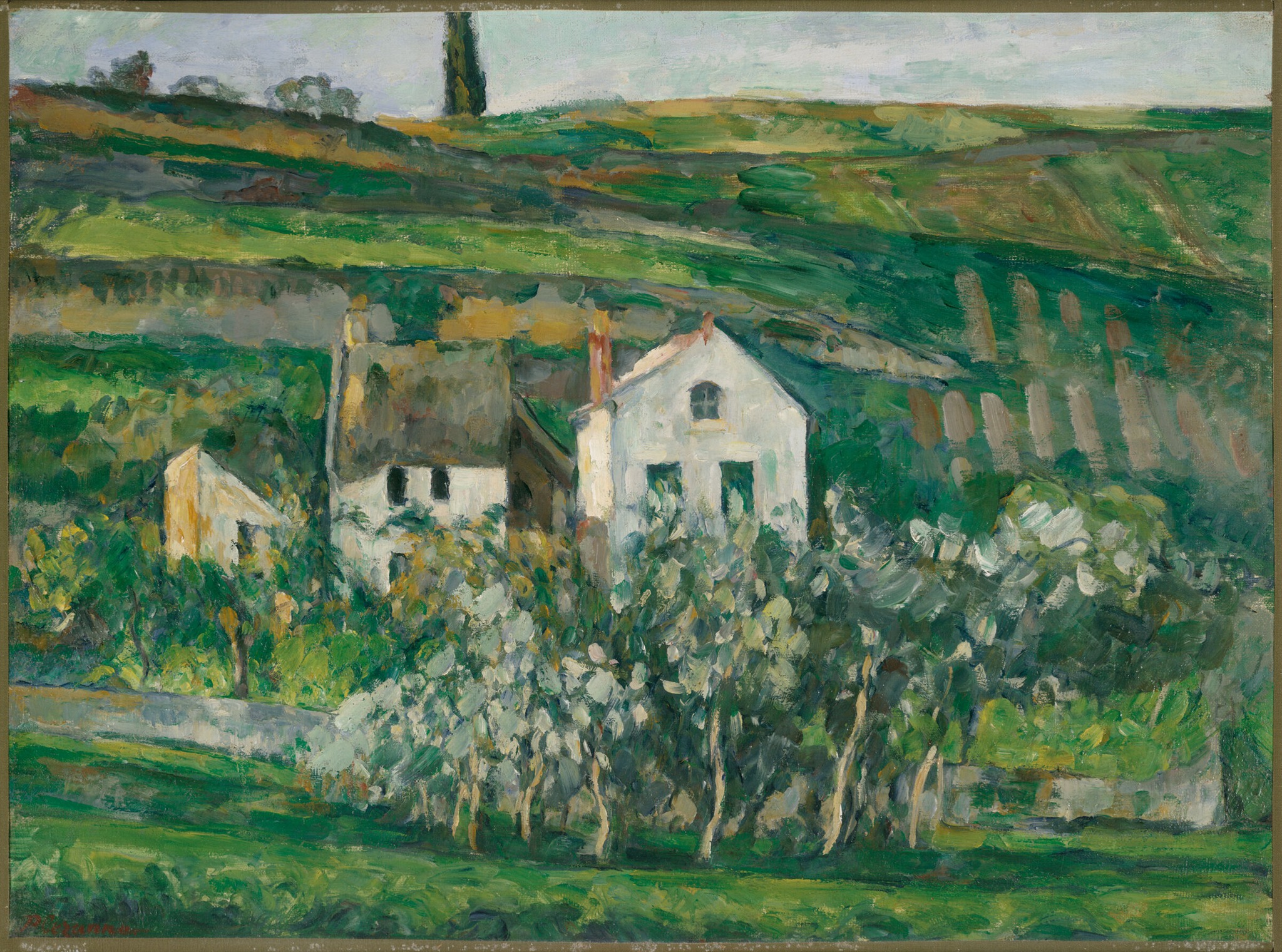
Bottom painting, Small Houses in Pontoise by Paul Cézanne
Martin François Suisse, born in 1781, started out as a baker’s apprentice, but early in life he found greater success posing as a model for some of the greatest French painters of his time. At the age of thirty-four he rented an apartment in a squalid, red house at 4 Quai des Orfévres on the Ile de la Cité. He used two of its rooms as his personal living quarters. A large third room he turned into an art studio, one which could accommodate up to eighty aspiring artists. He charged students 25 francs a month, for which he provided them with stools to sit on and a male model three weeks of the month and a female model in the fourth week.
Those who attended the Académie Suisse, as it became known, could create in any style that they chose. There were no requirements for acceptance and no standards as to what or how to paint. As an alternative to the highly controlled French establishment art academy and exhibition opportunities, Académie Suisse became a center for artistic innovation.
Camille Pissarro arrived in Paris from the island of St. Thomas in 1855. Within four years he was a regular at 4 Quai des Orfévres. Two years later he was joined there by an artist with whom he would share an intense friendship and joint artistic exploration over a two decade period: Paul Cézanne.
They were both outsiders, each in his own way: Pissarro as a Jew and from the far away Caribbean and Cézanne as one born and bred in the non-urbane area of Southern France. They were drawn to one another immediately. While Cézanne was laughed at by his fellow students both for his disheveled appearance and his paintings, Pissarro embraced and encouraged him. And Cézanne’s rebellious spirit continually rekindled Pissarro’s own.
In 1866 Pissarro moved from Paris to the medieval village of Pontoise, northwest of Paris. Cézanne first visited him there in 1872, and over the next ten years they walked and painted the countryside together…and differently.
Pissarro revealed on his canvasses the richness of the soil, the lushness of nature’s bounty and the dignity of the people who lived on and worked the land. Cézanne saw the geometry and planes of the landscape before him. Human figures are rarely present in his landscapes. Rather than a typical Impressionist’s attention to the ephemeral aspect of nature, Cézanne emphasized that a painter “should treat nature in terms of the cylinder, the sphere and the cone.”
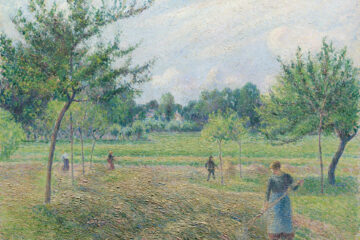
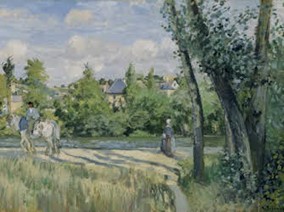
Pictured here are two paintings of the Pontoise countryside, one by Pissarro and one by Cézanne. Pissarro shapes the setting with a series of horizontal framings: the yard and trees in the foreground; a path, on which are a rider on horseback and a peasant woman and young child; next to the path is a river; on the other side of the river a line of trees and homes; and across the top a band of sky and clouds. Pissarro’s gentle brushstrokes and soft colors capture the effects of light and atmosphere. It is a scene of serenity, almost idyllic in its integration of nature and human habitation.
Cézanne has painted a scene empty of human figures. The sky and the effect of light are given less attention. What has captured Cézanne’s attention are the geometric elements: the verticality described by the small grove of trees and the houses immediately behind them and the horizontal swaths across the background. Atop those horizontal lines of fields is the straight vertical line of a tree. In the right middle ground are thick beige strips. Although they are obviously meant to be planting rows, Cézanne has made no attempt to hide their reality as just broad brushstrokes.
Instead of the soft, ephemeral description of life in the countryside presented by Pissarro, Cézanne discloses the solidity of forms to be found in a landscape. His exploration of faceted planes and his disregard for traditional perspective provided the foundation for the Cubist works of Pablo Picasso and Georges Braque.
Two deeply creative artists sat side by side facing the same vistas and saw profoundly different realities there. For two men who had affection for one another, this caused no tension, discord or rift. Towards the end of his life, Pissarro wrote to his son about his time with Cézanne: “We were together always, but each of us unquestionably retained the only thing that counts, our own sensation.” For his part, Cézanne, who by the end of his life had broken with the Impressionist approach and had critiqued some of Pissarro’s creative experiments, insisted that at his final exhibition his name be followed with the words “student of Pissarro.”
Parshat Naso (“take a census”) is the second portion in the book of Numbers, which follows the book of Leviticus. The two books seem to look out on similar vistas, similar themes: Levitical authority; maintenance of purity; gifts for the Mishkan. But each book seems to see something different in each of those.
In contrast to Leviticus’ valorization of rigid definitions and clear distinctions about matters of right and wrong, purity and impurity, Numbers offers up the cases of the sotah (a woman accused of adultery) and of the Nazirite (one who has voluntarily consecrated themselves to God by refraining from wine, cutting their hair and coming in contact with the dead).
Rabbinic commentary eventually turns the case of the sotah on its head. Instead of it being a matter of any indiscretion by the wife, the focus becomes the unreasonable jealousy of the husband. The Nazirite becomes not praised for dedicated discipline of denial but criticized for not experiencing the many pleasures God has made available.
Even such a fundamental matter as the offerings that are to be brought to the Mishkan is painted differently by the two books. Leviticus emphasizes the precise routine of the offerings: what was to be brought, when, for what purpose, and how presented. The story in Leviticus about Nadav and Abihu serves as a warning about the fatal consequence of varying from this uniformity.
Parshat Naso seems to echo this uniformity, describing in a precise, repeated formula the dedication offerings presented by each tribe. Each is described in great detail as bringing the exact same things. Early midrash discloses that the language in Numbers means that each tribe imbued their offerings with their own unique intention and understanding.
Does the Book of Numbers represent a disruption and a rejection of Leviticus’ point of view about the world and what it means to be holy? Is the conflict so severe that we must choose between the two?
In reflecting on the tension that seems to exist between conformity and creativity, between tradition and innovation, Rabbi Menachem Mendel Schneerson wrote: “On the one hand, we recognize the bedrock principles upon which a meaningful existence must rest; on the other, we are faced with the powerful drive to create, to personalize, to grow and soar with our individual talents and tools. Even as they relate to the ultimate common denominator of their bond with God, they each bring to the experience the richness of their own creative souls.”
The capacity of the Jewish spiritual tradition to thrive on ambiguity and lack of resolution, to embrace the inevitability of different points of view continues to amaze me. Torah itself seems to constantly remind us that the various “richness of creative souls” is not an obstacle to attachment to the unity that is the Divine. It is the pathway to it.
Join us at 7:00 p.m. (PT) on Thursday June 5 as we explore the richness of creative souls.
Top painting, Sunlight on the Road by Camille Pissarro
Bottom painting, Small Houses in Pontoise by Paul Cézanne