
Sacred beginnings are not based on a knowledge of our destination. They are driven by a desire to become more at peace than we are today.
View the study sheet here. Recording here.
Lewis Carroll was a master at undermining the value of the obvious. At the trial of the Knave of Hearts in Alice’s Adventures in Wonderland, the White Rabbi steps forward with evidence but isn’t quite sure how to proceed with the pages he has discovered. “Read them,” says the King. The White Rabbit asks, “Where shall I begin?” “Begin at the beginning,” the King says gravely, “and go on till you come to the end: then stop.”
Ah, if only it were that simple. The King’s instruction comes toward the end of a story where the obvious has been anything but helpful. Alice’s Adventures in Wonderland is a tale about the chaotic process of growing up in an adult-dominated world whose established rules, orders and protocols make no sense.
Even the order of how the details of a physical body appear or disappear confound. When the Cheshire Cat leaves after talking with Alice, it vanishes slowly, “beginning with the end of the tail, and ending with the grin, which remained some time after the rest of it had gone.” Alice marvels at the strangeness of it all. “Well! I’ve often seen a cat without a grin, but a grin without a cat! It’s the most curious thing I ever saw in my life.”
Alice’s navigation of Wonderland’s world and its imposed certainties is a call to challenge authority and logic which make no sense, no matter how imperiously they are proclaimed. Her journey is a celebration of curiosity, imagination and the questioning of established rules.
Much of modern art and literature can be seen as a rejection of absolute certainty and as an exploration of the transient, the subjective and the ambiguous.
“I have never started a poem yet whose end I knew,” wrote Robert Frost. “Writing a poem is a discovering.” To know with certainty what lies ahead is contrary to what propels the modern artist, writer and poet.
E. E. Cummings revolutionized poetry by releasing himself from the constraint of pre-existing forms. He expanded the possibilities of meaning through his experimentation with typography, grammar and syntax. The page was no longer a platform merely to hold words. It became a visual canvass, a scene of exploration, an explosion of imagination.
Cummings’ writing is propelled by the importance he placed on shedding habitual thinking, preconceived notions, and conventional wisdom. All of that, he wrote, is a barrier to self-discovery, creativity and expression: “The artist is no other than he who unknows what he has learned, in order to know himself.”
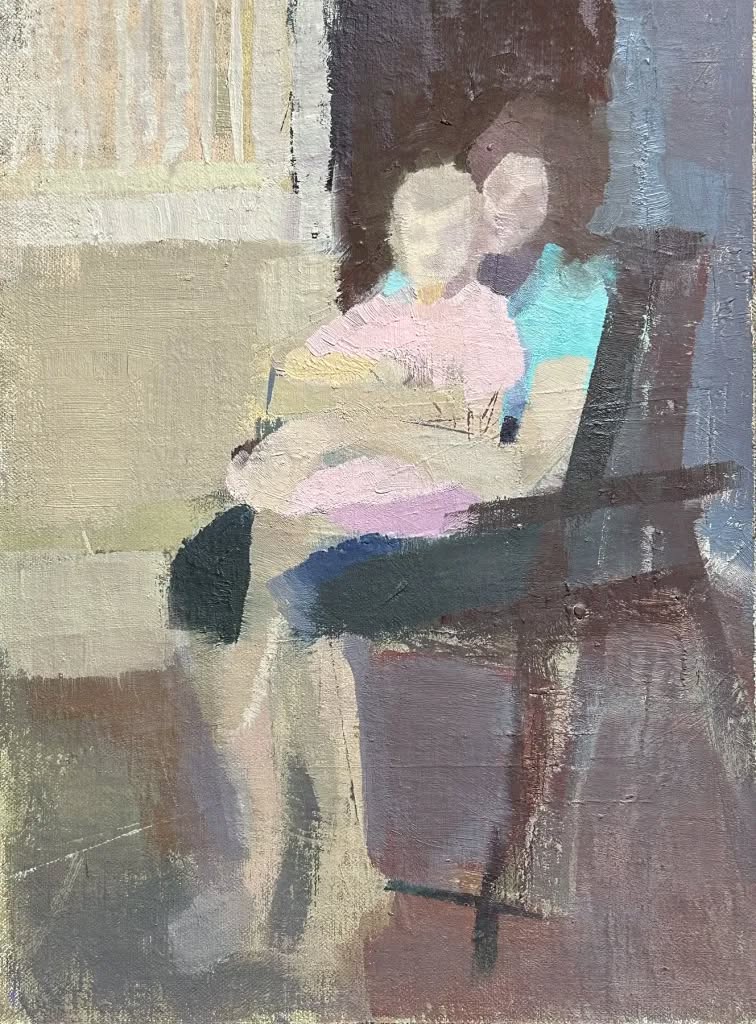
Tracy Everly is a contemporary artist who paints to explore the fleeting experience of being human. “I’ve realized, lately,” she writes, “that I am painting about uncertainty – about things not always being fully resolved or known. My paintings are about living with the feeling of mystery and of wanting to hold on to things, people, places, moments – that cannot be held. But the experiences are no less meaningful even though they are fleeting.”
Pictured here is her painting of a woman sitting in a chair and holding a child. According to the standards of classical art, the piece is unfinished, raw, lacking detail. Yet it is those very qualities that convey the rich love, caring and embrace two humans can share. The feelings described on the canvas are not enshrined or idolized in perfection. They are shown as fleeting, transient …which is what makes us aware of how precious they are.
To achieve that level of raw honesty requires, as it does for Frost, a surrender to the process itself. Let the story lead you, don’t lead the story.
“When I paint,” Everly writes, “I ‘begin without beginning.’ Another way to say it is to ‘begin without knowing.’ This approach is opposite of the advice to ‘begin with the end in mind,’ or to know where you’re going before you start. ‘Shoshin’ is a word from Zen Buddhism meaning ‘beginner’s mind.’ It means having an attitude of openness, eagerness, and lack of preconception…Paint what you see, not what you think you know.”
Parshat Mishpatim (“laws”) follows the portion in which the Ten Commandments were given at Mount Sinai. Mishpatim opens with God providing Moses with more detailed laws which he is to convey to the people, including those about: loans, damages and lost property.
When Moses then repeats all of that to the people, they proclaim: “All that God has said we shall do and we shall hear.” The order makes sense: ten broad subjects followed by pages of greater detail.
Not so, says the medieval commentator Rashi. What looks like a logical order of events is not what actually happened. The twelve verses that follow the listing of laws and the people’s declaration that “we shall do and we shall hear” is out of chronological order. They describe a moment that precedes rather than follows both the giving of the Ten Commandments and the detailed laws of Mishpatim.
Rashi suggests that what inspired the people to proclaim a passionate readiness to attune to God was not the issuance of laws but the telling of a story. Moses reads to them a “book.” This book, commentary imagines, is the story of everything that has transpired, from Creation up through the departure from Egypt.
The people are stirred by the tale. They reawaken to their desire to build a new culture, one built upon freedom, dignity and responsibility. They realize that their participation in that enterprise has so far been inadequate, too mechanical and too routine. There is, in the words of the Hasidic sage Ma Vashemesh, “a resolve to imbue old forms with new meanings…up to now all was habit and convention.”
Unleashed within the people is a desire for a new way. A yearning to reshape culture…to reconstruct themselves into builders of a new world. That readiness cracks open the portals of the universe, drawing down to them details of how to do that.
It is a new beginning. But it is a beginning shaped more by mystery than by clarity. More by possibility than by certainty. More by ambiguity than by explicitness. It is, after all, how the Torah itself opened. A beginning that was no absolute starting point at all. Just one stage in an ongoing process of releasing the divine dimension that is our spiritual inheritance.
To do so means, as artist Tracy Everly notes, “having an attitude of openness, eagerness, and lack of preconception.” It is to “begin without beginning.”
Join us here at 7:00 p.m. (PT) on Thursday February 12 as we explore to begin without beginning.
Painting by Tracy Everly