
Within convocations of intimacy we can experience the transcendent, the expanding and the sublime.
View the study sheet here. Recording here.
Tariffs have been in the news a lot lately. As an economic tool, they can serve to counter another nation’s unfair trade practices. The ideal outcome in such instances is to force an end to those practices and to restore more open and fair competitive economic relations among nations. Used inappropriately, tariffs can lead to higher prices for consumers, protection of inefficient industries, and a general degradation of overall economic welfare. In those instances, tariffs serve not as facilitators of but as barriers to a free exchange of value.
For decades now, we have been constructing other kinds of barriers…ones which have degraded our social capital and our mental and physical health. More of us are now living alone. Increasingly, we work in isolated settings. We move from community to community more frequently. Technological advances have increased communication opportunities while simultaneously decreasing face-to-face interactions. Our in-person social networks are shrinking.
In its 2023 American Time Use Survey the Bureau of Labor Statistics reported that 35% of those employed did some or all of their work at home. It also reported that on an average day individuals spent just 34 minutes a day socializing. The U.S. Census Bureau reported that in 2023 one in 8 people had moved to a new residence within the prior year.
A research paper published by the National Institute of Health found that social isolation takes a toll on health and well-being. This includes higher vascular resistance in young adults, which can lead to higher blood pressure; larger morning rises in cortisol, a cause of type 2 diabetes and heart disease; a decline in our inhibitory responses; and an increase in sleep deprivation. Together, these can contribute to early morbidity and mortality.
Boundaries and barriers can be important parts of both a healthy social and a healthy physical body. Too restrictive, they can cause catastrophic damage to the organism.
The arts are also arenas of human activity that can benefit from frameworks that give shape and can suffer from boundaries that are too constraining. The Impressionists launched a liberation movement against an art establishment built upon hundreds of years of standards about appropriate use of color, subject matter and the very purpose of art. Post-Impressionists took up the cause with a search for meaning beyond the obvious, the apparent, the representational.
Pierre Bonnard was a French painter who explored the expanse that could be found in small, intimate settings. He and his friend Édouard Vuillard were founders of Intimism, an artistic movement ostensibly concerned with small-scale domestic scenes. Yet, for them a room was never just a room. The mundane never merely mundane.
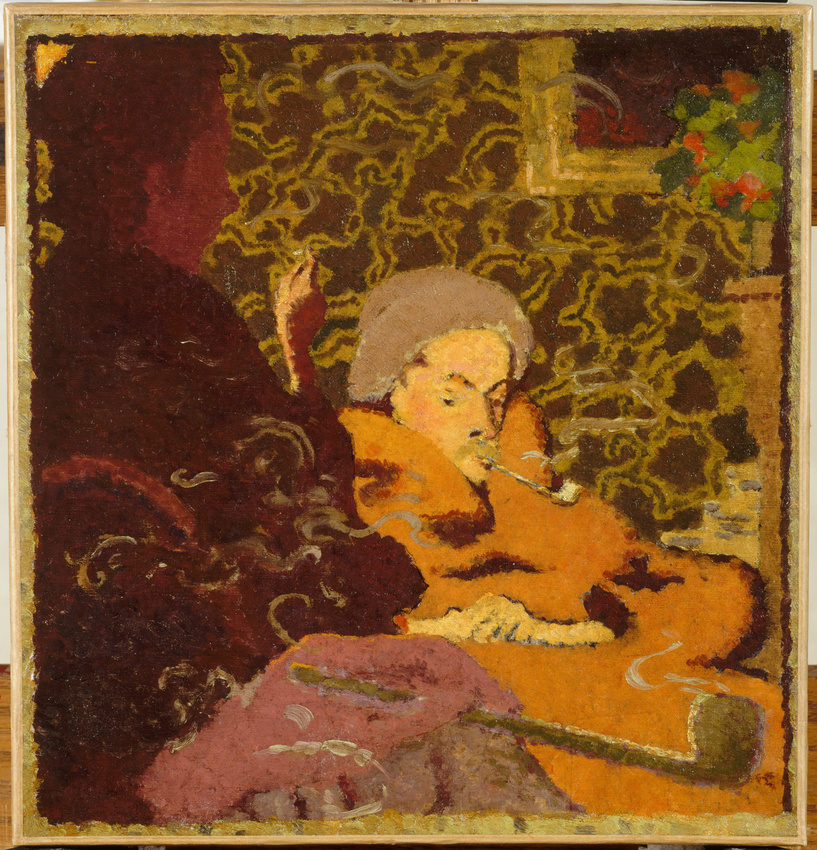
Pictured here is Bonnard’s painting Intimité. In the background is Bonnard’s friend the composer Claude Terrasse. He is hunched up, wearing a thick coat and hat and smoking a pipe. On the left, deep in shadow, is Bonnard’s sister, Andrée. In the foreground is a hand, most likely Bonnard’s, holding a long pipe. Coils of smoke rise up from it, intermingling with that of his friend. The spirals from both pipes mirroring the arabesque decorations on the wallpaper.
The setting is at once tight, seemingly confining. At the same time, the finiteness of the interior hints at something transcendent. There is a mystical subjectivity at work. What we see is both clarified and obscured. Both mundane and metaphysical.
The poet Stéphane Mallarmé was both a friend and a profound influence on Bonnard. In his poem “All Summarized the Soul…” he wrote: All summarized, the soul/When we slowly breathe it out/In several rings of smoke/In other rings is obliterated.
The rings of smoke in Bonnard’s painting mix and swirl and lose their individual identity. They find resonance in the walls…and in something beyond them. The room is no longer small. There is an intimacy that is both domestic and wild, finite and infinite.
The French writer Camille Mauclair described Bonnard’s Intimism style of painting as “a revelation of the soul through the things painted, the magnetic suggestion of what lies behind them through the description of the outer appearance.” Inhabitation can be simultaneously a charged and settled experienced. To meditate on the mundane sometimes reveals the sublime.
With the book of Leviticus the epic drama and forward march of the Israelites seems to come to a halt. The focus is no longer the endless expanse of the wilderness. It is the defined boundaries of the house, the Tent of Meeting. In Parshat Emor (“say’), Torah defies our expectations about the domestication and finiteness associated with a home as compared to a wilderness.
The text describes both Shabbat and the festivals as moadei, fixed times. Yet, it is only the festivals that require “fixing,” since it will be up to a human court to declare when a month has started and thus when a festival will occur during the annual calibration that is the calendar. In contrast, Shabbat occurs independently of human determination. One is the result of human initiative…the other of divine.
A moed is more than a “fixed time.” Its nature is disclosed in its use in the term “ohel moed,” the Tent of Meeting, the site where God will meet with the people. Moed speaks of a time, of a place where there is intimate contact between finite human and boundaryless Source of all. We sing of that tryst on Friday night, the excitement of union: “Hurry, beloved, for the appointed time has come (ki va moed)!”
Emor proclaims both – Shabbat and festivals – to be mikra’ei kodesh, holy convocations. One convened by God, one convened by humans. Our mutual initiatives of yearning break the boundaries, even if only for a moment. Yet, we emerge from those convocations of intimacy revived, restored and whole once again.
Join us here at 7:00 p.m. (PT) on Thursday May 15 as we explore convocations of intimacy.
Oil on canvass Intimité by Pierre Bonnard