
View the study sheet here. Recording coming here.
Hanging on a wall in our home is a painting by mid-twentieth century Israeli artist Joseph Zaritsky. It is titled in Hebrew 1808 בעקבות השני במאי (“After the Second of May”). The Second of May is a painting by the Spanish artist Francisco Goya. It depicts Spanish civilian resistance to the French occupation of Spain, an event witnessed by Goya.
In art the term “after” indicates that the artist is paying homage to an earlier artist’s work by borrowing compositional ideas from it while still incorporating the new artist’s unique style. Goya’s painting is a representational work depicting a fierce street battle between ordinary citizens of Madrid and Napoleon’s elite troops, the Mamelukes of the Imperial Guard. Zaritsky’s piece is an abstract expressionist work, with blocks and shapes in various colors.
I have no idea in what way aesthetically Zaritsky’s abstract painting is “after” Goya’s intense depiction of a historic battle scene. I do know, however, that Zaritsky was engaged in an uprising.
In 1948 Joseph Zaritsky cofounded the Israeli art movement Ofakim Hadashim (“New Horizons”). Members of the group committed themselves to creating art that was based in modernism yet also expressed unique Israeli reality. They rejected Israeli art that was steeped in nostalgia and romantic notions. They were contemptuous of paintings that depicted peasants on donkeys and shepherds with their flocks. Instead, they sought to express their experience of the land of Israel through the use of strong brush strokes and bright colors that reflected the Mediterranean light. Zaritsky and his fellow artists insisted on a style that honored the Zionist enterprise as one that created new dreams rather than merely embraced old ones.
The word used for “after” by Zaritsky in the title of his piece is based on the Hebrew verb akav (“to follow at the heel”). The name of one of the patriarchs is also based on this verb. Esau was the first of a twin born to Isaac and Rebecca. But his brother held onto his heel; so his brother was named Jacob (“heel grabber”). Eventually, Jacob would overtake, supplant the one traditionally entitled to family inheritance. And he became the founder of a new nation.
The name of this week’s Torah portion, Ekev, is derived from the same Hebrew verb. As an adverb it is typically translated “as a consequence of.” A straightforward reading of the opening verse would be: “As a consequence of your hearing these rules and guarding them carefully, God will faithfully maintain the covenant made with your ancestors.” However, Moses’ reminder of what nourished and sustained the Israelites on their journey hints that a diet of the known and familiar might not be enough.
Moses recounts that God gave the Israelites manna (man) to eat, something “which neither you nor your ancestors had ever known.” When the Israelites first encountered this substance, as recorded in Chapter 16 of Exodus, they said to one another, “What is it (man hoo)? for they did not know what it was (mah hoo?)” What sustained the Israelites during their forty-year journey was an encounter with the unfamiliar, the unknown. They identified their nourishment as the question before them. To feed on “what is it?” sustains human life.
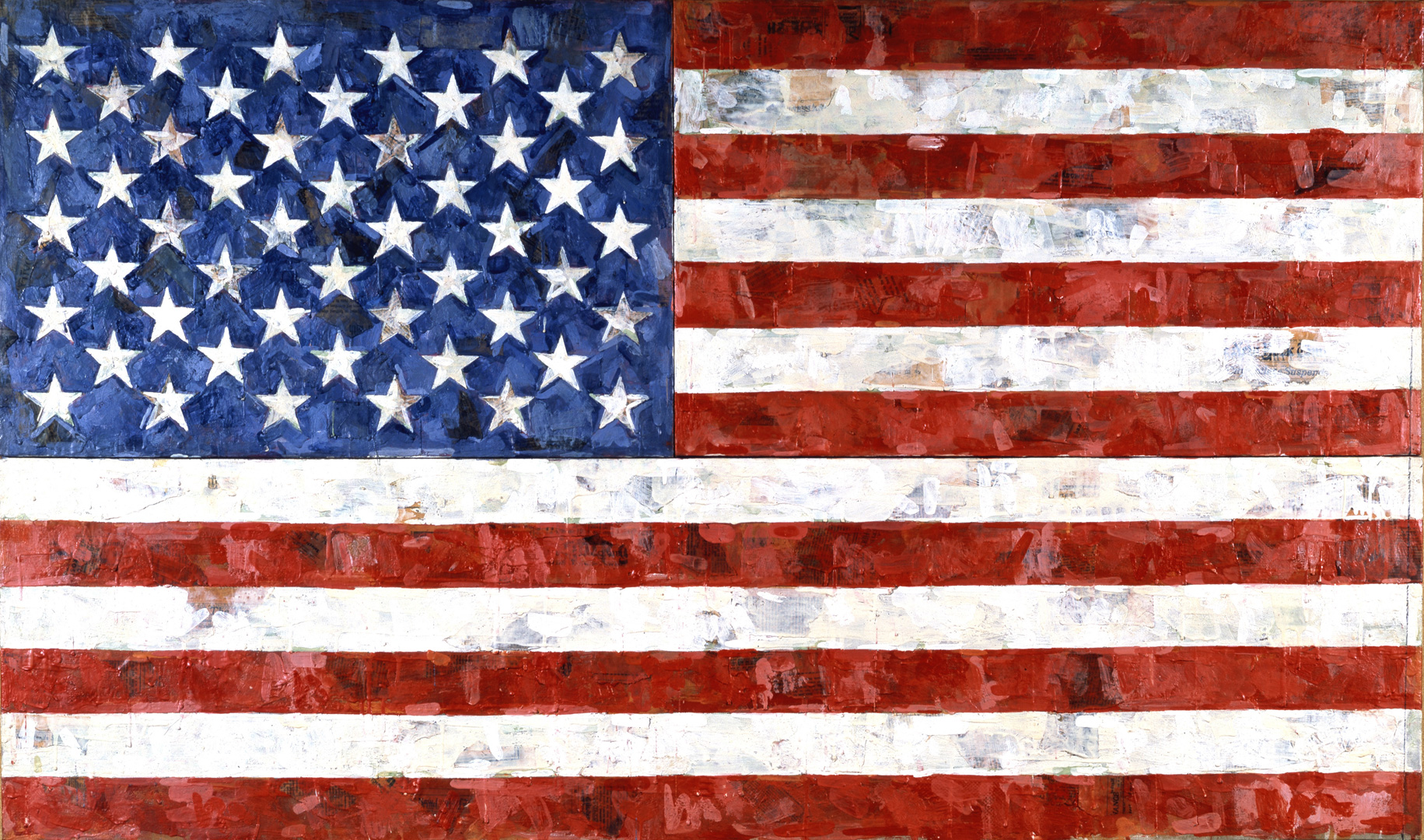
Jasper Johns was named after an American Revolutionary war hero, Sergeant William Jasper, who risked his life to recover and re-raise an American flag that had been shot down by the British at the battle of Fort Sullivan on June 28, 1776. From the age of nine Johns was raised by his Aunt Gladys, who was the teacher in a one-room Georgia schoolhouse. Johns’ aunt worked hard to instill in him a deep respect for the American flag and the traditions it embodied: a heritage embedded in him by his namesake, upbringing and education.
After his discharge from the army at age 24, Johns moved to New York to become a painter. Two years later he painted the American flag and titled it Flag. He painted a series of variations on the flag over the years. Pictured here is one he did in 1967.
Underlying the familiar design of stars and stripes are strips of newspaper clippings. Over these Johns poured molten, pigmented wax. As the wax cooled, it set the clippings into unusual shapes and forms. The stories those clippings tell, once coherent and contextualized, are now disjointed and hard to read and comprehend. Art historian John Seed writes, “For Johns, respect seem to involve an active and ongoing commitment to seeking and questioning ideas and values.”
In Parshat Ekev Moses teaches the Israelites that God gave them manna “in order that you might know that a person does not live on bread alone but on whatever comes forth from God’s mouth.” The elemental sustenance that comes from God’s mouth is speech. An allusion to the very name of this entire Torah book, Devarim (“words”). We first encountered language with Torah’s opening, the story of creation, and the power of words both to engender new life forms and to ambiguate and complexify apparently settled meaning.
The Israelite journey is not merely one across an expanse of geography. It is an odyssey of self-exploration and self-understanding.
Ekev…as a consequence of going on such a journey we make real the traditions we carry with us in the form of new insights and approaches (Ofakim Hadashim).
In his memoir about the Holocaust, Night, Elie Wiesel asks the humble synagogue caretaker Moshe why he prays when all around him is violence, destruction and horror. Moshe answers, “I pray to the God within me that He will give me the strength to ask the right questions.”
Ekev…the consequence of doing so is a transformation of self and a reconfiguring of the world. It is a fulfillment of divine promise.
Join us here at 7:00 p.m. (PT) on Thursday August 14 as we explore American manna.
Flag by Jasper Johns