
We have always carried with us what we seek. Our lives as a journey of rediscovering ourselves has no end, but it does have fulfillment.
View the study sheet here. Recording here.
It is so helpful to have a calendar. Days are distinguished from each other. Weeks lay claim to their own horizonal territories. Each month rules its own grid. A year ends, another begins. Then it’s time to toss out the old calendar and get a new one. Ends and beginnings separated from one another by boxes and lines and pages.
For those who follow both a Gregorian calendar and a Jewish one, marking time can be a little bit trickier. The former is a purely solar calendar. The latter is based on both solar and lunar cycles. In the Gregorian calendar, a day ends at 12:00 a.m. Every day, every month of the year. A Jewish day ends with sundown, the exact time of which varies throughout the seasons of the year.
The Gregorian calendar year begins with its first month, January, and ends with its twelfth month, December. The Jewish calendar has a first month, Nisan; but the number of the year changes with the holiday of Rosh Hashanah, which occurs during the seventh month, Tishrei.
The Jewish Bible defies our longing for clearly defined beginnings and endings. The very opening language of Genesis hints that there is a story that precedes what is written there. Teasingly, it begins with the letter bet, the second letter in the Hebrew alphabet, suggesting that there was an alpha version of creation. What opens with a story about exile from a garden ends, with Chronicles II, with the Israelites in exile in Persia, whose ruler offers them the opportunity to return to their homeland. The text is silent as to their response. The lack of resolution creates tension rather than closure. In between are a series of tales of settlement and dislocation. Jewish continuity, it seems, consists of a chain of discontinuities.
Lewis Carroll’s Wonderland is a domain where coincidence, absurdity and nonsense hold sway. Only in such a world, Carroll suggests, could its sovereign assume that there is such a thing as linear, logical progression. When the White Rabbit, about to present verses as evidence at the ending’s trial, asks, “Where shall I start?” the King of Hearts replies, “Begin at the beginning, and go on till you come to the end: then stop.” For the king, ends and beginnings have clearly identifiable and independent points of existence. They stretch away from each other, creating attenuation, loss of connection and irrelevance along the way.
In contrast to the king’s view, T. S. Eliot saw endings and beginnings as inherently looped into one another: We shall not cease from exploration/And the end of all our exploring/Will be to arrive where we started/And know the place for the first time. (“Little Gidding”)
The Talmud’s imaginative language describes birth, the end of life in the womb and the beginning of life outside it, as marked by a kiss that launches us on a journey of rediscovering ourselves. While still in the womb, the fetus knows and experiences all. As soon as it emerges, an angel kisses the newborn on the lips causing it to forget everything. We spend our life seeking what we once knew. The end is always to be found in the beginning.
Parshat Behar-Bechukotai (“on the mountain”-“in My laws”) concludes the book of Leviticus. It promises a life of peace, free of anxiety, if we live attuned to the ways of the Divine’s universe. The poetic description is: “I will cause evil beasts to cease to exist” (Leviticus 26:6). An early midrash declares that the beasts themselves will not be destroyed, only the evil within them. This ending, with its description of a purging of evil from within beasts of the land, takes us back to the very beginning of Leviticus.
The opening of Leviticus instructs: “When a human being brings from among yourself a beast…” At first encounter, the text seems to be about how to present cattle as an offering to God. Rabbi Schneur Zalman redirects our attention to its meaning for our inner life: “Each of us has two souls – the Godly soul and the animal soul. The essential purpose of our lives is to enable the Godly soul to prevail over the tendencies of the animal soul. The syntax of the verse reveals that the offering we are to bring is from our animal soul.”
We arrive at the ending of Leviticus where we started: the offering of a beast. But now we see that the journey through it has reshaped our understanding of what that beast is. It is not a creature outside of us. It is one we carry within us. This book of sanctifying rituals has been intended to refine us. To attune us, to train our way of walking to be in sync with the Source of all life, whose promise is “I will cause Myself to walk about in your midst” (Leviticus 26:12).
John O’Donohue was an Irish poet, author and ordained Catholic priest. He wrote extensively about “coming home to yourself.” In his poem “For A New Beginning” he wrote: In out-of-the-way places of the heart/Where your thoughts never think to wander/The beginning has been quietly forming/Waiting until you were ready to emerge…Though your destination is not yet clear/You can trust the promise of this opening/Unfurl yourself into the grace of beginning/That is at one with your life’s desire/Awaken your spirit to adventure/Hold nothing back, learn to find ease in risk/Soon you will be home in a new rhythm/For your soul senses the world that awaits you.
For O’Donohue, we have always carried what we seek. A journey of reflection, introspection and discernment transforms the apparent into mystery and then into a new apparency. In his book To Bless the Space Between Us, he wrote: “A beginning is ultimately an invitation to open toward the gifts and growth that are stored up for us. To refuse to begin can be an act of great self-neglect…Our very life here depends directly on continuous acts of beginning.”
O’Donohue’s celebration of our power to refine and transform ourselves is an urgency about the need for ongoing vigilance against stagnation. To have freed ourselves once from the fear of the unknown and untried does not guarantee enduring peace and freedom from anxiety.
Leviticus may have had a consecrating conclusion, but we now know that the story it carries forward has no end. The book of Numbers awaits, with its tales of yet to be explored dimensions of fears and longings. New cycles of beginnings and endings are at hand, and through them the opportunity “to arrive where we started, and know the place for the first time.” Our very life depends on finding our own story there.
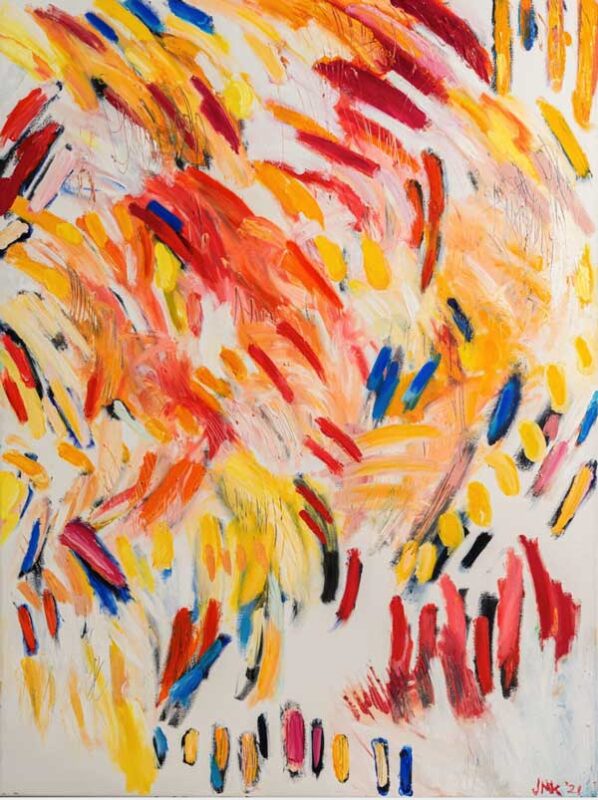
Oil on canvass Joy, in spite of everything by Julia Meyerowitz-Katz (part of her Diaspora Winds series)